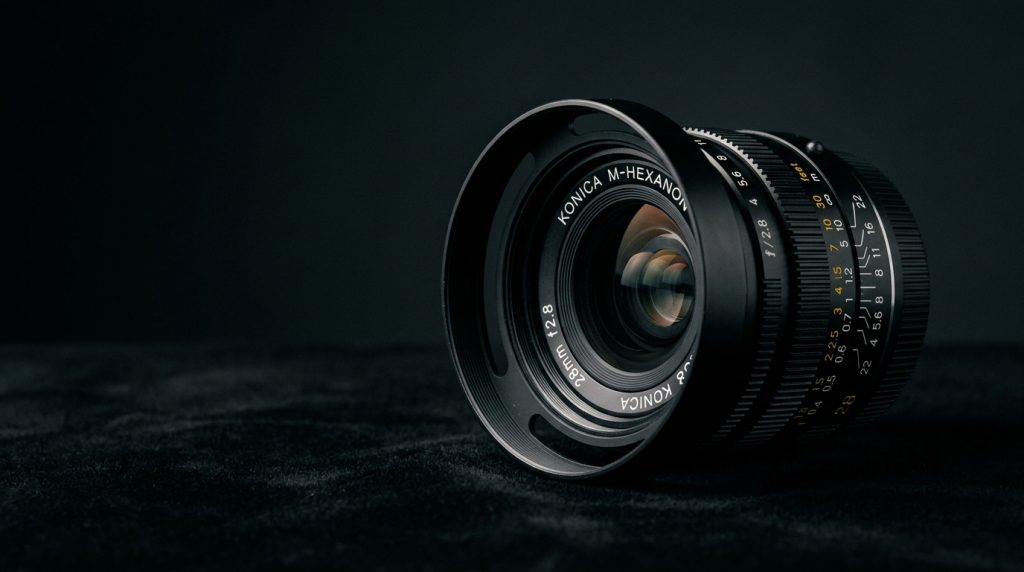
The 35mm rangefinder system was thought to be something only Germany's Leica could make. In 1999, Japan's Konica walked straight into that sanctuary, carrying one camera and a set of lenses. One of those wide-angles is precisely the Konica M-Hexanon 28mm F2.8. Not a mere "Leica substitute," but a lens infused with Konica's last optical pride — let's take a deep look.


01Konica taking aim at Leica, and the Hexar RF
To understand the M-Hexanon 28mm F2.8, you first have to know the background of its birth. This lens was announced in 1999, alongside the Hexar RF, the electronic rangefinder camera Konica put out with great ambition. It was a body compatible with the Leica M mount, and Konica called its own mount the "KM mount (Konica M)."
There are two interpretations of why Konica took on such a challenge at the time. One holds that it was an ambitious side project by engineers who had plenty of drive but little work; the other, that it was a pride project by management trying to flaunt their presence by building something to rival the so-revered Leica. Either way, the result was close to a commercial failure. That was because of the conservative mood of the rangefinder market, and the fact that this happened to be exactly when the film camera market itself was shrinking sharply.

The KM mount lineup that began this way started with the 28/2.8, 50/2 (kit lens), and 90/2.8, followed by the 35/2 the next year, and continued in 2001 with the legendary 50/1.2 limited edition and the 21-35/3.4-4 dual lens. But when Konica and Minolta merged in 2003, the entire KM lineup was discontinued. The first M-mount system developed independently of Leica met a somewhat anticlimactic, but clearly unfair, end. Within this short history, the 28mm F2.8 took its place as the most "classic" and most practical wide-angle.

02Specs — 8 elements / 7 groups, and the secret of the look-alike
Here's the interesting part. The M-Hexanon 28mm's 8-element, 7-group construction is a somewhat classic design that uses no aspherical element, and this construction closely resembles Leica's last non-aspherical wide-angle — that is, the 4th-generation Elmarit-M 28mm F2.8 (Type IV). Given the timeline that the Elmarit IV came in 1992 and the Hexanon 28mm in 1999, the assumption that Konica referenced the 4th-generation Elmarit naturally follows. That said, let's note that this is no more than an inference based on the construction diagram and release timing, not an officially confirmed fact. With the same focal length and same maximum aperture, arriving at a similar construction is entirely plausible too.

03Optics and rendering — the chops of a 25-year-old design
Sharpness
On film, it shows plenty of satisfying resolution and microcontrast even with the latest high-resolution films like Kodak Ektar 100. Things change a little, though, when you put it on a high-megapixel digital body. Wide open (F2.8), it can look a touch soft, especially toward the edges of the frame. The interesting thing is that this is closer to "lack of contrast" than "lack of resolution." Raise the contrast in post and much of it comes back. You can add contrast, but you can't conjure resolution that isn't there — so it's a rather fortunate weakness.
Bokeh and flare
For a wide-angle, the bokeh is surprisingly good. Used at minimum distance wide open, it can separate the background, and the somewhat restrained contrast actually softens the blur. And its real strength is backlight resistance. Even shooting with the sun in or at the edge of the frame, you hardly need to worry about flare or extreme contrast loss. It's a passage that shows how excellent Konica's coating technology was.
Chromatic aberration and color drift
In high-contrast situations, a little chromatic aberration (CA) appears. Stopping down improves it, but with tricky subjects like tree branches against the sky, it may not be perfectly crisp even at around F5.6. Still, compared with the severe CA shown by its contemporary sibling lens, the 90/2.8, the 28mm is far more well-behaved. Also, despite a structure where the rear element sits deep, close to the sensor, the color shift (color drift) you'd worry about on bodies like the Leica M10 is hardly visible. You have to look hard to catch a faint purple cast at the right edge (it may be more pronounced on older digital bodies).
04Handling — well-built metal, but no focus tab
The build quality is all metal and glass, very solid. It's hard to say it reaches 100% of Leica's standard, but it's well made enough not to fall far short of it. It's also thoughtful in deliberately giving the focus ring and aperture ring different knurling (texture) patterns so you can tell them apart by feel alone.
There is one regret, though. This lens has no focus tab. It's all the more puzzling since other M-Hexanon wide-angles from the same Konica have a tab. Without a tab, you can't use muscle memory like "6 o'clock = 1.2m," and you just have to grab and turn the knurled focus ring. The 0.7m minimum focusing distance is the same as the rangefinder's limit anyway, so it's no major complaint.
05"Does the KM mount miss focus on a Leica?"
This is the debate most often raised when using Konica lenses on a Leica body. The story is that the KM mount differs subtly from the Leica M mount, so focus doesn't land precisely. In fact, rangefinder experts like Stephen Gandy and Dante Stella have documented the minute difference between the two mounts. Depending on the individual copy, focus may be slightly off on a Leica, in which case a thin shim is fitted to correct it.
But to put the conclusion first, the 28mm is among the most forgiving on this issue. Thanks to the deep depth of field characteristic of wide angles, a tiny error is effectively buried. The most demanding is the 90/2.8, and the common view is that the 28mm can be used on a Leica body without trouble day to day. What's more, on a body with EVF (Visoflex) or live view like the Leica M10, you can shoot WYSIWYG, which renders this whole debate moot.
06A head-to-head with Leica — the Elmarit, and beyond

The most direct point of comparison is the 4th-generation Leica Elmarit-M 28mm F2.8 (Type IV) mentioned earlier. The two lenses are so close to twins on paper that one Japanese reviewer even put the question mark "Elmarit?" in the title of a Hexanon 28mm review.
| Item | M-Hexanon 28 | Elmarit-M 28 (IV) |
|---|---|---|
| Focal length | 28mm | 28mm |
| Max aperture | F2.8 | F2.8 |
| Lens construction | 8 elements / 7 groups | 8 elements / 7 groups |
| Aperture blades | 10 | 8 |
| Min focus distance | 0.7m | 0.7m |
| Filter | 46mm | 46mm |
| Weight | about 230g | about 260g |
| Hood | round vented screw | square hook-on |
| Release | 1999 | 1992 |
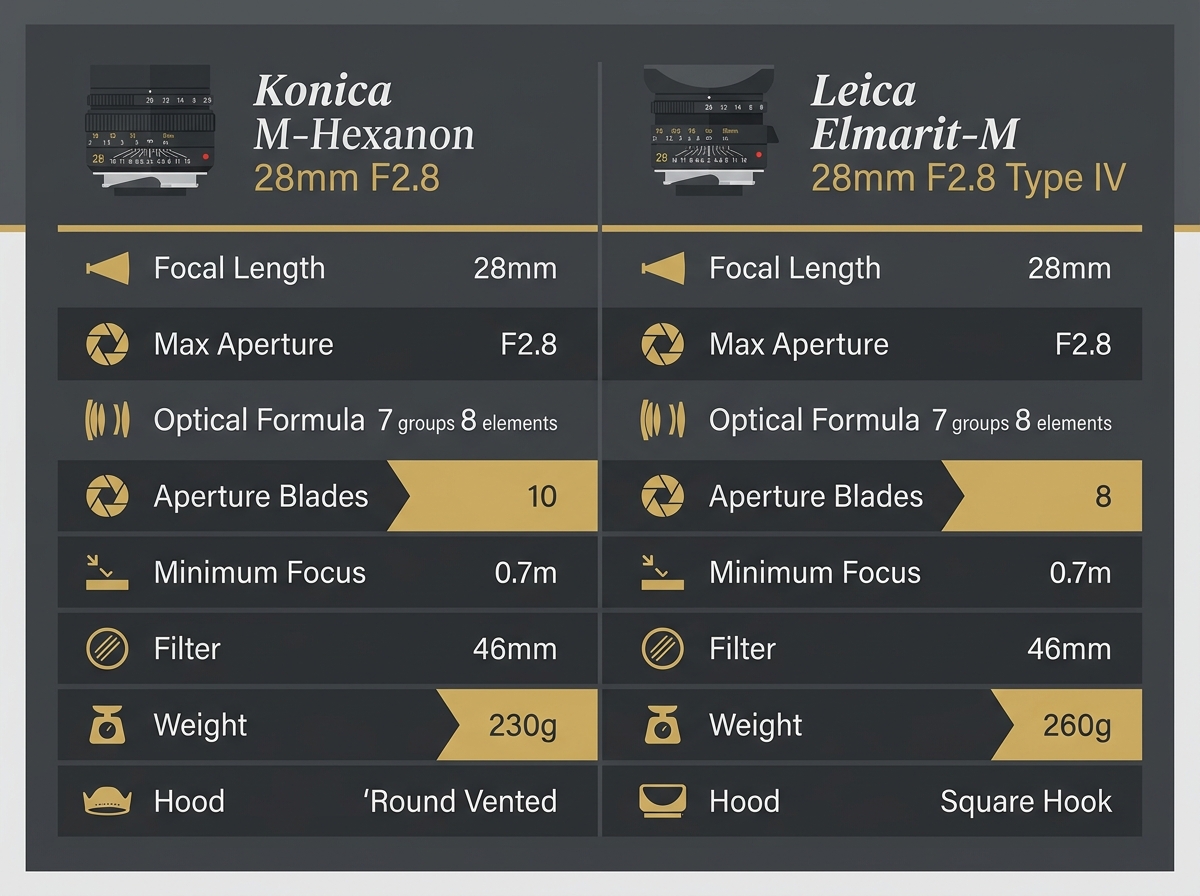
The construction is identical, and the minimum distance and filter size are the same too. The differences amount to the Hexanon having more aperture blades (10 vs 8) and actually being lighter. In other words, compared with the same-generation non-aspherical Elmarit, the Hexanon 28mm is by no means a "cheap copy" but has build quality on a par with it.
Shift the comparison to the latest Elmarit 28mm ASPH (aspherical), however, and the story changes. As its design is several years younger, the ASPH version (especially the 1st and 2nd generations) is clearly optically superior to the Hexanon. It's even lighter (the 1st-gen ASPH is about 198g). If you want to use the same 28mm a stop brighter, the Leica Summicron 28mm F2 (1st generation) is also an attractive option, with weight not much different from the Hexanon.
A budget new alternative — how does it compare with the 7Artisans 28mm?
Interestingly, in one comparison test the contrast and color of the Hexanon 28mm and the new 7Artisans 28mm came out quite close. The conclusion is clear. If you're after low-light shooting on a mirrorless with the brightness of f1.4, the 7Artisans is better, while for a small, characterful wide-angle that suits a rangefinder body, the Hexanon is more appealing for a street photographer.
07On digital bodies — the M8, M9, and beyond

On the full-frame Leica M9, focal-plane sharpness is plenty, and there's no distracting corner light falloff even with sky in the frame, so you can get clean photos across the entire image. On the other hand, with the APS-H sensor (1.33×) M8/M8.2, it becomes about 37mm equivalent, so it has less of the wide-angle flavor — but since you're effectively cropping to use only the lens's best central area, the resulting image quality is actually more stable.
One more thing — copies of this lens that have hazed up like old lenses (balsam separation / fungus) are rare on the used market. It's evidence that the quality of the cement used in the bonding was good, and there's a high likelihood it can be used for a long time without major problems going forward.
08Pros and cons summary
👍 The good
- Excellent backlight resistance, superb coating
- Natural bokeh for a wide-angle
- Solid all-metal-and-glass build
- 10 aperture blades, 0.7m minimum distance
- Excellent build quality for the used price
- Hazed copies are rare (bonding quality)
👎 The disappointing
- Soft wide open and at the edges on high-megapixel digital
- Chromatic aberration in high-contrast situations
- Absence of a focus tab
- KM mount focus variance (copy-to-copy)
- Optically behind the latest Elmarit ASPH
- Rising prices since discontinuation
09Who is this lens for
Overall ★★★★☆
The M-Hexanon 28mm F2.8 is one of the "closest-to-Leica non-Leica wide-angles." It puts a design nearly identical to the same-generation Elmarit into a solid metal barrel, and shows clear strengths in backlight, bokeh, and durability. Its weaknesses amount to wide-open and corner image quality on high-megapixel digital bodies and a touch of chromatic aberration.
It suits someone who shoots 50mm as their mainstay and wants to add one more lens at the widest angle of view that most rangefinders' built-in finders support, and someone who finds Leica prices a burden but trusts the build of Japanese optics. That said, if you want a new-product warranty and a more modern signature, the Zeiss Biogon ZM 28/2.8 may be a better choice, and if you want the best optics, the Elmarit ASPH.
To sum up the alternatives — if optics come first, the Leica Elmarit-M 28 ASPH; for new, value, and excellent image quality, the Zeiss Biogon ZM 28/2.8; for a CLE-era classic, the Minolta M-Rokkor 28 (but at purchase, checking the cemented-surface separation is a must); for a budget new lens, the Voigtländer / 7Artisans 28 are candidates. Even so, if you want to buy, along with it, the Hexanon 28mm's unique solidity and the story of "an era when Konica took aim at Leica," this lens is well worth recommending.
- Macfilos, "The M Files (13): Three Konica M-Hexanon lenses" (Joerg-Peter Rau)
- Shige's hobby, "Elmarit? M HEXANON 28mm" review and spec comparison table
- The Machine Planet, "Konica M-Hexanon 28mm f/2.8" (Dante Stella)
- Beers and Cameras, "Konica Hexanon 28mm vs 7Artisans 28mm M-mount"
- Konica 28/50/90mm Technical Report (Konica Minolta technical report)
- Images: some from Wikimedia Commons (Mike Funnell CC BY-SA 3.0, Nicolas Vigier CC0, Mustafa Dogan CC BY-SA 4.0, Andrew Xu CC BY-SA 2.0); the diagrams, infographics, and staged shots are AI-generated

댓글 0
첫 댓글을 남겨보세요.