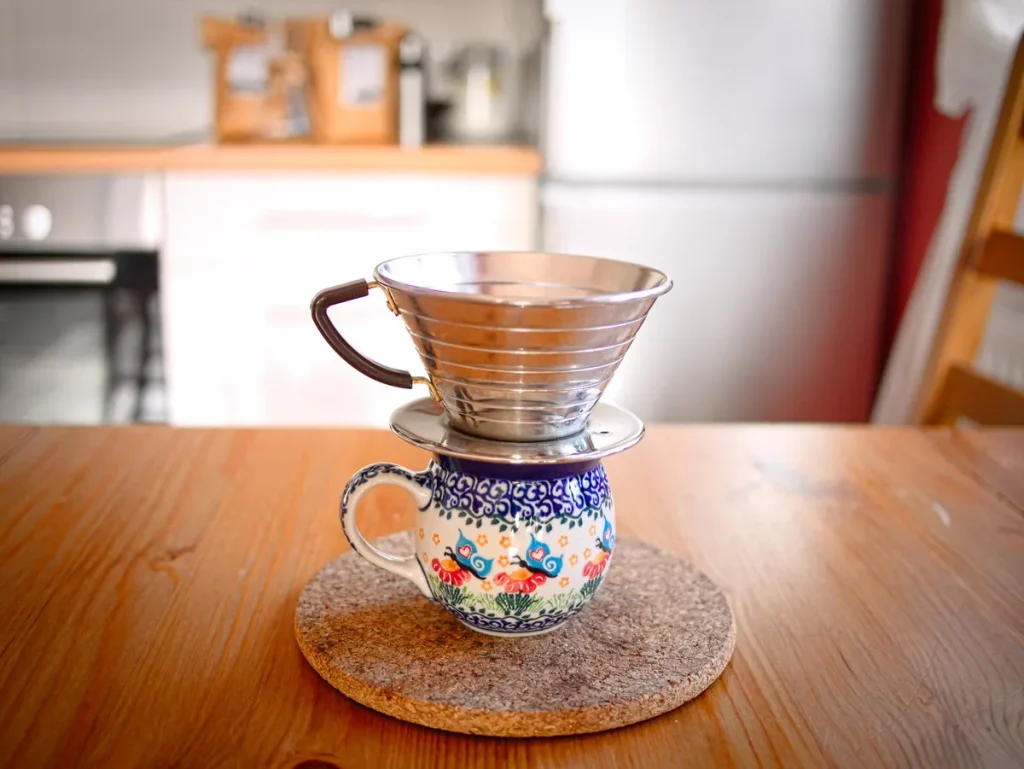
Same beans, same grinder, same water temperature. Yet swap nothing but the dripper and the cup changes. One brew is bright and zippy; the other settles round and soft, with sweetness lingering long. Right at the center of that difference sits the filter.
When you brew pour-over, it's easy to fuss over the beans, the grind, and the pour while treating the filter as "just paper." But a filter's shape and paper change the path water takes through the coffee, and that path becomes the flavor. Today we put the wave filter — increasingly beloved lately — at the center and untangle how each filter shape splits the cup.

FILTER SHAPEShape Changes the Cup — Cone vs. Flat Bottom
Filters fall into two broad families. The pointed-tipped cone (Hario V60, Chemex) and the wide, flat flat-bottom (Kalita Wave, Fellow Stagg). Different shapes mean water passes through the coffee bed in different ways.
A cone gathers water toward the center and sends it through a deep coffee bed. Think of a funnel. As water converges to a single point and drains quickly, the center extracts more strongly. The faster flow keeps acidity and aroma sharp and clear, yielding a light, clean cup. The trade-off: channeling, where water carves a single path down one side, and dry patches at the edges form easily, so when your pour wobbles, the flavor wobbles with it.
The flat bottom is the opposite. The coffee bed lies shallow and wide, so water passes evenly across the entire surface. Because extraction is uniform, the flavor stays balanced and the sweetness and body build up plump and full. Even a slightly clumsy pour won't break the result badly, which is why it's often called a "forgiving" dripper.
In a study run by the UC Davis Coffee Center in the United States together with the SCA and Breville, the shape of the filter basket affected the cup as much as the grind size did. Even novice tasters could detect the flavor difference between shapes, and the only variable with a bigger impact was the degree of roast.

THE WAVEThe Wave Filter — What Makes It Different
The wave filter is the paper used in the Kalita Wave, a flat-bottom dripper made by Japan's Kalita. As the name suggests, wavy ripples run all the way around its sides, and the bottom is flat with three small holes punched in it. These two features shape nearly all of the Wave's character.
① Three small holes keep the speed in check
The V60 has one large hole at the bottom, so the drain speed is fully at the mercy of grind and pour. The Wave's three small holes set an upper limit on the flow. No matter how hard the water pours in, only as much drains as the holes allow, so the time the coffee stays submerged in water stays stable. That's why the cup doesn't go badly off course even if your hand wobbles a little.
② Wave ribs lift the paper off the wall
The ribs (around twenty pleats) keep the wet paper from sticking to the dripper wall. An air layer forms between the paper and the wall, and that air acts as insulation to hold the temperature, while air circulating around the coffee bed keeps the water path from leaning to one side. Channeling decreases and extraction spreads evenly.

The paper itself plays a part too. Kalita Wave filters are made in Japan from oxygen-bleached softwood pulp, and they're praised for low papery taste and consistent flow. The standard sizes are the single-cup 155 (up to about 250ml) and the two-to-three-cup 185 (about 350–500ml), and because their shape differs from cone filters, the two can't be used interchangeably.
FIELD GUIDEFilter Types at a Glance
Here are the four families you'll see most often in practice. Even among cones, a thick paper like the Chemex's gives the filter a different character again.
Kalita Wave — balance and stability
Shallow, wide coffee bed + three small holes + wave ribs. Even extraction, plump body, round sweetness. Forgiving of pouring mistakes, it makes a great daily dripper. Set your grind around medium as a baseline.
Hario V60 — clarity and expression
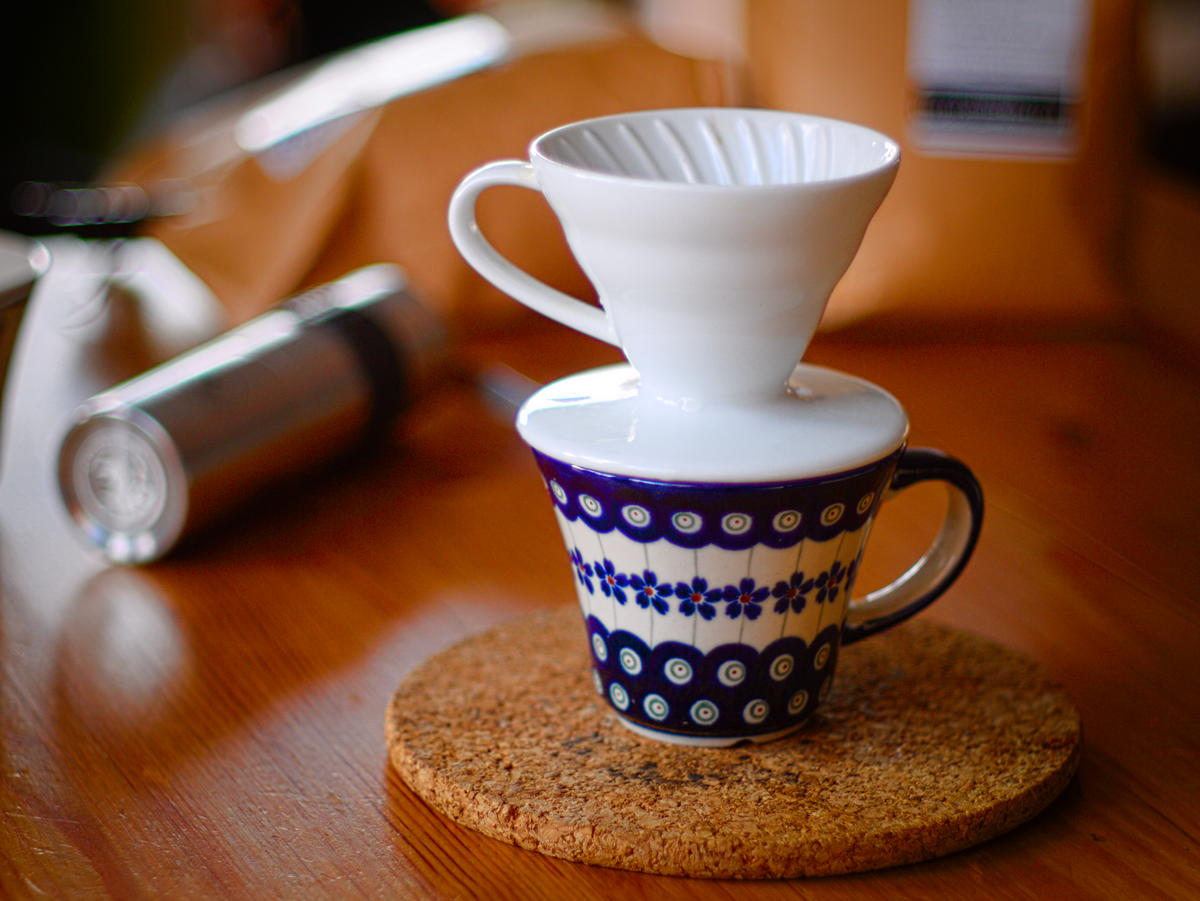
One large hole in a deep cone. The flow is fast, and acidity, aroma, and nuance come alive vividly. You can fine-tune the flavor with grind and pour, but it asks for a steady hand to match. A finer grind and a more delicate pour are recommended.
Chemex — a clear, light cup
It looks like a cone, but its dedicated paper is exceptionally thick. It filters out most of the oils and fines, yielding a cup as clear and light as tea. If you prize cleanliness above all, go Chemex — just be ready to give up on a plump body.

Basket (Melitta · drip machine) — generous and easygoing
A flat-bottom basket shaped like a cupcake tin. Mainly used in automatic drip machines, it brews a generous volume at once. Extraction is even and easygoing, but since you hand the pour over to the machine, there's little room to tune by feel.
THE PAPERThe Difference the Paper Makes — Bleaching, Thickness, Material
The paper changes the flavor as much as the shape does. Just remember three things.
Bleached vs. unbleached
White paper has been bleached with oxygen or chlorine; brownish paper is unbleached. People often say unbleached paper has more of a papery taste, but in truth a papery taste can appear regardless of whether it's bleached. So rather than fussing over the color, it's more important to make a habit of rinsing the filter once with hot water before brewing. It washes out the papery taste and helps the filter seat snugly against the wall.

Thickness
Thick paper slows the flow and traps more oil, leaning toward a clear, light cup (the Chemex being the prime example). Thin paper lets more compounds through, bringing out aroma and body. One champion barista says they choose thick paper (0.28mm) for dark roasts, thin paper (0.15mm) for mediums, and an abaca filter for lights. It's not a rulebook but an example that shows the direction.
Material — paper, metal, cloth
Even at the same shape, the material changes the body. Paper filters out the most oils and fines, for a clear, crisp cup. Metal (mesh) has larger openings that let oils and fine particles pass, making for a heavy, intense — but slightly cloudy — cup. Cloth sits in between: it catches the fines but lets some oil through, giving a plump texture. The catch is that cloth comes with the chore of washing it after every use.
TASTE MAPSo How Does the Flavor Split?
Here's the flavor difference made by shape, gathered into a single table. It's a tendency at most, and don't forget you can pull the cup somewhat one way or the other with grind and pour.
| Category | Cone (V60 · Chemex) | Flat bottom (Wave · basket) |
|---|---|---|
| Water path | Converges to the center, fast | Evenly across the whole surface |
| Extraction | Center strong, somewhat uneven | Uniform · stable |
| Body | Light and clear | Plump and round |
| Flavors brought out | Acidity · aroma · sharp nuance (smoke, cacao, dried-fruit notes) | Sweetness · balance (fruit, honey, tea, floral notes) |
| Forgiveness | Sensitive — needs a steady hand | Forgiving — strong against mistakes |
| Grind | A touch finer | Medium baseline |
To sum up: if you want to spread out the bean's character and acidity vividly, go cone (V60); if you want to enjoy sweetness and balance reliably, go flat bottom (Wave). And if the clearest possible cup is the goal, it's the Chemex.
Practical tips for getting the most out of the Wave
- Rinse the filter — wet it once with hot water before brewing to wash out the papery taste and settle the filter in place.
- Start the grind at medium — if it's too sour or thin, go a little finer; if it drags past four minutes, go a little coarser.
- Pour gently — with the Wave, "pouring softly" matters more than the shape of your stream. Pulse pours work, and so does a single stream poured slowly in circles.
- Match the size — 155 for one cup, 185 for two or more. Use the dedicated filter that fits your dripper's size.
- Keep the beans fresh — the Wave reflects the beans honestly. A good result starts with freshly roasted beans.
A filter is no longer "just paper." Simply changing the shape, the paper, and the material gives the same beans an entirely different expression. If you try one thing today, set a Wave filter beside your usual dripper and brew the same beans side by side. That single comparison will teach you far more than a hundred lines of charts.
If you want to try brewing with a Wave yourself
We've put together a 2–3 serving Kalita Wave 185 recipe that lays out the standard ratio (1:16), the bloom and pulse-pour steps, and a brew timer all on one page. It even notes the grind setting based on 25 clicks on the Comandante C40.

댓글 0
첫 댓글을 남겨보세요.