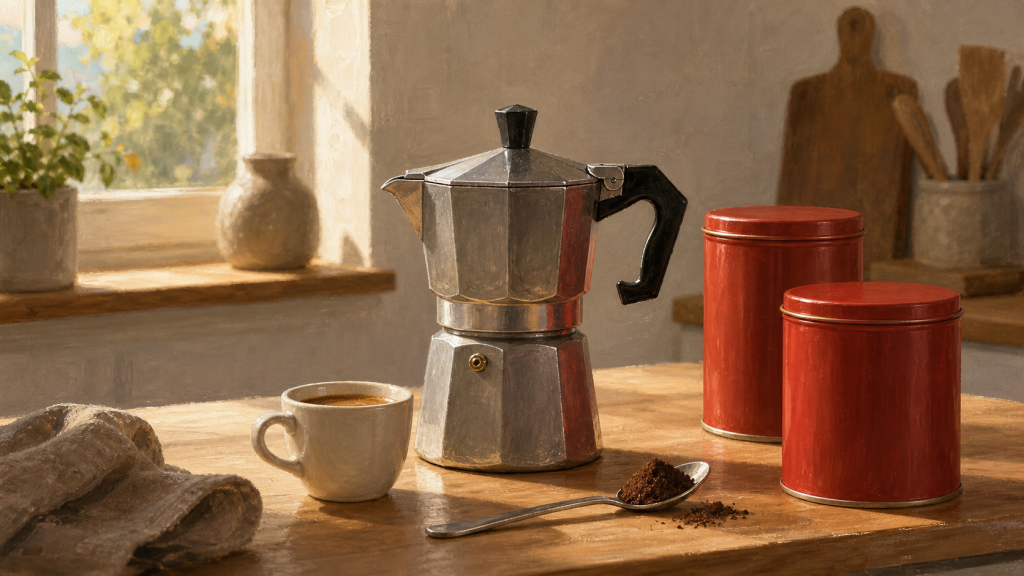
When choosing a Lavazza for your moka pot, the most confusing thing isn't the name but the role. Qualità Rossa is the everyday standard, Crema e Gusto is a richer Italian style, and Qualità Oro leans toward a clean-aromatic 100% Arabica. In Korea, the Lavazza products you can find vary often by importer and package size, so this article focuses on "what you can expect right when you add one to your cart."
1The Bottom Line First: Three Questions Are Enough
Lavazza is a coffee brand that began in 1895 in Turin, Italy. The heart of the brand is closer to blending than to single origins. How the aroma of Arabica is mixed with the body and crema of Robusta is what creates each product's character. So when choosing a Lavazza for your moka pot, too, it's easier to first look at "which cup do I want" rather than "which beans are more premium."
How to Read the Intensity Number — Lavazza's intensity isn't "caffeine content" but is closer to a perceived index blending roast, body, bitterness, and a sense of concentration. Because a moka pot runs at lower pressure than an espresso machine, rather than treating the number as an absolute value, it's easier to use it as a yardstick for "is this the heavier side, or the smoother side?"
2Why Do Moka Pots and Lavazza Go So Well Together?
A moka pot pushes water up through the bed of coffee using the pressure generated in the lower boiler. It sits at a middle point — richer than drip, smoother than an espresso machine. In this method, rather than overly delicate acidity, it's chocolate tones, body, and a slight bitterness that hold the cup together steadily.
This is where Lavazza's Arabica + Robusta blends gain their strength. Blends with Robusta tend to bring out a sense of body and crema in the moka pot, and even with a little milk added, the coffee flavor doesn't get washed out. Conversely, 100% Arabica products are clearer and more fragrant, but the heavy punch characteristic of the moka pot can be weaker. It's less that one is "better" and more that the cups go in different directions.

3Lavazza Models Worth Looking at in Korea
In Korea, ground coffee tins, 1kg whole-bean bags, and capsule products come in together through both official distributors and parallel/specialty import channels. The ratings below are based on the moka pot. They should be viewed differently from ratings based on an espresso machine.
This is the standard that's easiest to recommend first. Even on Lavazza's official page, the ground product is listed for Espresso and Moka use, emphasizing hints of chocolate and a rich body. Brewed with a moka pot, it's not too strong while being the closest to the image of "Italian home-style coffee."
Oro is smoother than Rossa with brighter aromatics. The official ground product is listed for Filter and Moka use and highlights floral and fruity notes. It's clean in a moka pot too, but if you expect a thick body like blends with Robusta in them, it may leave you wanting.
If you want something richer and heavier than Rossa, you can move up to this line. In Korea, the ground and whole-bean products appear differently from seller to seller, and the package names are sometimes split into Classico, Forte, Espresso, and so on. In the moka pot, it has the advantage that the flavor holds up even when you mix in a little milk.
This is a strong option that suits people who need "a single punch in the morning." However, in the moka pot, if the heat is too high or the grind too fine, bitterness jumps out quickly. Rather than sipping it slowly black, its strengths show better in lattes, iced café au lait, and a rich coffee with a little sugar.
This is a whole-bean line originally used a lot for espresso machines. It works well in a moka pot too, but you have to dial in the grind yourself. You can expect something smoother and creamier than Rossa, so if you have a grinder at home and often make milk drinks, it's quite practical.
These are lines often seen in Korea as 1kg bags. They're great for steady, large-volume consumption, but for a moka pot beginner picking a first purchase, the quantity is large and there's some setup burden. If you've already settled on a grind setting and brew multiple cups a day, they become an option.
4Comparison Table at a Glance
| Model | Character | Flavor Direction | Form Mostly Seen in Korea | Moka Pot Recommendation |
|---|---|---|---|---|
| Qualità Rossa | Balanced blend | Chocolate, full-bodied | 250g ground tin | First purchase |
| Qualità Oro | 100% Arabica | Floral, fruity, smooth | Ground tin · whole bean | Aroma-focused |
| Crema e Gusto | Rich blend | Chocolate, spice, heavy | Ground · whole bean | Rich black · milk |
| Forte / Espresso | Dark-roast tendency | Dark chocolate, bitterish | Ground · whole bean | Latte base |
| Super Crema | Smooth whole bean | Nutty, brown sugar, creamy | 1kg whole bean | Grinder owners |
| Gran Espresso, etc. | Espresso-oriented | Smoky, dark, full-bodied | 1kg whole bean | High-volume use |
Stock and Packaging Change — even under the same name, packaging, origin labeling, volume, and intensity markings can appear differently from country to country. Before buying, it's safer to first check the use labeling (ground/whole bean, moka/espresso/filter) and the best-before date on the domestic sales page.
5Settings That Bring Out the Flavor in a Moka Pot
Lavazza's strength is on the "easily produces a rich flavor" side, but in a moka pot, the slightest misalignment of heat and grind brings bitterness out first. The settings matter as much as the bean choice.

A Grind a Little Coarser Than Espresso
Grinding too fine, like for espresso, clogs the water path and brings bitterness up quickly. Too coarse, like for drip, and it's watery. The benchmark is around between fine salt and sugar. Using a ground tin is convenient, but if you buy whole beans, the moment you dial in a moka-pot-specific grind, the flavor becomes much more stable.

Hot Water and Medium-Low Heat
Putting pre-heated water in the lower boiler reduces the time the coffee sits and heats up inside the metal basket. Medium-low heat is good. When the coffee, rising into the upper chamber, starts to make a bubbly, sputtering sound, that's the end of extraction. At that point, turning off the heat and slightly cooling the lower section makes it easier to reduce burnt notes and over-extraction.
Don't Tamp
After filling the basket with coffee, just level it off. If you press it down firmly like espresso, the pressure rises abnormally, and the flavor tends to get harsh rather than richer. Especially with powerful blends like Crema e Gusto or Forte, it comes out plenty rich without pressing.
6Recommendations by Taste
7Wrapping Up
In one line, here it is. For starting out with a moka pot, Qualità Rossa; for rich flavor, Crema e Gusto; for aroma, Qualità Oro; for milk and high volume, Super Crema or the 1kg whole-bean lines. It's fine to start out drawn by the red-tin image, but the actual choice is much easier when you split it into "do I need a ground tin, do I need a rich body, or do I need aroma?"
With a moka pot, repetition makes the flavor more than grand equipment does. Even with the same Lavazza, just brewing it two or three times tuned to your water, your heat, and your grind quickly sets your baseline. We recommend a flow where you start out lightly with Rossa for your first tin, and move on to Crema e Gusto when you crave a slightly richer cup.
· Lavazza official product info — Qualità Rossa Ground, Qualità Oro Ground Coffee
· Lavazza official country/distribution info — Where we are: Korea
· Brand background — Lavazza World
Image Sources
· The first image in the article is a generated illustration.
· Moka pot — Michele Bucelli, Wikimedia Commons, CC BY-SA 4.0
· Moka pot structure — Shisma, Wikimedia Commons, CC BY-SA 4.0
· Ground coffee — Alorin, Wikimedia Commons, CC BY 4.0
Note — Domestic stock forms and product names still differ by seller as of June 2026. Before buying, re-check the ground/whole-bean, volume, and use labeling on the actual sales page.


댓글 0
첫 댓글을 남겨보세요.