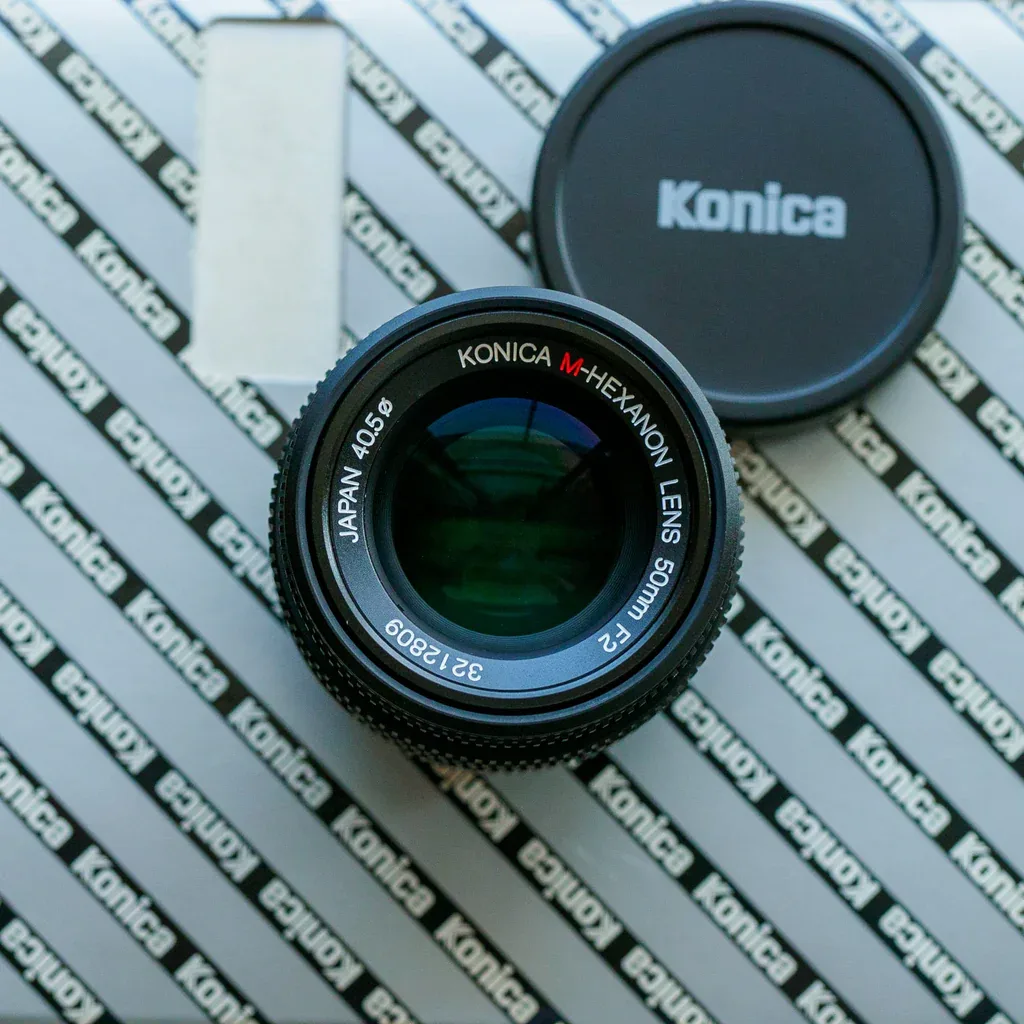
The Leica M mount isn't "Leica's alone." In 1999, Konica released the Hexar RF alongside a KM mount that copied the Leica M outright, and introduced its own lenses for that same mount — the M-Hexanon. Back then they were unfairly dismissed as "Leica knockoff glass," but today they're being reappraised as hidden gems. In this article we put the six M-Hexanons side by side and, with the addition of real-world reviews from Japanese users, sort out the true differences from Leica M.

1. What Is the Konica M Mount (KM Mount)?
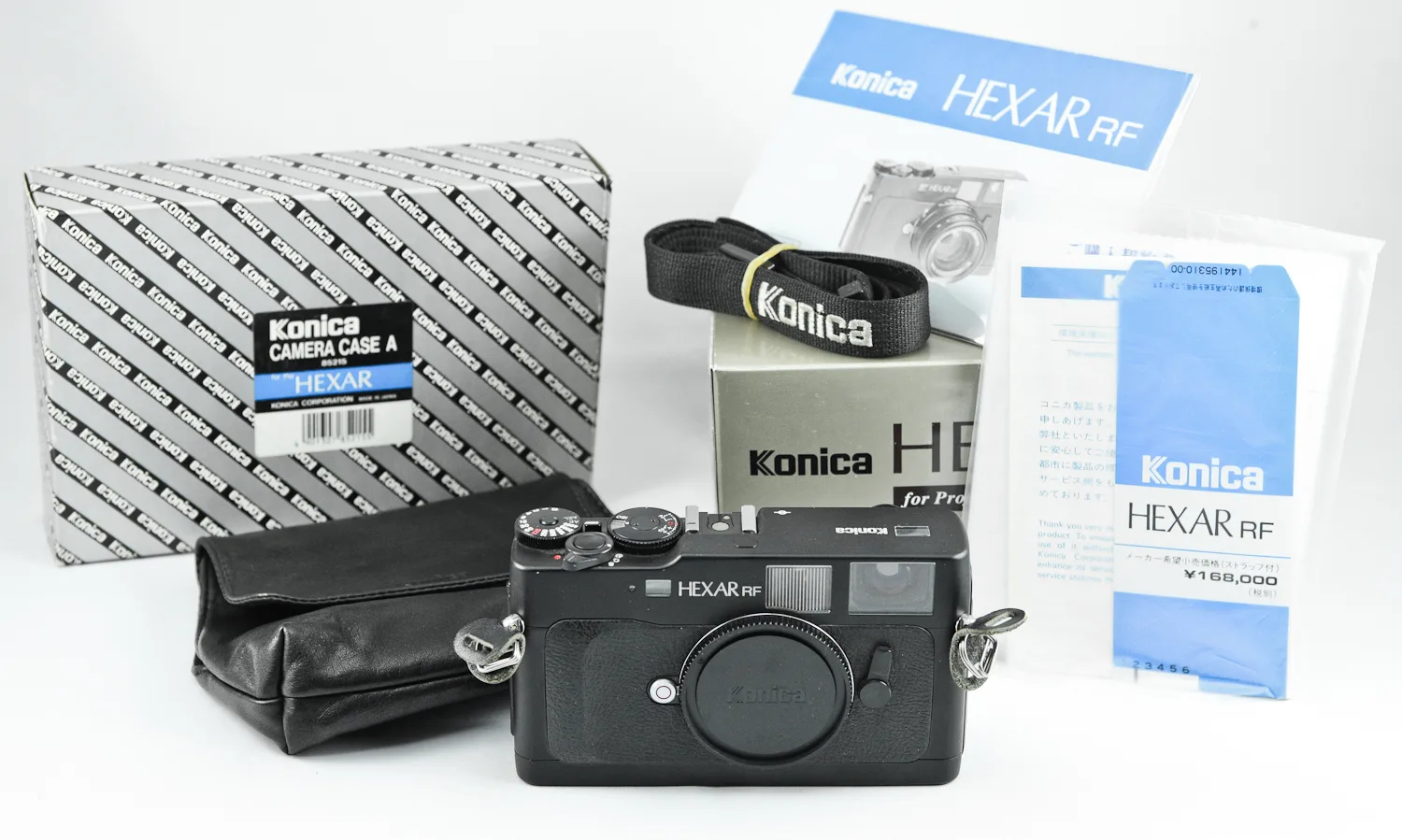
The Konica Hexar RF, a 35mm rangefinder film camera released in October 1999, adopted the "KM mount" that essentially cloned the Leica M mount. Thanks to this, you can fit other M-mount lenses from Leica, Zeiss, Voigtländer, and more directly onto it, and with an adapter you can even use older L39 screw-mount lenses.
The body's origins are interesting. The Hexar RF's body was made by the same partner that built the Contax G1/G2 and the Hasselblad X-Pan, and the established view is that Konica only made the lenses itself. With a rangefinder base length of 68.5mm and a 0.6× viewfinder, automatic frame-line switching for 28/35/50/75/90mm, aperture-priority AE and manual exposure, a 2.5 fps motor drive, and titanium top and bottom plates — at the time of release it was even rated as "the most advanced M-mount body," with automation ahead of the Leica M7.
2. The M-Hexanon Lineup at a Glance
The M-Hexanons Konica made specifically for the KM mount comprise five prime lenses and one dual, six in total. There's a 75mm frame line in the viewfinder, but Konica never released a 75mm prime.
| Lens | Released | Notes | Filter size |
|---|---|---|---|
| M-Hexanon 28mm f/2.8 | 1999 | A versatile wide-angle classic. The shortest prime among the three (28/50/90) at launch | — |
| M-Hexanon 35mm f/2 | 2000–01 | A new 8-element/7-group design (retrofocus). Arrived late, so it's scarce and pricey | 46mm |
| M-Hexanon 50mm f/2 Bundle · Entry | 1999 | Resembles the Summicron 50/2 V5 right down to the slide-out hood. The most common, best-value standard | 40.5mm |
| M-Hexanon 50mm f/1.2 Limited Edition | 2001 | Bundled with a titanium limited-edition kit. Fast and rare, but its wide-open rendering is divisive | — |
| M-Hexanon 90mm f/2.8 | 1999 | A slim, solid telephoto. Finish and handling that are classic RF-lens | — |
| M-Hexanon Dual 21-35mm f/3.4-4 Unusual | — | A dual-focal-length lens switching between 21mm and 35mm. A "niche of niche" treasure | 62mm |
3. Detailed Lens-by-Lens Comparison + Japanese User Reviews
M-Hexanon 28mm f/2.8 — the Japan-made Elmarit
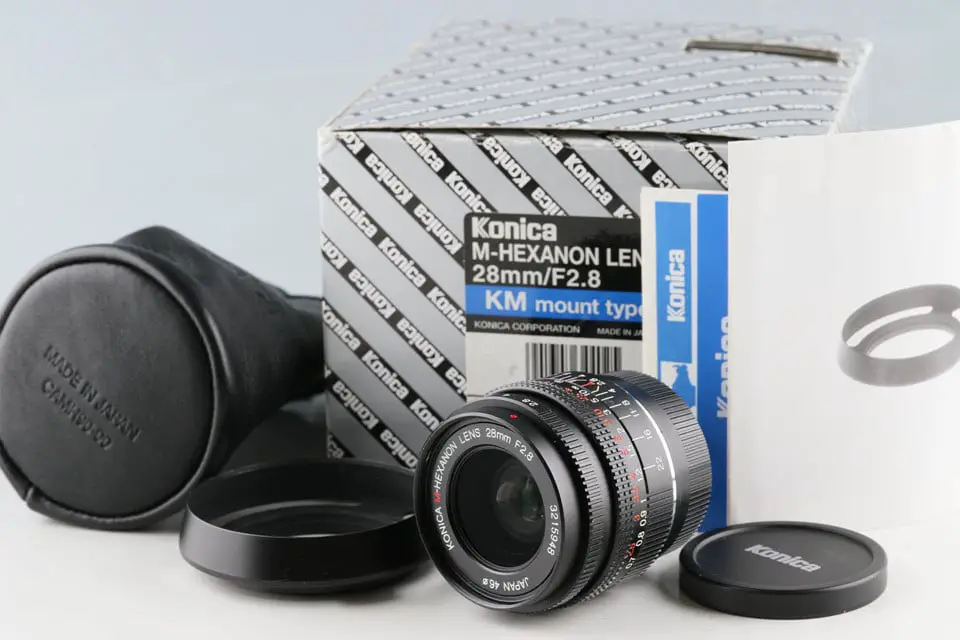
Excluding the dual, this is the widest of Konica's M-mount lenses. Because its optical formula and size closely resemble the Leica Elmarit 28mm (4th generation), in Japan it's nicknamed the "wasei (Japan-made) Elmarit."
"A polished, modern 28mm with vivid color, delicate rendering, and abundant peripheral illumination. The barrel diameter matches the M-mount's outer diameter (52mm), so it's easy to grip and operate."
— Shige's hobby (used in practice with the LEICA M9/M8 and Hexar RF)
A Fujiya Camera review also rates it as "a lens like a sibling to the 4th-gen Elmarit, resistant to ghosting and flare. Color is faithful but somewhat understated."
M-Hexanon 35mm f/2 — a Freshly Designed Wide-Angle

A new 8-element/7-group retrofocus design added belatedly in 2000. It pushed flatness up, aiming for rendering suited to the digital era. The 46mm filter size is unremarkable.
"A new design that doesn't simply follow past formulas, with improved flatness, it became a performer suited to the digital era. That said, the specs are unchanged while the barrel grew larger than the old 35/2, which is a shame from a user's standpoint — if it was going to grow anyway, I wish they'd opened it up to f/1.4."
— Shige's hobby. He also explains that the thicker barrel led to a Summicron-style focus tab.
M-Hexanon 50mm f/2 — the Standard You'll Meet First
The Hexar RF's bundled lens and the easiest to find. With a 6-element/5-group double-Gauss design, a 0.7m minimum focus, a 10-blade aperture, a 40.5mm filter, and a built-in hood, it's very similar to the Leica Summicron 50/2 4th generation. The one drawback is the uncommon 40.5mm filter size.
"It shoots well from wide open and isn't high-contrast. The front and rear bokeh are gentle and smooth, making it an all-rounder for both distant and close subjects."
The standard-lens collection blog tokinon5014 rates it as "clear and sharply focused even wide open, with excellent distortion correction. Compared to the Zeiss Planar 50/2 ZM, the bokeh is a touch firmer and there's slightly more purple fringing."
M-Hexanon 50mm f/1.2 — a Fast but Finicky Limited Edition

An ultra-fast standard that came bundled with the Hexar RF Limited, capped at 2,001 units in 2001. At a 0.9m minimum focus, it lets you get relatively close for such a fast lens.
"Wide open you see purple fringing and coma in the periphery, and point light sources spread radially. But with rendering where the outlines of light seem to melt, depending on how you use it you can also expect cinematic expression." (Shot mounted on an α7 II)
— Camera no Naniwa (Ginza Kyokai branch)
Another user (Cheri-goya) wrote, "Being able to get as close as 0.9m is a big advantage on an RF. With its slightly high-contrast yet under-exposed, ND-filter-like distinctive color tone, it's a cherished lens I always took along when carrying the Leica M9."
M-Hexanon 90mm f/2.8 — a Solid Medium Telephoto

5 elements in 4 groups, a 10-blade aperture, a 1.0m minimum focus. It shows the solid metal barrel and refined finish common to the KM mount.
"It renders solidly from wide open, and the focus-ring feel is smooth, common to the whole series. That said, using 90mm with a finder magnification of 0.7× or lower means cropping only a tiny part at the center of the field, so for this focal length an SLR is actually more practical."
— Shige's hobby (using a Leica M8)
Another user (SK's camera hobby) rates it as "strong against backlight and genuinely sharp — it's puzzling that it isn't popular. A lens that deserves more credit." Meanwhile, there are reports that some units had a shifted back focus that wouldn't reach infinity, addressed with shim adjustment or tape, so a check is advised when mounting on a Leica body.
M-Hexanon Dual 21-35mm f/3.4-4 — the True Treasure

The most unusual of Konica's M-mount lenses. Not a zoom but a "true dual-focus" lens that pursues performance only at the two focal lengths of 21mm and 35mm (the in-between region is out of focus), with 11 elements in 10 groups and full multi-coating except on cemented surfaces, giving excellent contrast and color reproduction. The filter size is 62mm — among the largest of RF lenses — and the index markings are distinguished as orange for 21mm and green for 35mm.
"Trying it on both digital and film, film draws out this lens's inherent rendering better."
— Shūsa Love (Aberration Love) (used with a Zeiss Ikon ZM + film)
Another user (Rakushumi) left a practical complaint: "Switching between 21/35 just from the markings engraved on the lens is confusing and a source of misoperation — I wish there were a clearer indicator."
4. Leica M vs Konica M-Hexanon

Image Quality & Rendering
Today the M-Hexanon 28/35/50/90 earn praise as "sharp, with soft bokeh, excellent build, and focus rings that don't stiffen up even in the cold." The 35/2 in particular is even rated as a match for the Summicron. Conversely, some users insist that "the real reason for the M mount is Leica glass," arguing that Leica still has the edge in color reproduction and the like when shooting wide open. In other words, the general conclusion is that in practical use they're nearly on par, but taste divides at the extremes of wide-open rendering.
The Truth About the Compatibility Rumors
The rumor that "Konica bodies and lenses have a subtly different flange distance and aren't compatible with Leica" floated around for a long time. The fact that Konica, to avoid trademark disputes, never officially claimed Leica compatibility fed the misunderstanding. These days it's largely settled as an exaggerated rumor, but as in the 90mm review above, there are cases of measurable focus error reported on Leica digital bodies (M8, M240, etc.), so when mounting on a digital M it's safer to consider per-unit calibration.
5. Is It Worth Buying Now — a Purchase Guide
Along with the film renaissance, M-Hexanon prices have risen considerably from the past. Even so, there's still a reasonable range relative to equivalent Leicas, making them plenty attractive for the goal of "RF glass close to the Leica look, more cheaply."
- Check the filter size — the 50/2's 40.5mm makes filters and hoods hard to source. The 35/2 (46mm) is more manageable, and the 21-35 Dual is large at 62mm.
- Beware infinity focus — the standard primes have no internal infinity stop, and are set from the factory to go slightly past infinity. Don't arbitrarily set it to infinity (the 21-35 Dual has a different structure).
- If you plan to use a digital M, test focus accuracy in advance (especially the 90mm).
- The 50/1.2 and 21-35 Dual carry a large rarity premium. Judge by separating image-quality expectations from collectible value.
- The best-value entry is the 50/2, and the one with high image-quality satisfaction is the 35/2.
Wrapping Up
The Konica M-Hexanon isn't a "Leica knockoff" — it's what came of Konica, once Japan's top optical maker, challenging Leica head-on. From the solid fundamentals of the 28/35/50/90 to the rarity of the 50/1.2 and the unusual charm of the 21-35 Dual — as the Japanese user reviews above also show, this is a lens group worth passing through at least once if you want to add depth to your M-mount system. That Leica isn't the only answer is something these small pieces of glass prove.
References: Wikipedia (Konica Hexar RF / Leica M mount), Camera-wiki.org, Macfilos. Japanese reviews: Shige's hobby (shige-art.net), Shūsa Love (lens-aberration.com), Camera no Naniwa, tokinon5014, the Fujiya Camera blog, Cheri-goya. Lens product photos: Yaotomi Camera (yaotomi.co.jp), Japan Camera Hunter, Doppietta-Tokyo. Camera body images: Wikimedia Commons.

댓글 0
첫 댓글을 남겨보세요.