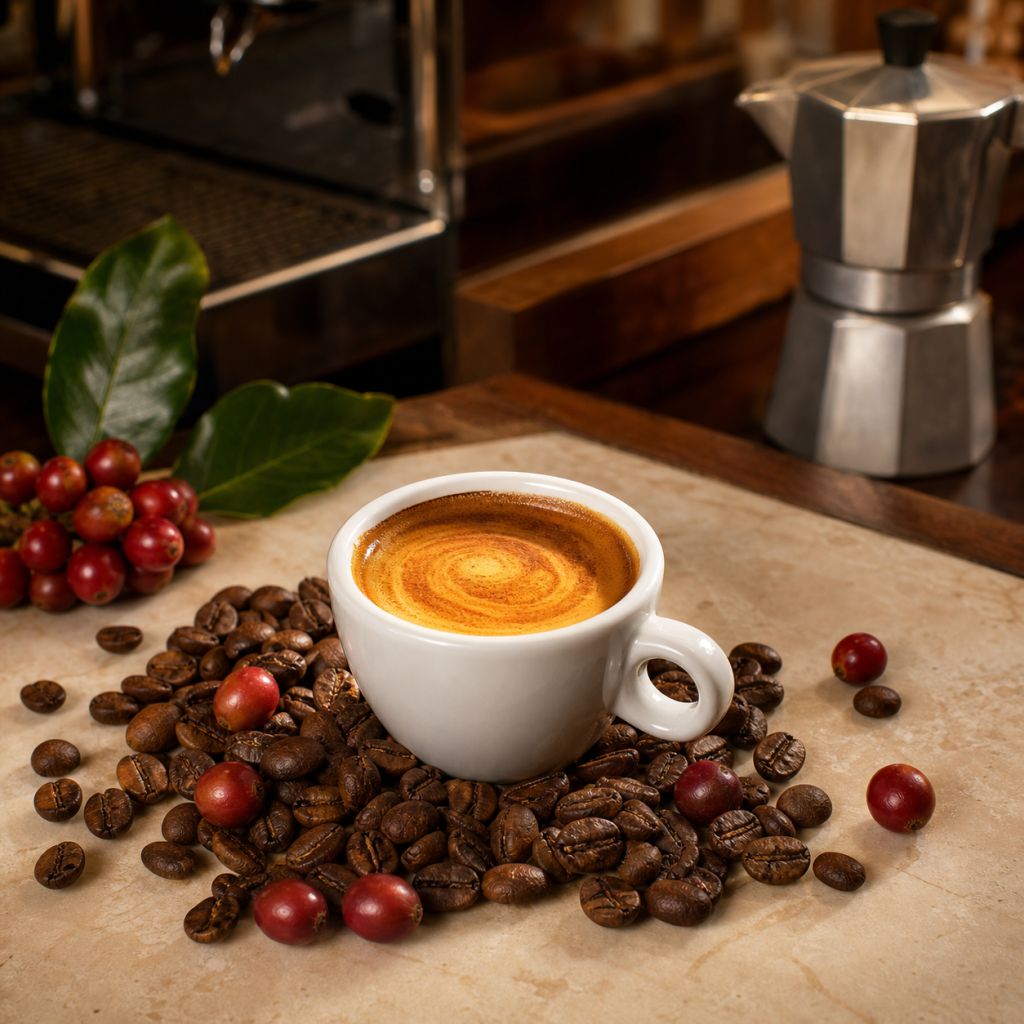
The menu at a specialty café invariably carries the phrase "100% Arabica," worn almost as a badge of pride. Yet at the bars of Italy, espresso's home ground, many blends still contain robusta to this day. Why does the country fussiest about its coffee insist on a bean reputed to be of low quality?
Robusta, a "robust" bean from the name on down
The coffee we drink is, in effect, a contest between two species. Arabica (Coffea arabica) and robusta (Coffea canephora). Robusta's scientific name is canephora, but the nickname meaning "robust" became so famous it essentially turned into the bean's name. Native to central and western sub-Saharan Africa, it now accounts for 40–45% of global coffee production.

It lives up to its name. Unlike arabica, which needs cool highlands above 1,000 m, robusta thrives even in the hot lowlands of 200–800 m elevation. With strong resistance to pests and disease, it needs fewer pesticides and yields more. One secret behind that is caffeine itself. Caffeine acts as a natural insecticide for the plant, and robusta's caffeine content is about 2.2–2.7%, nearly double that of arabica (1.2–1.5%).
Arabica vs. robusta, by the numbers
| Arabica | Robusta | |
|---|---|---|
| Scientific name | Coffea arabica | Coffea canephora |
| Caffeine | about 1.2–1.5% | about 2.2–2.7% |
| Sugar | 6–9% | 3–7% |
| Growing altitude | Highlands (above 900 m) | Lowlands (200–800 m) |
| Flavor | Floral, fruity, acidic, complex | Heavy body, earthy, woody, bitter |
| Share of world production | about 55–60% | about 40–45% |
| Main producers | Brazil, Ethiopia, Colombia | Vietnam, Brazil (Conilon), India, Uganda |
It's an intriguing relationship genetically, too. Arabica is in fact a child-like species, born long ago when an ancestor of robusta naturally crossbred with another species (Coffea eugenioides). As its chromosomes doubled (to 44), the genes that produce aroma compounds also multiplied, and the common explanation is that this gave arabica its more complex flavor. Robusta, conversely, chose survivability over a complex genetic structure.
So why does Italy add robusta?
The starting point of Italian espresso is not a single bean but a blend (miscela). Even now, drinking single origin in Italy is rare; the standard is a base of Brazilian natural arabica mixed with several origins. And especially in the south, a blend with 20–40% robusta is actually closer to the norm. The reasons are clear.
① Thick, long-lasting crema
Robusta makes the golden foam on the espresso's surface, the crema, thick and dense. The syrupy, mouth-coating texture is the trademark of a robusta blend.
② Heavy body and punch
In a culture of knocking back a one-euro cup in two or three sips at the bar, a short, strong impression is a virtue. The high caffeine guarantees a "kick."
③ Harmony with sugar and milk
Italian espresso is often drunk with sugar added. Robusta's bitterness and heft survive cutting through both the sugar and the milk of a cappuccino.
④ The reality of price
Robusta has long been cheaper thanks to its low cultivation cost. The blending tradition that took hold in the lean postwar years still underpins the economics of the "one-euro espresso" today.
If specialty coffee tries to express a region's character through light roasting and acidity, Italy looks in exactly the opposite direction. With dark roasting, careful blending, and low acidity, it pursues a "comfortable cup" you can drink every day without strain. It's a culture that doesn't want its coffee to be special so much as identical to yesterday's.

North and south, the latitude of robusta
Even within Italy, attitudes toward robusta divide along latitude. As with food, coffee too has a distinct regional character.
The north — arabica territory
Trieste's illy is a leading champion that sticks to a 100% arabica blend, and northern roasters like Turin's Lavazza use a medium roast closer to an American city roast. The result is an elegant, balanced, relatively smooth espresso.
The south — Naples, the capital of robusta
The farther south you go, the darker the roast and the higher the robusta ratio. The pinnacle is Naples. According to data measuring the strength (TDS) of Naples espresso, it averages around 12% — breaking through the upper limit of a typical espresso (8–12%). The cups are small, black, and as thick as syrup.

Look at the product lineups of Naples roasters and you'll see that robusta holds a different standing here.
Naples's Caffè Borbone headlines its "Miscela Nera," high in robusta, and even a "Miscela Rossa" made entirely of 100% robusta. Naples brands like Kimbo and Passalacqua likewise default to a dark roast + robusta blend.
Through northern eyes it's a "rough" coffee, but to Neapolitans, that is the very definition of coffee.
From "cheap bean" to an era of reappraisal
For a long time robusta lived with the stigma of being raw material for instant coffee, a "burnt-rubber taste." And indeed, mass-produced low-grade robusta can taste that way. But the recent current is different.

First, a grade called Fine Robusta has emerged. Robusta made from only ripe cherries, painstakingly processed, gives off flavors like dark chocolate, nuts, and malt instead of earthiness. India's washed robusta "Kaapi Royale" was an ingredient in Italian premium blends from early on, and specialty-grade robusta is now coming out of Vietnam and Uganda as well.
Second, climate change. Arabica is sensitive to temperature and vulnerable to pests and disease, so its suitable growing land is shrinking. Robusta, strong against heat and disease, is becoming the coffee industry's insurance policy, and research into disease-resistant varieties crossed from arabica and robusta (Catimor and the like) also leans on robusta's genes. The bean once treated as a "substitute" is now being mentioned as a candidate to play a leading role in the future.
If you'd like to taste robusta at home
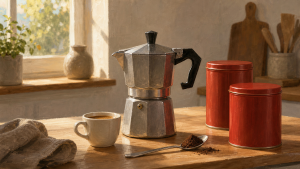
A moka pot is the best entry point. The moka pot, the brewing tool of Italian households, pairs well with the heft of a robusta blend. We recommend the following order.
① Start with a 20–30% robusta blend — Italian supermarket blends like Lavazza Crema e Gusto and Kimbo are representative. First feel the difference in crema and body.
② Once you're used to it, move to a Naples-style dark roast (Borbone Nera, etc.) — with a spoon of sugar, just the Naples way.
③ As your curiosity grows, take on 100% Fine Robusta — the point where the prejudice that "robusta = low grade" falls apart.
"100% Arabica" is used like a phrase for quality coffee, but it isn't the whole of coffee. In that black, intense cup emptied in two sips after stirring in sugar at a Naples bar, there's a kind of satisfaction arabica can't give. Robusta is not an inferior bean, but a bean with a different purpose. And Italians have known that purpose precisely, and used it accordingly, for over a hundred years.

댓글 0
첫 댓글을 남겨보세요.