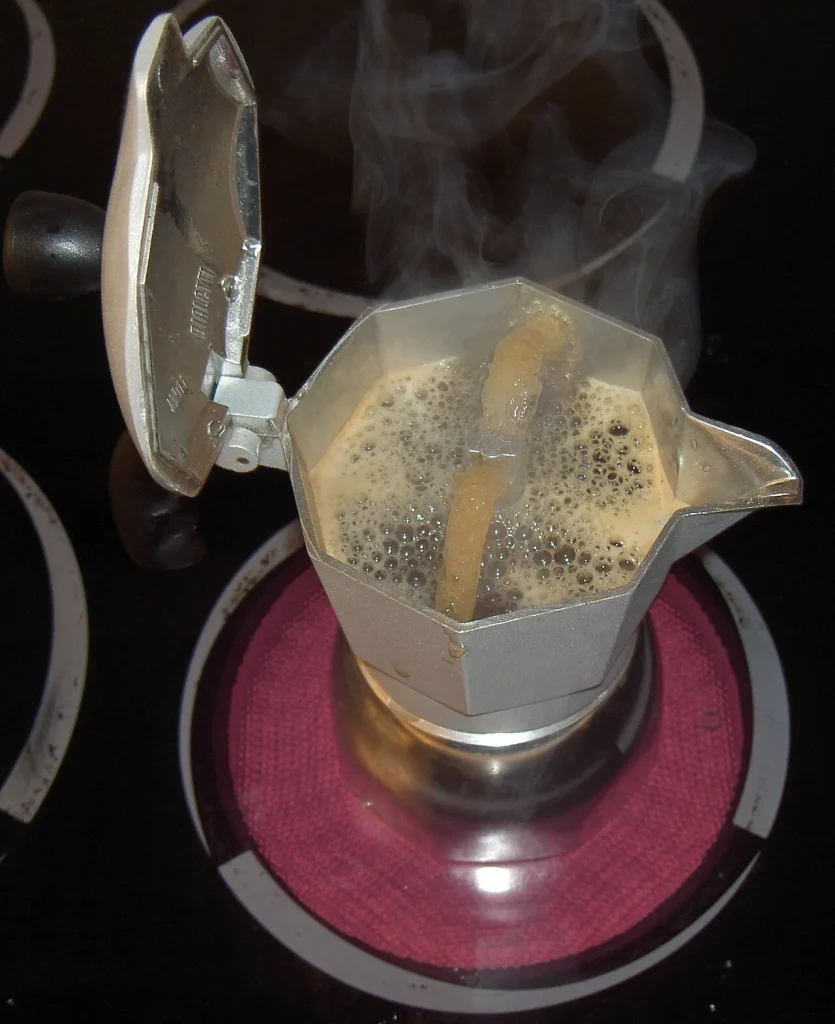
"With a moka pot, you turn off the heat the moment the water starts to boil." This is the most commonly circulated explanation in Korea. But if you trust only this and brew with a large 6-cup pot, something strange happens. No matter how long you wait, the coffee doesn't rise all the way up, and half the water is left in the boiler. So when exactly is the right time to turn off the heat? I went straight to the home of the moka pot, Italy, to find out how the locals handle this problem.

How Italians View the 'Heat'
From local coffee communities to roasters to the official Bialetti manual — the principle for handling the heat is almost the same. "Weak, and small."
The key isn't simply low heat but keeping the flame from going beyond the bottom edge of the pot. One Italian torrefazione (roaster) operator explains the reason this way. If the flame is large, the heat climbs up the side of the pot and overheats the still-empty upper chamber. That gives the coffee a burnt taste, and the rubber gasket also softens and deforms. The Bialetti manual also makes it clear that on induction or electric stoves, you should never use maximum heat and keep it at medium.
Sources: Bialetti official user manual, Italian torrefazione operator Q&A (Quora), accademiadelbar.it, etc.

The Timing to Turn It Off — The 3 Stages Locals See
Italian guides set the timing for turning off the heat not by time (minutes) but by 'stage'. To sum it up, here it is.
In fact, local outlets like amicidelcaffè advise to "reduce to the lowest when the coffee starts to come out, and turn it off when the spruzzo arrives," and cibo360 writes to "turn it off when a hint of bubbles appears, before all the coffee has come out." The Bialetti manual is simpler still: "when the upper chamber is full of coffee, remove it from the heat." Either way, they point to the point where extraction is nearly finished, not the 'first boil.'

So Why Is "Turn It Off as Soon as It Boils" Wrong?
Italian material that covers the science of the moka pot divides extraction into two phases. There's the 'normal extraction' phase where the tip of the funnel is still submerged in water, and the 'volcanic (vulcanico)' phase where the water drops below it and steam mixes in and erupts. The flavor we're aiming for comes out during the normal phase, while the volcanic phase is the point where over-extraction and burnt notes begin.
The problem is that "the moment the water starts to boil" is precisely when normal extraction is just beginning. If you turn off the heat here — especially in a 6-cup with a lot of water and high heat capacity — the remaining residual heat can't push the rest of the water all the way up. That's why half is left sitting in the boiler. This is the reason that "turn it off and finish with residual heat," which worked on a small pot, doesn't work well on a large one.
"Half My Water Is Left" — A Local-Style Diagnosis and Solution
In Italian communities, "il caffè non sale" (the coffee won't rise) is a frequent question. The order in which they pinpoint the cause is consistent, and transcribed as is, it goes like this.
| Order of Suspicion | Local Diagnosis | Solution |
|---|---|---|
| ① Heat | The heat was too weak, or you turned it off too early → the pressure didn't rise enough to finish extraction | Keep low heat until the bubble stage. For a 6-cup, bump it up one notch to medium heat |
| ② Grind/Packing | The grind is too fine or packed down firmly, creating a 'plug' so the water can't break through and rise | Use a coarse moka-specific grind coarser than espresso, without pressing, just leveled flat |
| ③ Parts | The gasket is worn or the safety valve is clogged, so pressure leaks or doesn't build | Replace the gasket, clean the valve |
Sources: boccadellaveritacaffe.it, perfectmoka.com, and other Italian coffee communities
One Emergency Trick Locals Use
There's a method Italians use when extraction stalls midway. Briefly dipping the bottom of the pot (the boiler) in cold water. According to one roaster's explanation, when it touches cold water, the boiling inside the boiler momentarily stops, and when you put it back on the heat, the pressure immediately rises again and pulls up the remaining water and coffee. When it seems blocked, lightly cooling just the base and then putting it back on often gets the remaining water to rise the rest of the way.
One-Line Summary
- Heat Level — weak, and small (don't let it go beyond the bottom). Medium for induction/electric, no maximum.
- Timing to Turn Off — not the first boil. Coffee starts to come out → reduce to lowest; turn off when it sputters as bubbles/steam with a "gurgle" sound.
- When Water Is Left in a 6-Cup — ① keep the heat going until the bubble stage (medium heat) ② if it still stalls, grind coarser + don't press.
- Emergency — if it stops, dip the base in cold water and put it back on.
- Normal — having 'just a tiny bit' of water left at the bottom is normal (the funnel is designed not to touch the bottom). 'Half' is a stalling signal.

In the end, the Italian answer is clear. The moka isn't a 'boiling' device but a 'pushing-up' device, and the heat merely supports that pushing-up with a small flame until the very last moment it turns into bubbles. Don't hastily turn it off at the first boil; wait until the sound and bubbles tell you. The water that used to be left half-full in a 6-cup will rise up cleanly.

댓글 0
첫 댓글을 남겨보세요.