
From a small body that fits in one hand comes SLR-class image quality that no one would doubt. This promise, which Ricoh threw down with the film camera GR1 in 1996, never once wavered all the way to the GR IV of 2025, thirty years later. Even as models changed and film gave way to a sensor, a single word — "snap" — held the backbone of the series together. This article traces those thirty years through the inside stories of how the products were born and the people who made them.
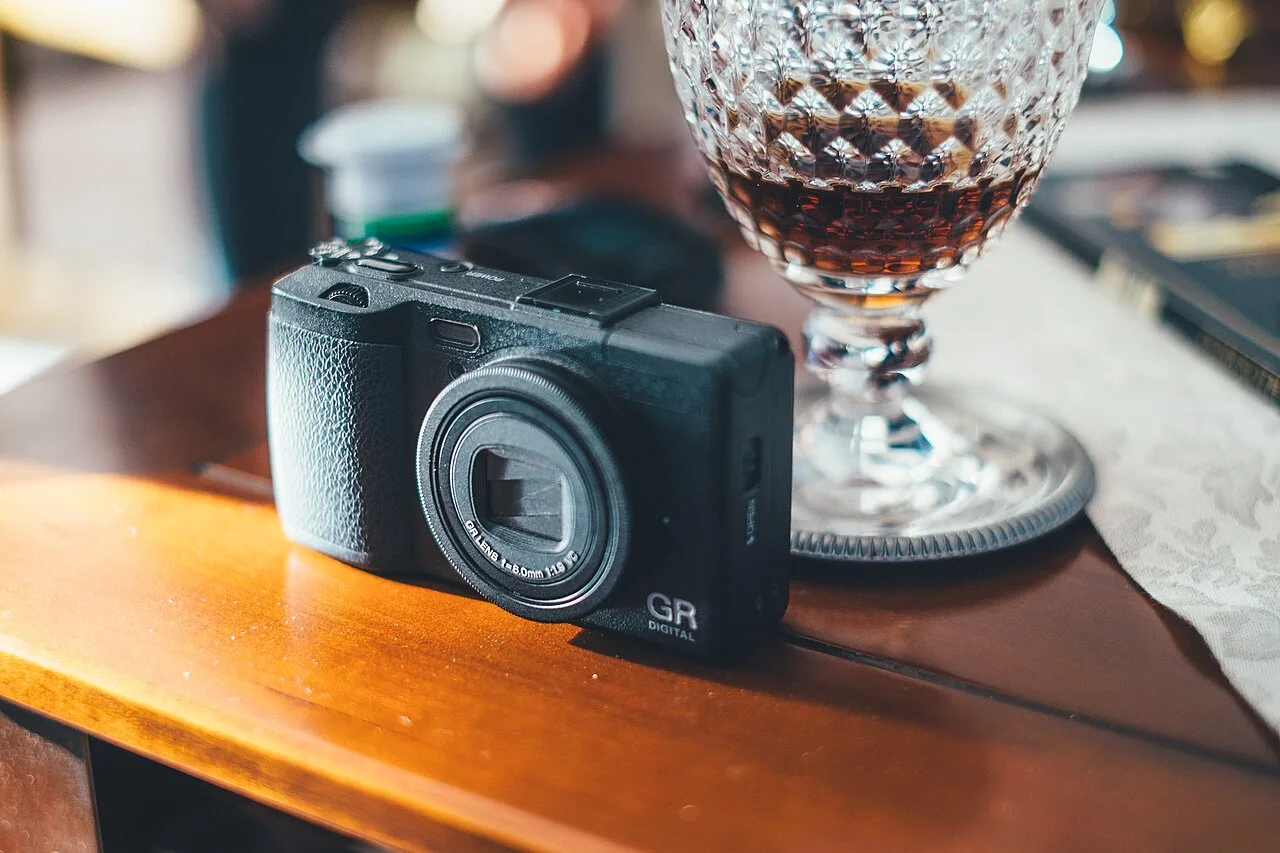
As it happens, 2026 marks the 30th anniversary of the GR1's release. In an age when the smartphone has swallowed nearly every camera, the fact that a single type of fixed-lens compact with a 28mm prime keeps drawing cult devotion and releasing new models in its 30th year is, in itself, close to an event. How was such a thing possible? Surprisingly, the starting point wasn't the GR1, but a popular compact camera that came two years before it.
PART 1 · THE FILM ERAFrom the R1 to the GR1 — a camera the pros asked for
1994 RICOH R1 → 1996 RICOH GR1
In 1994 Ricoh released a compact camera called the R1. With a 30mm f/3.5 lens, an aluminum exterior, and a panorama crop function, this camera was a commercial success. But some of the people who used the R1 — professional photographers in particular — asked the company for one thing: "Keep the image quality, but give us a version with more serious manual control."
Ricoh's answer to that request was the GR1 of October 1996. While using a viewfinder similar to the R1's, it placed a newly designed 28mm f/2.8 "GR lens" on a magnesium-alloy body. Ricoh was confident that this lens delivered performance surpassing even an interchangeable SLR lens of the same angle of view. More astonishing was the thickness. Even with 35mm film loaded, the body measured a mere 26.5mm thick. It was a hard-to-believe slimness for the time, and the GR1 soon became a byword for "the high-quality compact camera."

At first the GR1 was positioned as something like a "sub-camera" to the SLR. But more and more photographers made the GR1 their main camera, and before long even photo books "shot with the GR1" began to be published. "GR" became a brand, not just a model name. Years later, Tomohiro Noguchi of Ricoh's development team summed up the essence of the series like this.
The combination of high image quality and a small size — that is the identity of the camera called the GR. — Tomohiro Noguchi, Ricoh GR development team
An almost perfect lens, and the Leica-mount anecdote
There's a famous anecdote that shows just how well-made the GR1's 28mm lens was. After completing the lens, Ricoh's engineers themselves realized they had "made a 28mm lens that was overly well-corrected, and yet very small." That pride soon turned into action. In 1997, Ricoh released this GR lens separately as a prime in Leica screw mount (LTM). They reincarnated a lens designed for a compact camera as a limited-edition interchangeable lens that could be fitted to a Leica body. It's rare for a camera company to stake this much pride on the lens of its own compact.
The GR1 film lineup
GR1 (1996) → GR10 (1998, simplified entry model) → GR1s (1998, improved version) → GR1v (2001, the final form of the 28mm film GR, same optics + improved coating) → GR21 (2001, a 21mm f/3.5 ultra-wide version). The optical design of the 28mm GR lens was essentially carried over unchanged from the GR1 through the GR1v.
PART 2 · THE DIGITAL TRANSITION
"Make the GR1 digital" — a request that started inside the team
2005 RICOH GR DIGITAL
In the early 2000s, the digital camera market was caught up in a megapixel race. At first the very fact of being "digital" was the selling point, then it was "megapixels," and after that "the number of features." But the trend Ricoh's development team sensed was different. The market was shifting its center of gravity back to image quality. Hiroyuki Higuchi of the development team recalls that, just as the quality of digital photos was approaching film, talk of "let's make the GR1 digital" came up within the team. In his words, it was less an order than something closer to a "request."
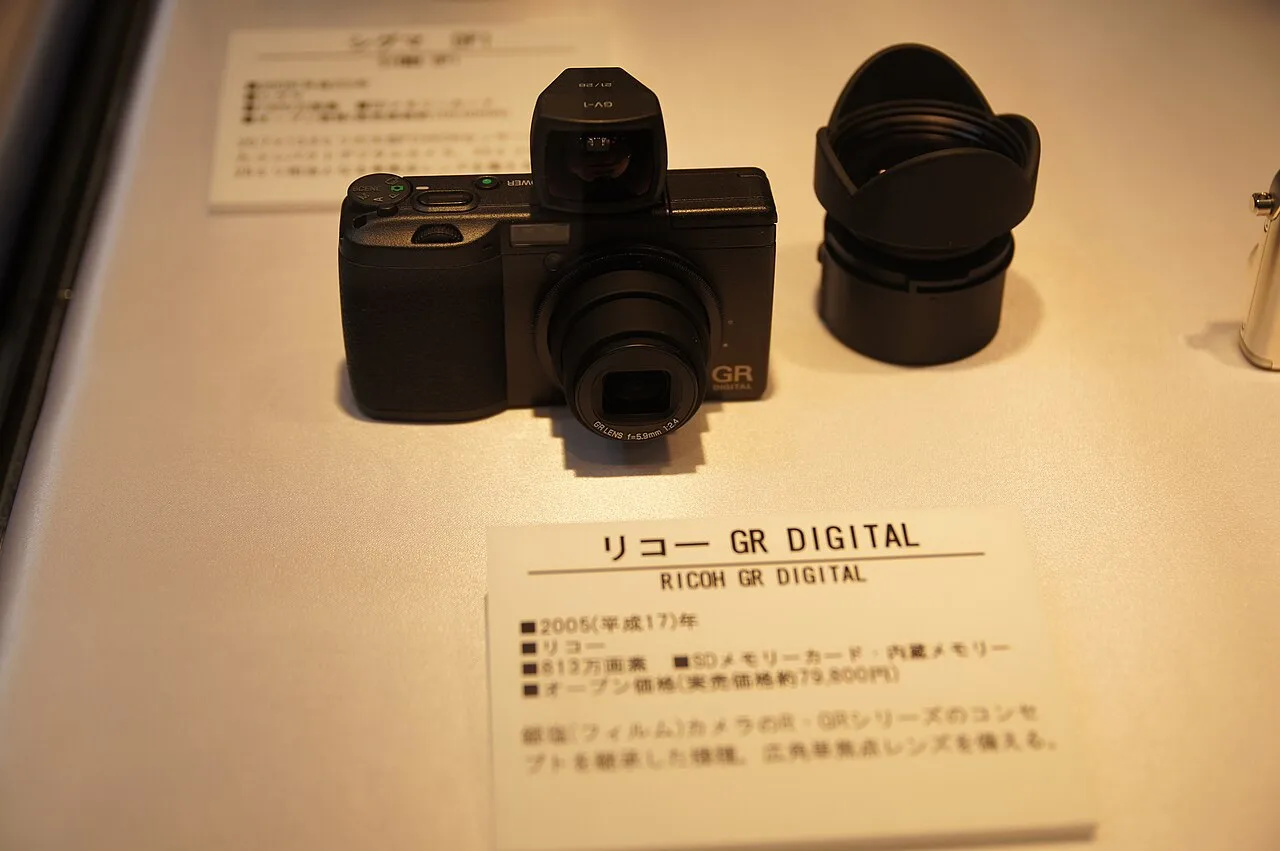
The result was the GR DIGITAL, released on October 21, 2005. With a 1/1.8-inch CCD sensor (about 8.1 megapixels) and a 28mm-equivalent f/2.4 lens, it transferred the film GR's compact body and intuitive feel of operation intact into digital. Among fans, the mere news that "the GR is going digital" stirred excitement. The fact that, even before release, users were already picturing their own GR DIGITAL in their heads — that itself was the power this brand held.
An interesting point is that, around the same time, Ricoh also ran an experiment called the GXR (2010). It had a unique structure that swapped the lens and sensor together as a module, and among them the 28mm-equivalent f/2.5 + APS-C sensor module was, in effect, a preview of the "APS-C GR." The confidence that it was possible to put a big sensor in a small body was built up at this time.
PART 3 · THE APS-C REVOLUTION
Dropping "DIGITAL" from the name — a sensor 9 times larger
2013 RICOH GR · 2015 GR II
In April 2013, Ricoh announced simply the GR, with "DIGITAL" stripped from the model name. On the surface it was the successor to the GR DIGITAL IV, but inside it was a completely different camera. The sensor, which had been 1/1.7 inch, was enlarged to APS-C size (about 16.2 megapixels). In area, it was a sensor roughly nine times larger. And yet, thanks to a retractable lens, when powered off it ranked among the thinnest in its class.

Even more striking was the price. Even though the sensor had grown nearly nine times larger, the suggested price was a mere $200 more than its predecessor, at $799. The 28mm-equivalent f/2.8 lens omitted the AA filter to maximize sharpness, backed by the GR ENGINE V engine. Critics responded with the phrase "DSLR image quality that fits in your pocket." The 2015 GR II was an incremental improvement that added Wi-Fi/NFC wireless connectivity to this.
PART 4 · DESIGN PHILOSOPHY
GR III and IIIx — "Everything had a meaning"
2019 GR III · 2021 GR IIIx
The 2019 GR III is the model in which the series' design philosophy comes through most clearly. Into a body one size smaller than the GR II, it packed a 24-megapixel APS-C sensor, the series' first 3-axis in-body image stabilization (IBIS), phase-detection + contrast hybrid AF, and a touchscreen. The core was still one-handed operation. By arranging every button and dial within reach of one hand, it physically embodied the GR creed of "a camera that keeps up with the pace of life."

The designer who has long been responsible for the GR's design, Toshiya Inaba, revealed the behind-the-scenes design stories of the series when the GR received the Invention Encouragement Award from the Japan Institute of Invention and Innovation in 2022. The sentence he stressed again and again was "Everything had a meaning." A few examples show that the GR isn't simple minimalism but "intended minimalism."
Details that carried meaning
· The grip leather embossing — after searching for a completely new pattern for the GR III, the pattern they settled on turned out to be almost identical to that of the very first film GR over 20 years earlier. The designer said he felt a renewed reverence for the original GR.
· The ridge line — the GR II's "C (chamfer) surface" was changed to an "R (round) surface" on the GR III. It was a decision reached after actually measuring how people hold the now-smaller body.
· The shutter button — being oval, it's easy to press and has a wide contact area. On top of that, the shutter button of the GR III and IIIx is tilted ever so slightly.
The GR's concept is "a tool for taking photographs." It is not a decorative accessory. — Toshiya Inaba, RICOH GR designer
Rejecting the conventional wisdom that "luxury = gleaming metal," the GR arrived at a different conclusion: matte black — a form for usability. When creating the body color, it even drew inspiration from Nambu tekki (南部鉄器), traditional Japanese ironware. Details like these weren't one designer's stubbornness; they reached mass production because there was close communication with the factory craftsmen.
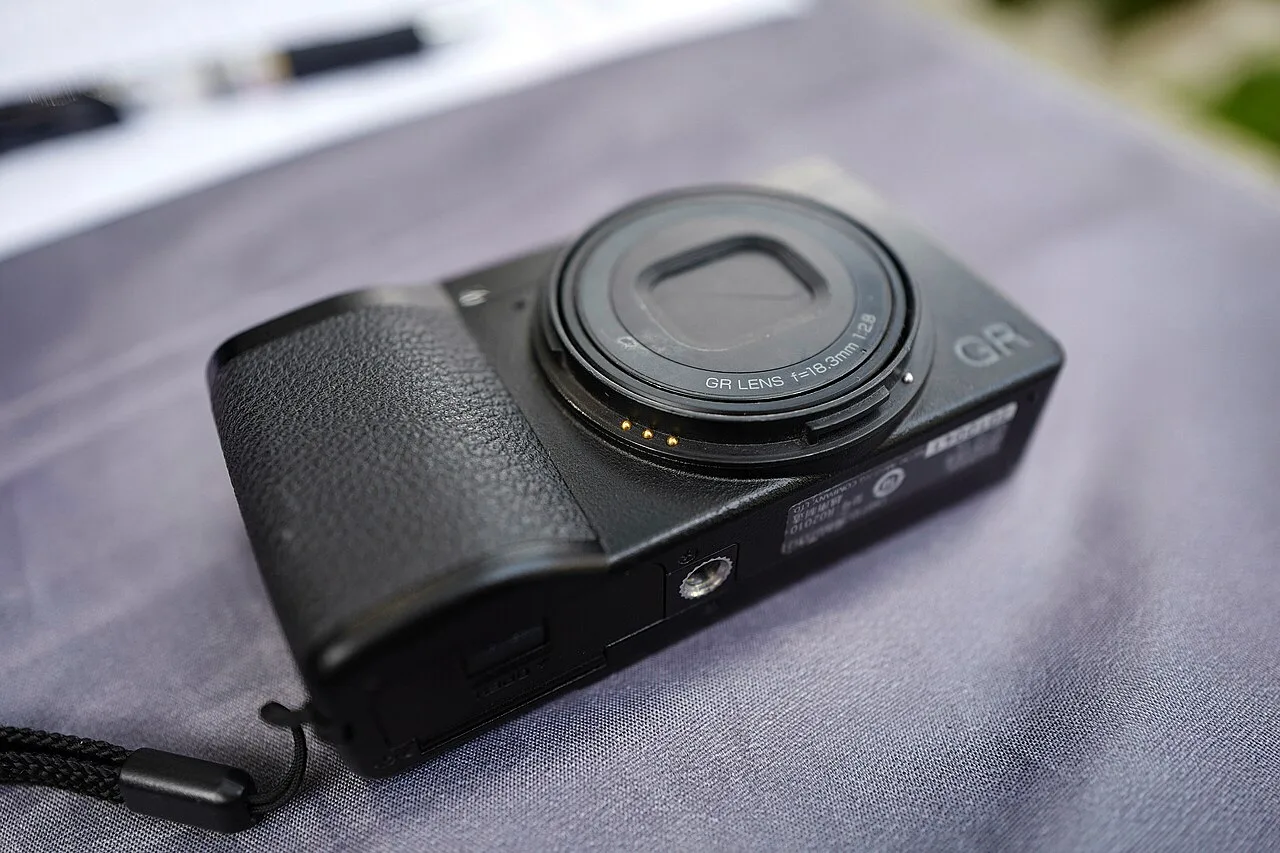
Snap Focus — "the soul of the GR," passed down since the film days
If you had to name the one feature that makes the GR a GR, it's unquestionably Snap Focus. If Leica holds its ground with the rangefinder, the GR does so with snap. Set a focus distance in advance (0.3m, 1m, 1.5m, 2m, 2.5m, 5m, ∞), and the moment you press the shutter, it shoots instantly at that distance without waiting for AF. It's the GR's implementation of what's known as zone focusing. Combined with the deep depth of field of the 28mm wide angle, just estimating the distance brings everything from 1.7m to infinity into sharp focus at once. There's a line the designer nailed down on the subject of distance — that snap is the unchangeable soul of the GR, present since the film days.
The 2021 GR IIIx was a variation that kept that soul but changed only the angle of view. For the first time in the series' history, it mounted a lens that was 40mm-equivalent rather than 28mm, opening up another branch better suited to portraits, table photos, and everyday snaps.

PART 5 · THE FINAL EVOLUTION
GR IV (2025) — every key component made anew
2025 RICOH GR IV
The GR IV was a long-awaited model. Its development was first announced in Paris on May 22, 2025 ("the ultimate snap camera in GR history"), formally unveiled on August 20 of the same year, and shipped from mid-September. The U.S. suggested price was $1,499.95. Recalling that the 2019 GR III was $899, the price point has clearly risen. Due to parts-supply difficulties, the GR III was discontinued in July 2025 (with the GR IIIx sold alongside for the time being), and the GR IV took over its place.
The heart of the GR IV is not a "refresh" but a "redesign." Lens, sensor, engine — all three of the key components that determine image quality were made anew.
① A new 18.3mm F2.8 GR lens
It keeps the 28mm-equivalent angle of view and F2.8 maximum aperture, but the optics were redesigned. It has a 7-element, 5-group configuration with three aspherical elements, and places a large-diameter glass-mold aspherical element in the rearmost lens. Using high-refraction, low-dispersion glass, it suppresses distortion and chromatic aberration while aiming for high resolution all the way to the edges, and as a result the body thickness was reduced further.
② A new BSI APS-C sensor + GR ENGINE 7
It carries a new approximately 25.74-megapixel back-side-illuminated (BSI) APS-C sensor and upgrades the engine to GR ENGINE 7. With Ricoh's proprietary Accelerator Unit added, it handles ultra-high sensitivity up to a maximum of ISO 204800.
③ 5-axis image stabilization (up to 6 stops)
It evolved from the GR III's 3 axes to 5-axis SR. The correction algorithm was greatly improved to handle pitch, yaw, and roll, as well as shift shake in macro work, correcting up to 6 stops at the center of the frame (CIPA 2024 standard).
④ 0.6 seconds — the fastest startup in the series
With a new lens barrel and an optimized startup sequence, it takes about 0.6 seconds from power-on to shooting, the fastest in GR history. The macro-switching and lens-stowing times were also shortened, reinforcing the camera's calling of "capturing the moment."
The controls were reworked too. The magnesium-alloy body became slimmer, and the rear thumb grip was sculpted for a firmer hold. The existing ADJ toggle became a dial type that turns as you press, and the +/− rocker switch of past GR generations was revived for faster exposure compensation. Built-in memory grew from the GR III's 2GB to a whopping about 53GB, and Bluetooth 5.3 + wireless LAN dual communication was tied together with the dedicated GR WORLD app for transfer and remote shooting. On the expression side, a Cinema mode (yellow/green) aiming for a nostalgic visual feel was newly added to the image controls, and 35mm and 50mm crop modes allow angle-of-view variations.
The GR IV's siblings — HDF and Monochrome
The GR IV didn't end with a single model. An HDF (Highlight Diffusion Filter) model with a built-in filter that softly diffuses highlights was announced for release sometime after winter 2025, and a GR IV Monochrome variant with a dedicated black-and-white sensor also appeared, drawing the attention of black-and-white photographers. The Monochrome model pushed the GR's identity as "the least conspicuous street camera" to the extreme, even changing the color of its exterior — turning the front GR logo black, too — to suit a black-and-white aesthetic.
A generation-by-generation comparison at a glance
| Model | Released | Sensor | Lens (equiv.) | Highlights |
|---|---|---|---|---|
| GR1 | 1996 | 35mm film | 28mm F2.8 | Magnesium, 26.5mm, TIPA award |
| GR1v | 2001 | 35mm film | 28mm F2.8 | Final form of the 28mm film GR |
| GR DIGITAL | 2005 | 1/1.8" CCD | 28mm F2.4 | The first digital GR |
| GR (APS-C) | 2013 | APS-C 16MP | 28mm F2.8 | Sensor 9×↑, AA filter removed |
| GR II | 2015 | APS-C 16MP | 28mm F2.8 | Wi-Fi/NFC added |
| GR III | 2019 | APS-C 24MP | 28mm F2.8 | First IBIS (3-axis), touch |
| GR IIIx | 2021 | APS-C 24MP | 40mm F2.8 | First 40mm angle of view |
| GR IV | 2025 | APS-C 25.7MP BSI | 28mm F2.8 | 5-axis SR, 0.6s startup, 53GB |
Why it has been loved for 30 years
Following the GR's history, what changed and what stayed the same come into sharp focus. Film became a sensor, the sensor grew nine times larger, and the pixels swelled from 810,000 to 25.74 million. Image stabilization came in, and the startup time shrank to 0.6 seconds. But 28mm, one-handed operation, snap focus, matte black — these four are just as they were in 1996.
That consistency is no accident. The GR1 was born from the requests of R1 users, the GR DIGITAL was born from a request within the development team, and the designer gave meaning to even a single leather pattern on the grip. In the end, the GR is a camera that clung obsessively to the single word "tool." That's also why the GR IV still holds meaning in an age where the smartphone has leveled all photography — a tool that powers on quickly, fits in one hand, and shoots the instant you press, as an extension of the photographer's consciousness.
In 2026, it will be exactly 30 years since the GR1 came into the world. Standing at the end of those 30 years, the GR IV is the most advanced and, at the same time, the most unchanged GR.
· RICOH IMAGING, GR IV official announcement materials and key specifications (us.ricoh-imaging.com)
· RICOH IMAGING, GR IV development announcement (ricohgr.eu, 2025-05-22)
· Ricoh Global, "Inside Story / Digital Cameras" — developer interviews with Noguchi and Higuchi
· RICOH Design, "Everything Had a Meaning" Behind the Design of RICOH GR — designer Toshiya Inaba
· Wikipedia, Ricoh GR film cameras / Ricoh GR digital cameras / Ricoh GR (large sensor)
· Casual Photophile, Japan Camera Hunter, DPReview, Digital Camera World, Pentax & Ricoh Rumors
※ Specifications and prices are based on official announcements and may vary by region and point in time. All images are CC-licensed photos from Wikimedia Commons, with the author and license noted in each caption.


댓글 0
첫 댓글을 남겨보세요.