
If you use fountain pens long enough, a moment comes when you stop loving the pen and start loving the company. Anyone who has ground a nib, swapped an ink, or taken a converter apart eventually runs into the philosophy of the place that made the pen. Japan's Pilot is one of those fountain pen makers you come to love "at the brand level." This article is an attempt to re-read Pilot not as the stationery giant behind ballpoints, FriXion, and Hi-Tec, but thoroughly through the eyes of a fountain pen lover.

A name that began at sea
Pilot's starting point was a single nib. Ryosuke Namiki, a professor of mechanical engineering at the Tokyo Higher Nautical School (now the Tokyo University of Marine Science and Technology), left teaching to set up a small factory near Tokyo and began making gold nibs. In 1918, founding the "Namiki Manufacturing" company together with his colleague Masao Wada marked the company's official first step.
What's interesting is where the name "Pilot" comes from. The two founders were lovers of the sea, and they took the name from the pilot/captain who guides a ship along a safe course. Even after the company changed its name to "The Pilot Pen Co., Ltd." in 1938, nautical symbols like the anchor, the helm, and the life ring remained deeply embedded in the brand identity. In effect, they saw the fountain pen as both a "writing tool" and "something that points the way."
The true significance of those early Namiki nibs lay in the culture of writing Japanese. Until then, kanji and kana were written with a brush, but as soft, springy gold nibs became able to mimic the thick-and-thin of a brush, the pen began to take over part of the brush's role. The saying "Pilot was a nib company from the very beginning" comes out of this.
.jpg)
Why fountain pen lovers trust Pilot nibs
The biggest praise Pilot receives among fountain pen enthusiasts is, surprisingly, not flashy. It's that "it writes well straight out of the box." A nib that flows evenly and reliably without any tuning or adjustment, an ink supply that hardly ever dries out, and consistent quality control. The reason collectors end up owning more Pilots than other brands is usually this "dependability."
The sense of nib width is worth knowing, too. Compared to Western brands, Japanese nibs tend to run one grade finer, so the advice to pick a nib one width broader than what you usually use circulates almost as established wisdom. An EF really is a thin line, and even an "M" is thinner than a European one. For Korean and Japanese users who prefer fine writing, this is actually part of the appeal.
Gold nibs use either 14K or 18K depending on the model. Generally, 18K feels softer and breaks in quickly to the user's writing pressure, while 14K gives a firmer, more defined feel. The Capless (Vanishing Point) uses 18K, while a good many of the Custom line use 14K, for example.
A nib universe: 16 writing experiences made by one company
If you boil the heart of a Pilot fountain pen down to one word, it's "nib." Counting steel, gold-plated steel, 14K, and 18K separately, there are no fewer than 16 kinds of nibs, and on top of that come the width options. The spectrum is wide — from the simple steel nibs in entry-level pens, to the vintage-feeling inset nib (E95s), the retractable Capless nib, and the special nibs that fountain pen lovers go wild over.
| Category | Nib | Characteristics |
|---|---|---|
| Standard widths | EF · F · FM · M · B · BB · C | From the fine EF to double broad (BB) and the broad Coarse (C). Overall a Japanese fine-writing tendency. |
| Soft family | SF · SFM · SM | At the same width, a bit of springiness is added for a softer feel and subtle line variation. |
| FA (Falcon) | Semi-flex | Designed with cutouts at the shoulders for light flex. Line width changes with pressure (watch for railroading). |
| WA (Waverly) | Upturned tip | The tip curves slightly upward, so it writes smoothly across a range of writing angles. |
| PO (Posting) | Extra-fine | An ultra-fine nib well suited for writing very small or onto absorbent paper. |
| SU (Stub) | Calligraphy | Thin on horizontal strokes, thick on verticals — it adds character to your writing. |
| MS (Music) | Three-tine nib | It started for notating sheet music, but it's loved as a kind of "beefed-up stub" for enjoying a thick line with a touch of flex. |
No discussion of special nibs can leave out the Falcon. Also called by its Japanese name "Elabo," this pen has a hooded nib shaped like a bird's beak, so it bends more softly and elastically than a normal nib. It isn't as dramatic as vintage flex, but it's regarded as the easiest way among modern mass-produced fountain pens to create "expression in the line." The fact that even within the same FA, the #10 (Custom Heritage 912) and #15 (Custom 743) differ in nib size and feel is a detail that those who dig deep into Pilot love to compare.
A map of the lineup: from entry pens to flagships, and the Capless
① The best "first fountain pen" — the entry line
KakunoMetropolitan(MR)Prera78GVarsity
The reason Pilot is so often named when recommending someone their first fountain pen is the high level of completeness in its entry pens. The Kakuno, with a smiling face engraved on the nib, is loved for its triangular grip that even a child can hold easily and its bright colors, while the Metropolitan (MR), with its hefty metal barrel, long held the spot of "the standard for value entry pens." From the small, portable Prera and the classic 78G, to the disposable Varsity that comes pre-filled with ink — the fact that even the entry pens have stable nibs is what makes them so very Pilot.
.jpg)
② The brand's home base — the Custom series
Custom 74742 / 743823Heritage 912845 UrushiCustom Urushi
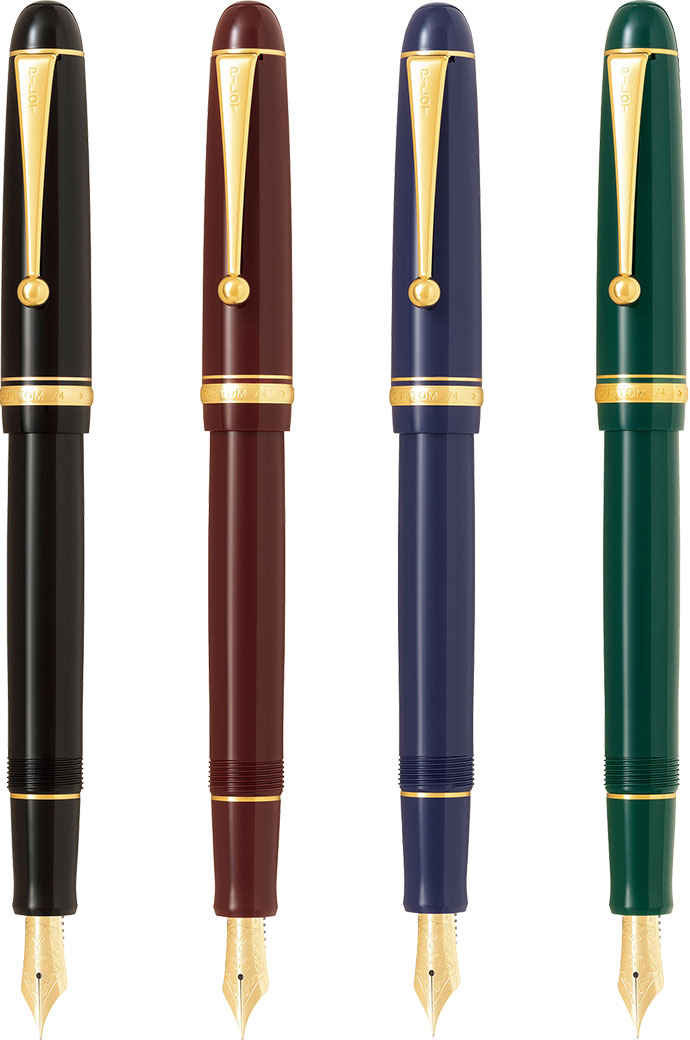
The place that shows "what kind of company Pilot can be" is the Custom line. The Custom 74 (#5 nib), commonly cited as the first gold nib for someone who has graduated from entry pens, charms with its classic cigar-shaped body and just-right bounce. The 742 and 743, fitted with larger #10 and #15 nibs, offer a rich array of special-nib options and become the stage for "nib play."
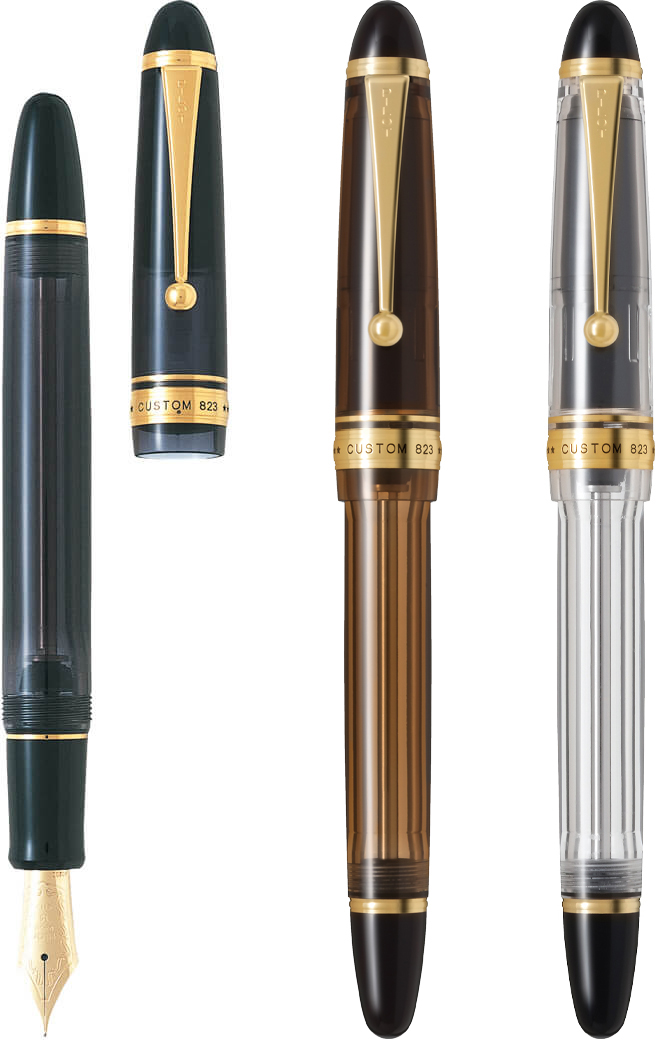
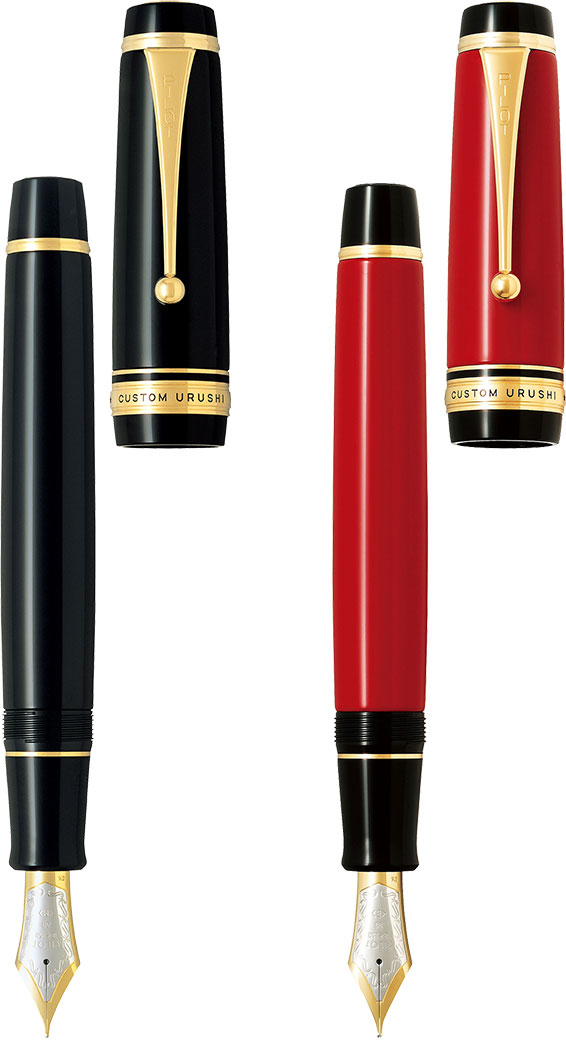
Among them, a regular on the fountain pen lover's wish list is the Custom 823. It houses a vacuum (plunger) filling mechanism inside a translucent body, so its ink capacity is large, and the more you write, the more decisive the benefit of not having to refill often. If you want to choose across nib sizes and widths, the flat-top Custom Heritage 912 awaits; if you want to see the pinnacle of lacquerwork, the 845 Urushi and Custom Urushi do.
The numbering convention in the model names is fun to know, too. The two-digit number means the release year counted from the founding (Custom 74 = 1992), and the last digit of a three-digit number means the price at launch (×10,000 yen). So the Custom 823 means it came out in 2000 at 30,000 yen.
③ Pilot's own invention — the Capless / Vanishing Point
CaplessVanishing PointDecimoFermo
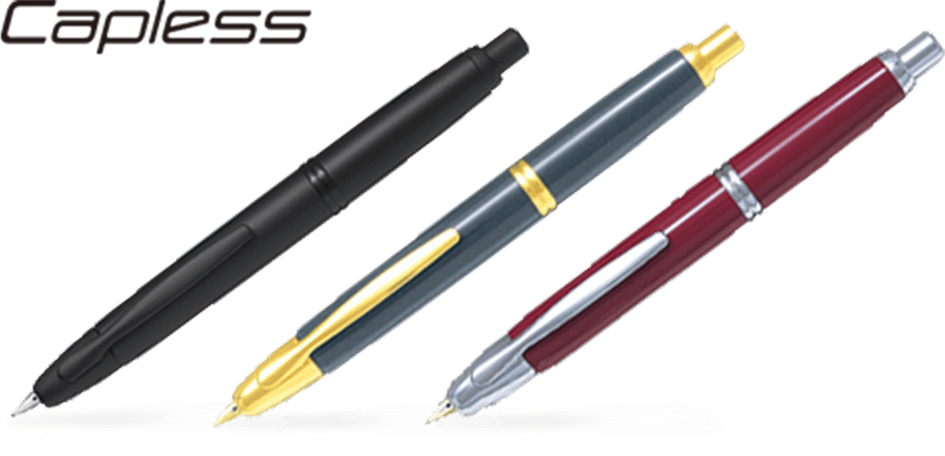
The Capless, which appeared in 1963, left a line in fountain pen history with the title "the world's first retractable fountain pen." In the U.S. and elsewhere it's called the Vanishing Point. Press the knock button like a ballpoint and an 18K gold nib springs out; press again and a shutter window rises to wrap the nib tip and keep the ink from drying. The idea of writing and putting it away instantly with one hand, no cap, shines especially for "people who write standing up," like medical staff who jot notes often.
On the downside, the clip sits at the grip section, so opinions split depending on where you hold it; for slimmer hands the thinner Decimo is an alternative, and if you'd rather deploy the nib by twist instead of knock, the Fermo is. Filling is done by pulling out the whole nib unit and using a CON-40 converter or a dedicated cartridge.
Five representative models: images, symbolism, and Japanese user reviews
Now let's take a deep look at the five pens that represent Pilot, alongside official images. Together with each model's symbolic meaning, I've organized actual Japanese users' assessments into Korean. (The user reviews are summaries and arrangements of evaluations from Japanese reviews and blogs, with sources noted.)

Ink and filling: the two axes that complete Pilot

Pilot is a brand serious enough about ink to have set up its own ink company early on. The pinnacle of that is the Iroshizuku line, introduced from 2007. The name is a compound of "iro" (色, color) and "shizuku" (雫, droplet), and it holds around 24 colors drawn from Japan's natural scenery — kon-peki (deep blue-green blue), shin-kai (deep blue-black), tsuki-yo (moonlit night), momiji (autumn leaves), and more. It flows smoothly and is gentle on the pen, making it easy to clean, and the oval glass bottle with its V-shaped groove is designed so you can dip the nib down to the last drop. That said, most aren't water-resistant or archival, so it suits everyday writing and journaling more than documents meant for permanent preservation.
The variety of filling methods is also so very Pilot. Most Customs use the cartridge/converter (CON-40, CON-70) system, but the 823 uses vacuum filling and the Heritage 92 uses piston filling. One detail — Pilot feeds are designed with the ink intake hole close to the nib tip, so even from a bottle with little ink left or a sample vial, filling is much easier without dirtying the grip.
Namiki and maki-e: where the pen becomes art
Pilot's luxury domain is handled by Namiki, which carries the founder's surname as is. Namiki pens are decorated with maki-e (蒔絵), the traditional Japanese lacquer craft of building up gold and silver powder and mother-of-pearl layer by layer over urushi (lacquer). This work is performed by hand by Kokkokai (国光会) artisans, and completing a single pen takes anywhere from several months to, at the longest, several years. No two pictures can ever be alike — it's literally "an artwork you can write with."
This tradition is no accident. By teaming up with Alfred Dunhill in 1930 to present maki-e pens to Europe under the name "Dunhill-Namiki," Pilot impressed Japanese craftsmanship on the West early on. The very fact that the modern Capless and the deeply handcrafted maki-e coexist within one company is what shows the breadth of the Pilot brand.
An at-a-glance summary for fountain pen lovers
This Pilot for this kind of person
· If you're looking for a first fountain pen → Kakuno or Metropolitan (MR)
· A pen to use for life as your first gold nib → Custom 74
· A heavy writer who hates frequent refills → Custom 823 (vacuum)
· Curious about expression in the line (flex) → Falcon (Elabo) or the 912 FA nib
· Want to write fast without a cap → Vanishing Point / Decimo
· Want to enjoy color → start with Iroshizuku ink
· Want one pen for a lifetime → Custom Urushi
It's a company more famous for ballpoints and FriXion, but seen from the fountain pen perspective, Pilot is "a brand that speaks through its nibs." A 100-year voyage that began with a single nib, went on to invent the retractable fountain pen, and embraced 24 colors of ink and maki-e that takes years to make. The fact that even if you start with a single entry pen, you end up voyaging through this company's nib universe may be a conclusion that lives up to the name (pilot).
The next step. If Pilot is new to you, start with a Metropolitan and a bottle of Iroshizuku. If that one pen wins you over, the course leading from Custom 74 → 823 → special nib (912 FA) → Custom Urushi opens up naturally.
Official fine writing introduction: Pilot Fine Writing


댓글 0
첫 댓글을 남겨보세요.