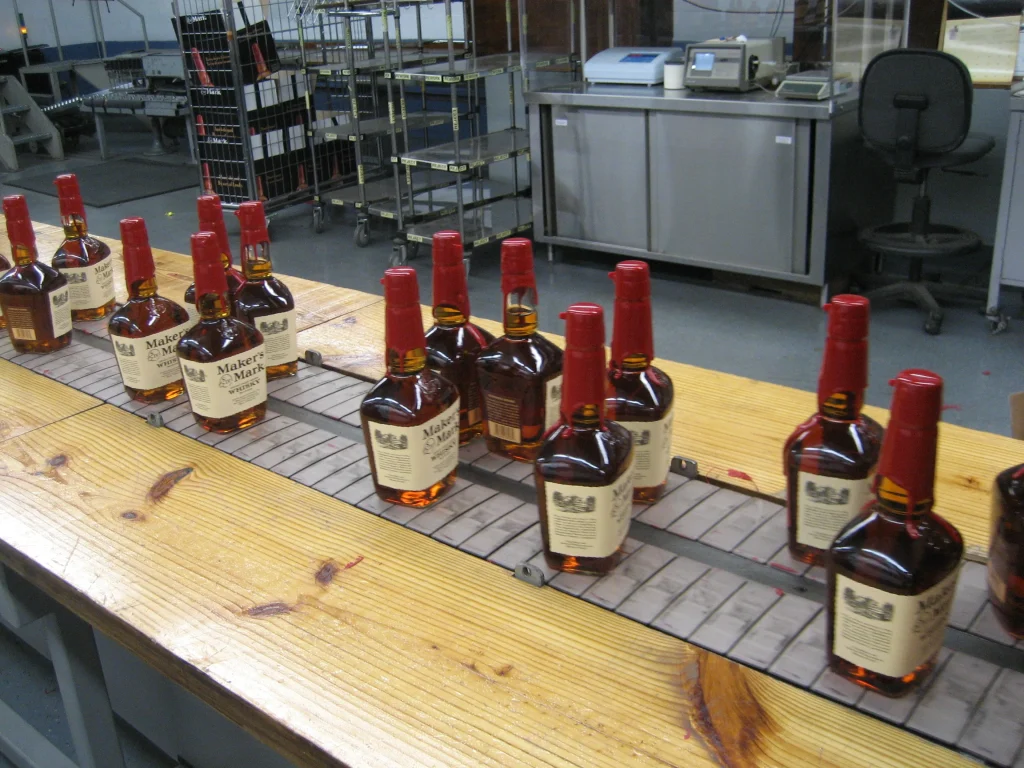
A bourbon that drops the rye in favor of soft winter wheat, a red wax seal dipped by hand one bottle at a time, and the stubborn practice of physically moving aging barrels up and down the warehouse by hand. Maker's Mark, a small distillery in Loretto, Kentucky, is a bourbon that chose "well" over "a lot." And that choice is what created the very idea of "premium bourbon."
In the world of bourbon whiskey, Maker's Mark holds a curious place. By volume it is no giant, yet whether you are just getting into whiskey or have been drinking it for years, that square bottle with red wax running down its neck is instantly recognizable. The flavor is remembered not for the sharp bite typical of rye bourbon but for the soft sweetness of caramel and vanilla, and every detail of the brand is stamped with one family's name. Maker's Mark is a rare whiskey that has kept the word "handmade" not as a marketing line but as an actual way of working.
The BrandBuilt on the Spot Where a 170-Year-Old Recipe Was Burned
The site Maker's Mark occupies in Loretto, Kentucky, is far older than the brand itself. Its history reaches back to 1805, when Charles Burks dammed Hardin Creek and built a gristmill and distillery here. That is why the distillery is registered on the U.S. National Register of Historic Places today under the name "Burks' Distillery."
The brand as we know it began in 1953. T. William "Bill" Samuels Sr., of the Samuels family who had been making whiskey in Kentucky for six generations, bought this old distillery for 35,000 dollars. The first thing he did was unexpected. He burned, without regret, the whiskey-making recipe that had been handed down through the family for 170 years — an old recipe that, in his own words, he never much liked. He wanted to design a more drinkable bourbon from scratch.

The Samuels couple named the site Star Hill Farm. Distilling began in 1954, and the first fully matured bottle reached the world in 1958 — wearing that now-famous red wax seal. Through the 1960s and 70s, Maker's Mark positioned itself as a premium bourbon with the cheeky tagline that it "tastes expensive — and is." In 1980, the distillery was designated a National Historic Landmark while still in operation.
Bill and Margie — A Couple Who Divided the Taste and the Face
Maker's Mark has two founders. Bill Samuels Sr., who designed the "taste" of the whiskey, and his wife Marjorie "Margie" Samuels, who created its "face." If Bill made a good spirit, it was Margie who made people pick it up in the first place. That is why the brand passes down the saying: "Margie is the reason people bought the first bottle, and Bill is the reason they bought the second."
Margie Samuels majored in chemistry at the University of Kentucky and was also a collector of English pewter. From the craftsman's stamp engraved on the bottom of pewterware — the "maker's mark" that guarantees its quality — she drew the brand's name. The square bottle shape, the label design, the typeface still used as the logo today, and above all the dripping red wax all came from her hands. Margie is said to have taken inspiration from the wax seal of a cognac bottle and dipped the first bottles herself, melting wax in the deep fryer in her own kitchen.

Margie's influence did not stop at design. She wanted the distillery to be not just a factory but "a place people go out of their way to visit," and she personally conceived the village-like scenery of black walls and red shutters. That is why she is credited with creating the starting point of bourbon tourism (distillery visits) as we know it. Margie became the first woman inducted into the Kentucky Bourbon Hall of Fame.
The RecipeWheat Instead of Rye — A Mash Bill That Chose Smoothness
The biggest choice that shapes the flavor of Maker's Mark lies in the grain. Most bourbons add rye as the second grain to corn, giving a spicy, peppery character. Bill Samuels parted ways here. Instead of rye, he used soft red winter wheat. Wheat replaces the sharpness of rye with a bread-like sweetness and a creamy texture, making a bourbon that is rounder and easier to drink overall.
The story behind this decision is also famous. With no time to distill and age each candidate mash bill (grain blend) for comparison, Bill is said to have baked bread with each blend and had the family taste it blind. That is how they concluded the rye-free blend tasted best. The wheated-bourbon know-how itself is said to have come with help from "Pappy" Van Winkle, the legendary figure of Stitzel-Weller. Today Maker's mash bill is generally described as roughly 70% corn · 16% red winter wheat · 14% malted barley.
Rye Bourbon
- Corn + rye
- Spicy and peppery
- Sharp spice nuance
Wheated Bourbon (Maker's)
- Corn + soft winter wheat
- Sweet, creamy, round texture
- Caramel · vanilla flavor
Hand-Rotated Barrels, Maturation Decided by Taste
As much as the mash bill, what makes Maker's so distinctly Maker's is its stubbornness about maturation and bottling. The most symbolic of these is hand barrel rotation. In the warehouse, the higher the floor, the greater the summer-to-winter temperature swing. After a certain period, Maker's moves the upper-floor barrels down to lower floors by hand, one by one, so that every barrel goes through a similar temperature history. It is a method most large distilleries have given up on because of cost — yet Maker's has actually doubled down on it in recent years.

The maturation period is not nailed down to a number either. The standard Maker's Mark carries no age statement, because release is decided not by "how many years" but by "taste." It is usually around six years, but it is bottled when the tasting team judges it ready. On top of that — much like the kinship that lent grain know-how — Maker's enters the barrel at a relatively low strength to mature, and uses spring water from Star Hill Farm, where Kentucky limestone filters out the iron. Finally, the red wax on every bottle is still dipped by hand at the Loretto distillery to this day. Even now that "small batch" has become a common marketing term, Maker's holds firmly to its own definition: a unit of about 20 barrels (under 1,000 gallons).
"We bottle not when it hits a certain age, but when the taste is ready."

A Look at the Flagship Lineup
For a long time Maker's Mark was close to a "single core product" brand, but since 2010 it has steadily expanded a set of premium expressions built around stave (wooden strip) finishing. Here is a rundown of the representative lineup.

Maker's Mark
The starting point of everything. The core bourbon made from corn, winter wheat and malted barley, bottled at 90 proof (45%). With its red wax and soft caramel-vanilla flavor, it is the face of "wheated bourbon."
Maker's Mark 46
The first serious variation, launched in 2010. Ten seared French oak staves are placed inside fully matured Maker's barrels for additional aging. A deeper expression with added vanilla and spice, it became the prototype for every stave finish that followed.
Cask Strength
Bottled at barrel strength with almost no water added. The same mash bill, but a richer, fuller-bodied Maker's you can experience at full intensity.
Cellar Aged
Using the cool, stable environment of a limestone cellar, this line captures more than ten years of long maturation without turning overly tannic. The brand's answer to "an older Maker's."
Private Selection
A custom barrel program in which stores and bars choose their own stave combination to create their own barrel. Five stave types allow more than 1,001 possible combinations.
Star Hill Farm Whisky
Maker's first American wheat whisky, debuting in 2025. A "vintage" series whose blend changes from year to year — and the one product that does not wear the brand's signature red wax.

Maker's Mark Today
Maker's Mark currently sits under Suntory Global Spirits, part of Japan's Suntory group. Yet the heart of the operation is still the Samuels family. Bill Sr.'s son Bill Samuels Jr. brought Maker's 46 into the world, and today his son Rob Samuels leads the distillery. Interestingly, although it is an American bourbon, Maker's insists on spelling "whisky" without the "e" on its label — a spelling that honors the family's Scottish roots. The star, "S," and "IV" placed at the center of the label likewise carry the meanings of Star Hill Farm, Samuels, and the fourth generation of distillers.
The red wax is more than mere decoration — it is also a legal asset of the brand. Maker's registered this dripping wax as a trademark in 1985, and in the 2000s it won a trademark lawsuit against a premium tequila that used a similar red wax. Margie's design, in other words, went on to defend the brand even in court more than 60 years later.
Meanwhile, Maker's is shifting its center of gravity toward land and agriculture — growing its own wheat and barley at Star Hill Farm and operating a "natural water sanctuary" that protects its own water source and watershed. The Star Hill Farm Whisky launched in 2025 being a vintage series that shows "how nature changes the flavor year by year" is an extension of that same spirit. The spirit that burned a 170-year-old recipe and redesigned a better glass from scratch is still alive today, right there in the hand-rotated barrels and the hand-dipped red wax.
Note · Compiled based on official materials from Maker's Mark and Suntory Global Spirits, Wikipedia (Maker's Mark, Margie Samuels), and reporting from specialist bourbon media. Vintage and limited lineups may vary in composition over time.


댓글 0
첫 댓글을 남겨보세요.