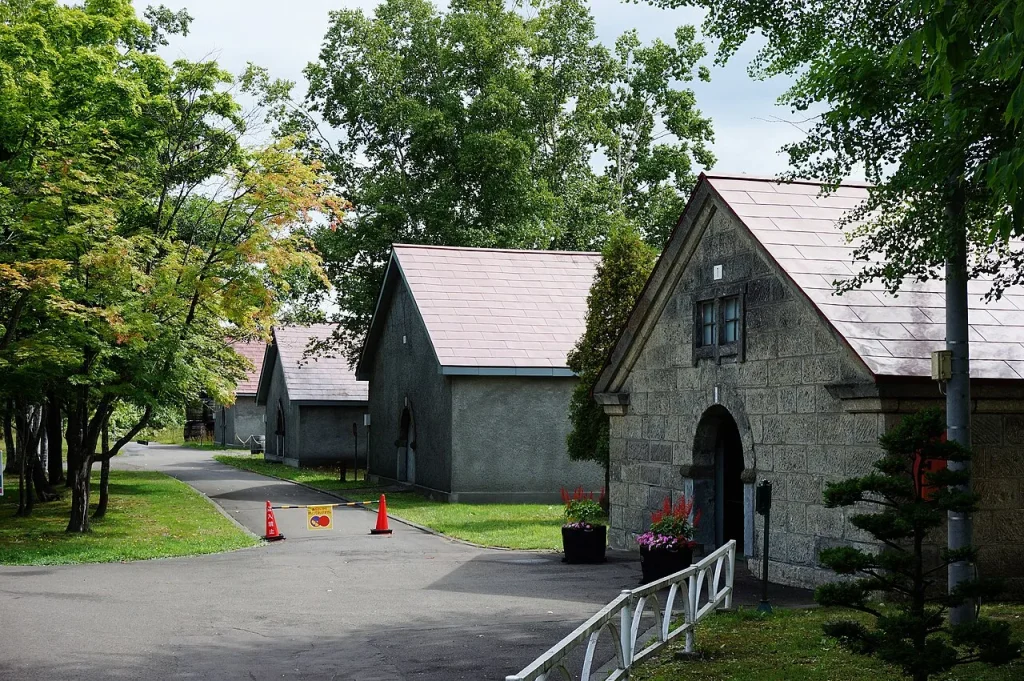
A young Japanese man who learned how to make whisky in Scotland built a distillery on the edge of Hokkaido, where the cold sea wind blows. Ninety years later, that stubbornness has become a genre of its own — 'Japanese whisky.' Nikka is the name that holds that beginning within it.
Ask a whisky lover to bring to mind 'Japanese whisky,' and usually two names come up. Suntory, and Nikka. If Suntory opened up the Japanese whisky industry commercially, Nikka is the brand that breathed a soul of 'Scottish authenticity' into that industry. Interestingly, the same single figure is entwined in the roots of both companies.
The BrandWhere East and West Met
The Nikka Whisky Distilling Company began with the company that Masataka Taketsuru (竹鶴政孝) established in Yoichi, Hokkaido in 1934. The company's original name was 'Dai Nippon Kaju (大日本果汁)' — a name that came from getting by selling juice made from local apples during the long time the whisky was maturing. Today's brand name 'Nikka (日果)' comes from an abbreviation of this 'Nihon Kaju (日本果汁)' (Japan Juice).
Nikka's identity is summed up by two malt distilleries located in the north of mainland Japan, Yoichi (余市) and Miyagikyo (宮城峡). That a single company runs two distilleries of opposite character and crafts depth from their combination — this is the way Nikka has kept for 90 years. Nikka is currently under the Asahi Group (Asahi Group Holdings).
The FounderMasataka Taketsuru and Rita
Born in 1894 into a sake-brewing family in Takehara, Hiroshima, Taketsuru grew up watching the work of brewing up close from childhood. Captivated by whisky, he crossed over to Scotland in 1918, studied chemistry at the University of Glasgow, and learned whisky-making methods firsthand on the floor of a distillery.
During his time studying abroad, he also met his lifelong partner. The Scottish woman Jessie Roberta 'Rita' Cowan. The two married in 1920 and returned to Japan together. After returning home, Taketsuru worked at Kotobukiya (later Suntory) and, together with Shinjiro Torii, led the construction of Yamazaki, Japan's first full-scale whisky distillery. And then in 1934, he finally established his own company and headed for Hokkaido.

Taketsuru is commonly called the 'father of Japanese whisky,' and Rita the 'mother of Japanese whisky.' Honoring Rita, who passed away first in 1961, Nikka released the blended whisky Super Nikka the following year. Taketsuru himself closed his eyes in 1979 at age 85, ten years after the completion of the Miyagikyo distillery. The love story of the two was depicted in the 2014–2015 NHK morning drama 〈Massan (マッサン)〉, sparking another Nikka boom in Japan.
Distillery 01Yoichi — The Robustness the Sea Made
There was only one reason Taketsuru chose Yoichi, a small port town in Hokkaido, as the site for his first distillery: it most closely resembled Scotland. Though the location was far from the mainland and inconvenient for logistics, he would not bend his principle of 'an environment suited to good whisky.'
Yoichi's biggest feature is the direct coal-fired distillation (石炭直火蒸溜) it still adheres to. This traditional method of heating the still directly with a coal fire of about 1,000℃ is a technique that has nearly disappeared worldwide today, and it produces a heavy, strongly aromatic spirit. On top of this, the sea wind blowing in from Ishikari Bay lends a subtle saltiness to the spirit as it matures. That's why Yoichi malt commonly passes as a whisky that is robust, smoky, and clearly peated.


Miyagikyo — The Elegance the Forest Made
In the 1960s, Taketsuru, buoyed by the success of his whisky, conceived of a second distillery. After more than three years of searching for a site, the place he chose was a quiet valley in Miyagi Prefecture, an hour and a half from Sendai. On this land surrounded by forests of conifers and maples and with clear water flowing through it, he sought to make a whisky of completely opposite character to Yoichi.
Indeed, Miyagikyo is the opposite of Yoichi in everything. Instead of a rugged coast, a serene forest; instead of direct coal firing, stills using a steam indirect-heating method. As a result, Miyagikyo malt is elegant, rich in fruit aromas, and delicate in texture. It's a soft style where the ester aromas created by carefully chosen yeast meld with the influence of sherry casks.

Another key asset that Miyagikyo holds is the Coffey still. This continuous still began operating at the Nishinomiya plant in 1964, was moved to Miyagikyo in 1999, and remains there to this day. The grain whisky made here is the core ingredient of Nikka's blended whiskies, as well as the foundation of the 'Coffey' line described below.
"Yoichi is crafted by the sea, Miyagikyo by the forest."
Two FacesOne Company, Two Faces
The reason Nikka's whisky is deep ultimately lies in this contrast. How the malts of two distilleries of differing character are combined with the grain whisky of the Coffey still — that art of blending is Nikka's identity.
Yoichi
- Direct coal-fired distillation
- Saltiness of the sea wind
- Robust · smoky · peat
Miyagikyo
- Steam indirect-heating distillation
- Forest and clear water
- Elegant · fruity · delicate
A Look at the Signature Lineup
Nikka's product range is broad. From entry-level blends to premium single malts, the representative expressions can be organized as follows.
From the Barrel
Released in 1985. After blending, it's matured once more in the cask (a 'marriage') and bottled at 51% ABV with almost no added water. With its heavy, rich flavor, it's a Nikka signature especially beloved in the West.
Taketsuru Pure Malt
A series named after the founder. A 'pure malt (blended malt)' mixing only the single malts of Yoichi and Miyagikyo without any grain, it's the expression that best shows the balance of the two distilleries.
Coffey Grain / Malt
The line distilled with the Coffey still. The corn-centered Coffey Grain is smooth, light, and sweet like honey, making it a great entry dram for bourbon lovers. Coffey Malt is characterized by toffee and citrus flavors.
Yoichi / Miyagikyo
Single malts that capture each distillery's character as is. Yoichi stands out with peat and smokiness, Miyagikyo with fruit aromas of sherry nuance. Perfect for comparing Nikka's 'two faces' side by side.
Super Nikka
A whisky that Taketsuru completed in 1962, immersing himself in blending to honor Rita, who had passed away. A classic blended whisky symbolizing Nikka's history.
Nikka Days / The Nikka
From the light, smooth daily blended (Days) to a premium expression (The Nikka), a lineup that's fine for both beginners and gifts.
Nikka Today
In 1989, Nikka acquired the Ben Nevis distillery in Scotland. That the descendants of Taketsuru, who had learned to make whisky in Scotland, conversely became the owners of a Scottish distillery is often spoken of as a 'story that came full circle.'
Meanwhile, as Japanese whisky gained worldwide popularity, the side effect of a spirit shortage also arose. Nikka, too, discontinued a number of age-statement products in the mid-2010s, and around 2016 reorganized its lineup into no-age-statement (NAS) versions. Furthermore, in 2021, as the Japanese industry established a labeling standard for 'Japanese whisky,' the discussion over what counts as real Japanese whisky also grew lively.
Even so, the essence of the story Nikka tells has not changed. Seeking out a better environment and accepting the inconvenience, adhering to traditional methods, and patiently combining things of differing character to create balance — that philosophy a young man brought from Scotland is still contained in every glass today.
References · Organized based on the official NIKKA WHISKY site, Wikipedia (Nikka Whisky Distilling, Masataka Taketsuru), and others.
댓글 0
첫 댓글을 남겨보세요.