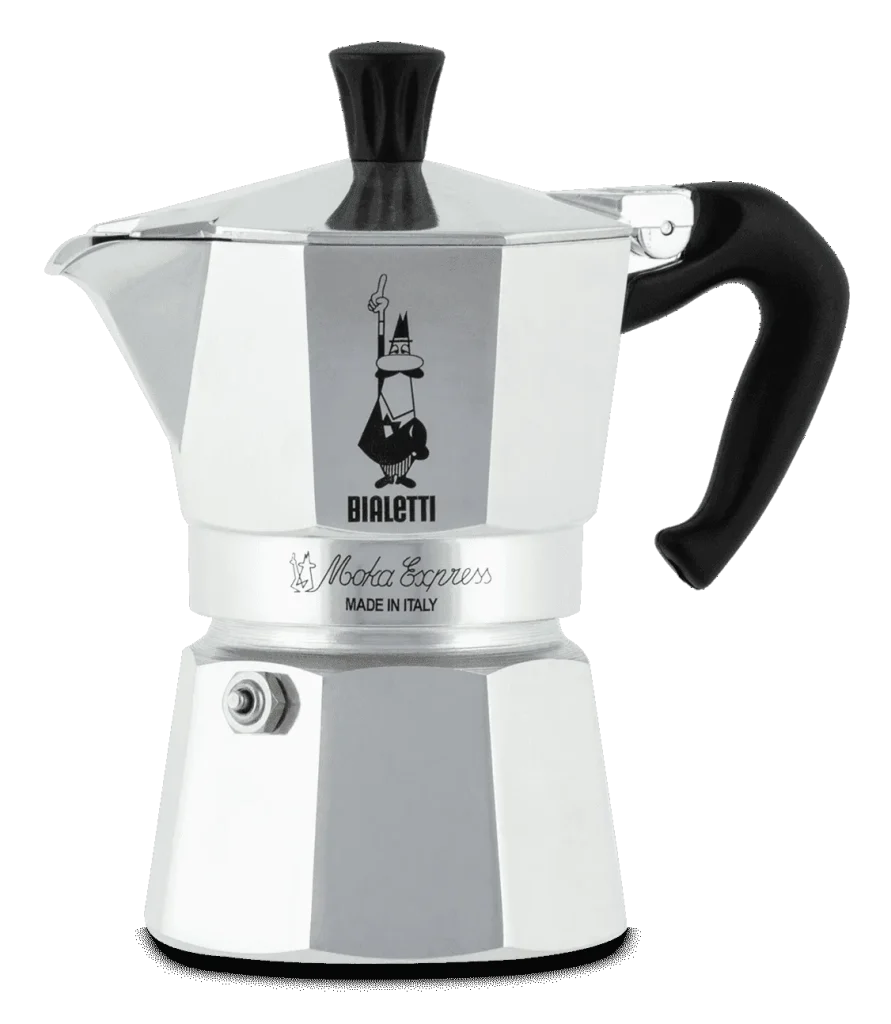
People buying their first moka pot usually ask the same thing: "So, how many cups should I get?" But peek into an Italian household's kitchen and the answer gets a little strange. There you'll usually find not one moka pot but two or three, lined up by size. It's not because they love coffee that much. Given how the device is built, it's simply the most sensible choice.
Here's the conclusion up front: a moka pot is not a device that "covers every situation with a single unit." It's closer to a tool where you swap sizes depending on how many people and what the occasion is. Let's break down why that is, and how to buy one in Korea without regret.
The "How Many Cups" Trap — Italian Cups and Korean Cups Are Different
Go to buy a Bialetti Moka Express and the sizes split into 1, 2, 3, 4, 6, 9, 12, and 18 cups. This is where the first misunderstanding begins. The moment we hear the word "cup," our minds picture a 200–350ml mug. "Six cups means six servings, so that should be plenty."
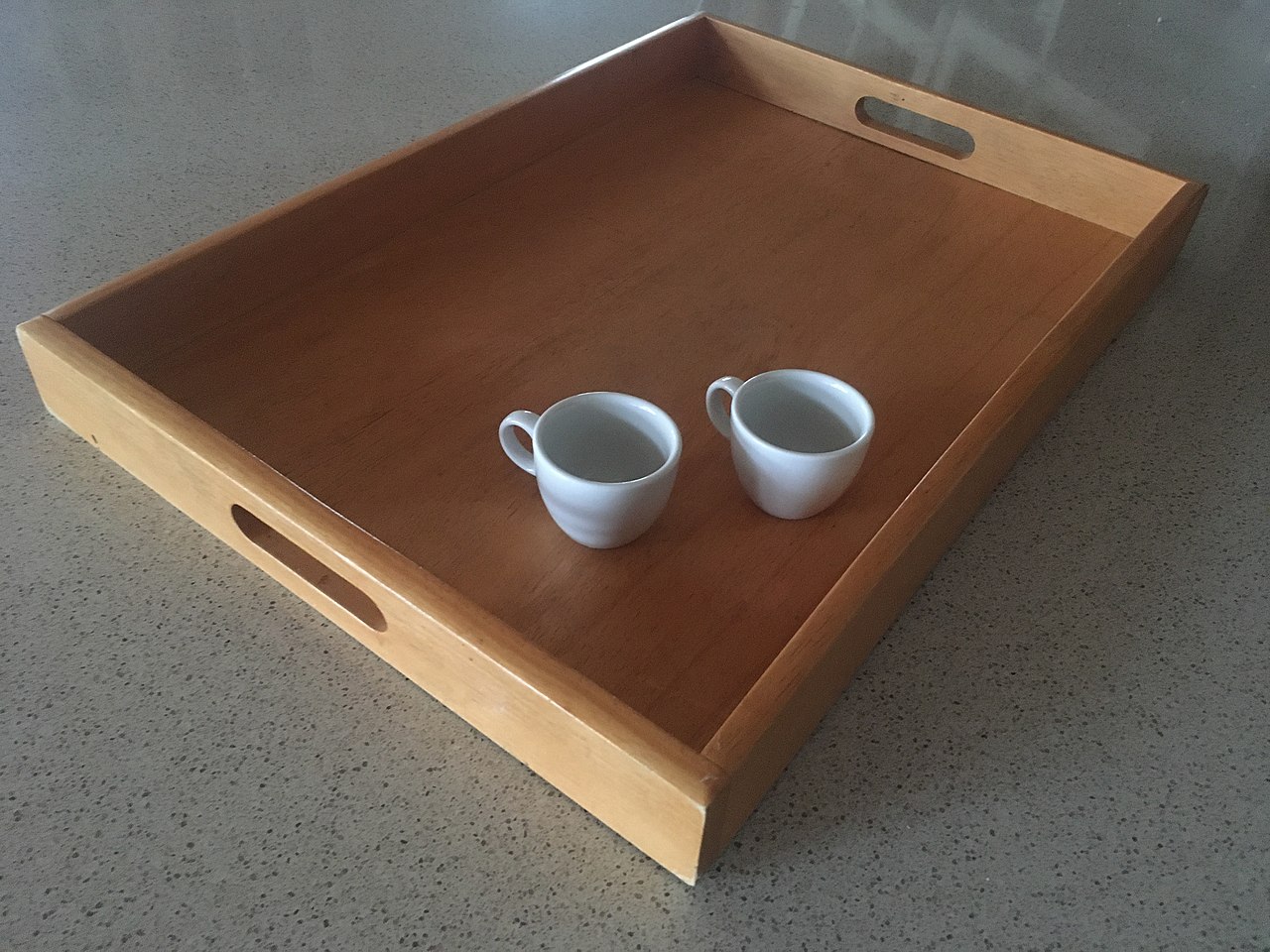
But the cup a moka pot refers to is tazza in Italian — that is, the palm-sized demitasse cup you drink espresso from. A single serving holds roughly 30–50ml. Not the mug we know, but a single sip of strong espresso. When an Italian says "caffè," this little cup is exactly what comes to mind.

So when you convert to "ml," the gap in perception becomes obvious at a glance. Taking one cup as about 50ml, here's the total yield by size.
| Label | Total yield (approx.) | In Korean-style mug terms |
|---|---|---|
| 1 cup | 50ml | 1 espresso |
| 3 cups | 150ml | 1 strong mug / 2–3 small cups |
| 6 cups | 300ml | about 2 mugs / 6 small cups |
| 9 cups | 450ml | about 3 mugs |
| 12 cups | 600ml | 4–5 mugs |
| 18 cups | 900ml | enough to share among several people |
In other words, "6 cups" isn't six mugs — it's about 300ml of strong coffee. Think of it as roughly two mugs' worth once you stretch it with milk or water. Not knowing this difference in units, people often pick "a generous 6 cups," only to find it's far too much to drink alone.
🇮🇹 The Italian View
1 cup ≈ 50mlOne demitasse (tazza). A strong sip, drunk standing, and done.🇰🇷 The Korean Sensibility
1 cup ≈ 250mlOne mug to set on your desk and sip slowly.Buying a 6-Cup Doesn't Mean You Can Brew Just 2 Servings
And here's the second key point. "Then I'll just buy a 6-cup and fill it halfway when I'm drinking alone, right?" — unfortunately, that doesn't work. A moka pot is a "fixed-volume" brewing device.
Look at the structure and the reason becomes clear. A moka pot divides into three parts — the boiler (water) at the bottom, the basket (ground coffee) in the middle, and the top chamber on top — and the capacities of these three parts are precisely matched as a single set. It's designed so the steam pressure created by boiling water pushes the coffee in the basket up exactly as intended.

So if you put only half the water and coffee into a 6-cup, two things break at once.
① Too little water means insufficient steam pressure. Put too little water in the boiler and it won't build up the pressure needed for extraction, leaving the brew half-baked. On top of that, the empty boiler walls overheat, making off-flavors easy to develop.
② An empty basket causes channeling. Fill the basket only halfway and the steam can't pass evenly through the coffee bed, leaking out through the empty space instead (channeling). As a result, some grounds get over-extracted and turn bitter, while others barely extract and turn sour. You end up with a muddy coffee that mixes bitter and sour in a single cup.
There are, of course, accessories like "half-volume reducer disks" for certain models, but they aren't standard, are hard to find, and produce inferior coffee. The conclusion is simple. If you want to make less, you need a smaller pot.
That's Why Italian Homes Have Several Pots
Now that opening scene makes sense. An Italian household keeping a range of sizes isn't a collector's hobby — it's thoroughly practical housekeeping. With a moka pot, "changing the size" means "changing the pot."
- One strong cup alone in the morning → a small 1-cup or 3-cup pot
- For two, or a big mug stretched with milk → 6-cup
- When family or guests gather on the weekend → 9-cup or 12-cup

On a weekday morning drinking alone, exactly one cup from the small pot; on a weekend when guests come, plenty from the big pot. Instead of getting by half-heartedly with one, you pull out the pot that fits the occasion. That's the only way to get the tastiest brew — "filled to its proper capacity" — every single time.
How Should You Buy One in Korea?
That said, there's no need to buy all three from the start. Based on Korean drinking habits (sipping slowly from a mug, often mixed with milk or water), here's a realistic order to buy in.
In short, you'll have fewer regrets if your first pot is sized small to match what you drink alone (around 3 cups). Don't fall into the "a generous 6 cups" trap. Then, as your coffee life deepens and you host more often, that's when you add one bigger pot. The moment you have a two-pot setup, a small one and a big one, like an Italian home — that's when you start to properly enjoy the moka pot.

In one line — the moka pot's "cup" isn't a mug but a 50ml espresso cup, and filling it halfway to make less is impossible. So when the number of people and the occasion change, you have to change the pot itself. That's why Italian homes have several moka pots.


댓글 0
첫 댓글을 남겨보세요.