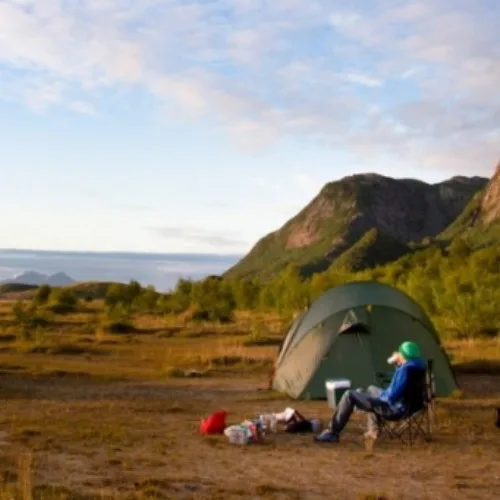
There's a tent that campers nickname "Geum-le" (Gold Gimle) — a blend of the Korean word for "gold" and "Gimle." It captures the idea that while it costs a pretty penny, once you own one you'll use it for years. Today we'll pull together everything about the flagship family tent from Norwegian premium outdoor brand Helsport, the Gimle Family 4+ — from the brand story to specs and features, honest pros and cons, and real-world reviews — all in one place.
BRAND MINI
Mini Deep-Dive — What Kind of Brand Is Helsport?
Helsport is a Scandinavian tent and sleeping-bag specialist founded in Norway in 1951. It introduced its first sleeping bag in 1954 and its first tent in 1957, and made its name in 1970 by launching the world's first tunnel tent. Over more than 70 years, the brand's identity has been built on weather resistance and rugged durability proven in the harsh Nordic climate.

Within that range, the Gimle series is the lineup that leads with "spacious, comfortable livability," making it especially beloved by family car campers. The red-roofed gable silhouette we so often picture is exactly the Gimle's signature. While the TAN color is familiar in Korea, in its homeland a calm olive green — like the one above — is also popular.
SPEC & FEATURE
Gimle Family 4+: Features and Specs
The Gimle Family 4+ is a model that adds a tall, wide vestibule (front space) to a classic tunnel structure. Inside the living-room-like vestibule you hang a single inner tent to use as a bedroom — a "docking" approach — and the biggest appeal is being able to handle both a living shell and a bedroom in a single tent.


Key Features at a Glance
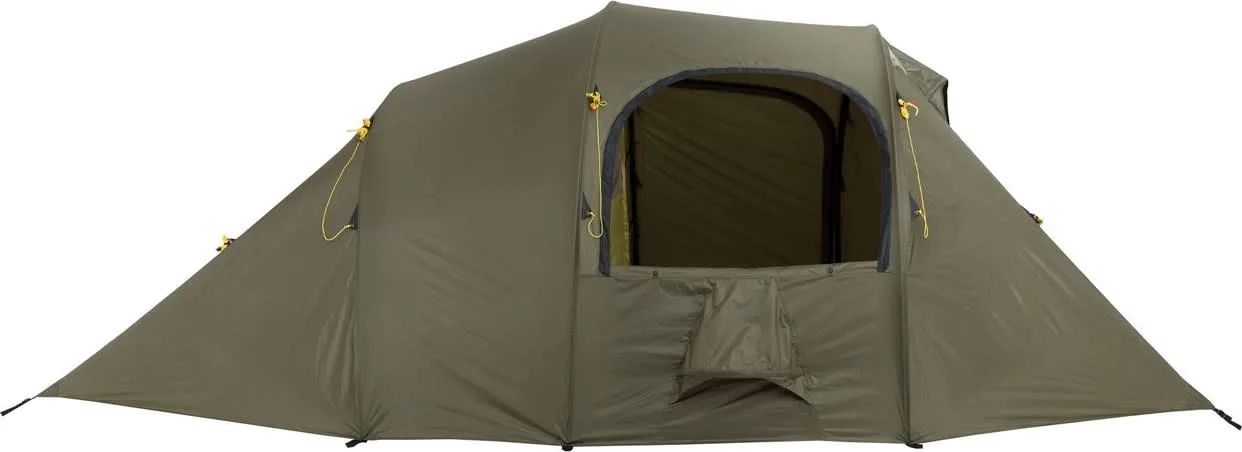
- Stable wind resistance — the tunnel structure plus tension lines means little movement even on windy sites.
- Tall ceiling and wide vestibule — high enough for adults to walk around standing up, making indoor life comfortable on rainy days.
- Three-sided ventilation design — ventilation points are placed in several spots to reduce condensation.
- Flame-retardant fabric — FR treatment offers relative peace of mind near a flame (but never let sparks make direct contact).
- Color-coded setup — the poles and sleeves are color-matched, so once you're used to it the tent goes up intuitively.
FLEX
Transform to Suit Your Group — the Vestibule Becomes a Living Room
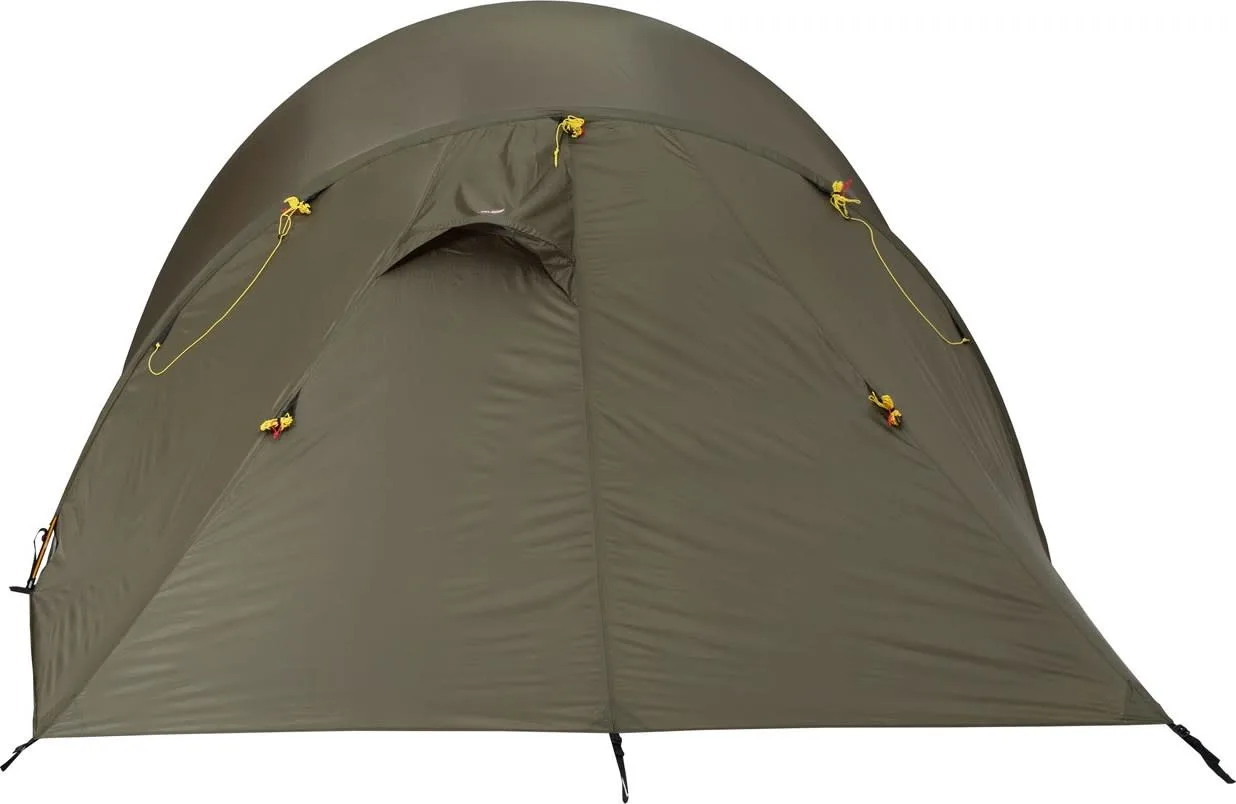
The real strength of the Gimle Family 4+ is its "flexibility." The base configuration is one 4-person inner tent hung at one end + a wide vestibule. Add an optional 2-person inner tent at the opposite end of the vestibule and you can sleep up to six in total. (The inner-tent attachment method changed from the 2018 model onward, so when buying make sure to choose an inner tent that matches your tent's model year.)

👨👩👧 4–6 people — hang the base 4-person inner tent plus an optional 2-person inner tent at both ends for six sleepers. The central vestibule becomes a shared passage and living room.
🧑🤝🧑 For 2–3 people? — Keep the base 4-person inner tent as a bedroom and use the spacious 180cm-tall vestibule as one big "living room." There's room to spare even with a table, chairs, and a mini kitchen spread out, so indoor life stays comfortable on rainy days. In other words, with a single tent you can move between a "4-person bedroom + living-room vestibule" (comfortable for 2–3) and "4 + 2 = 6 sleepers" (a big family).
4 vs 4+
Gimle 4 vs Family 4+: What's the Difference?
When researching the Gimle, the choice people agonize over most is between these two models. The answer depends on your camping style.
| Category | Gimle 4 | Gimle Family 4+ |
|---|---|---|
| Character | Compact & lightweight | Wide vestibule & livability |
| Recommended for | 2–3 people, minimalist / doubles as backpacking | 4-person family, car camping / long stays |
| Vestibule | Relatively small | Wide, can substitute for a living shell |
| Bulk & weight | Light and small | On the large, heavy side |

PROS & CONS
Honest Pros and Cons
👍 Pros
- The ruggedness and weather resistance typical of Nordic brands — many reviews say "buy it once and use it for 10 years."
- The vestibule + inner-tent docking handles both living room and bedroom in one tent.
- Reassuring stability in strong winds and bad weather.
- Highly polished design — a photogenic signature silhouette.
👎 Cons
- Price — the "Gold Gimle" nickname didn't come from nowhere.
- It's bulky and heavy, so setting up and packing down solo can be a bit of a burden.
- Condensation forms on days with big temperature swings — ventilation management is needed.
- It's not poly-cotton (a cotton blend), so watch out for sparks when using a fire pit or stove.
REAL VOICE
A Collection of User Reviews

Across the board, stability, livability, and design satisfaction are rated highly, while price and weight are repeatedly mentioned as the downsides.
BUY GUIDE
A Checklist for Choosing the Right Model for You

- Group size — Gimle 4 for a minimalist 2–3 people, Family 4+ for a 4-person family car-camping setup.
- Season — if you're looking at winter too, the Family 4+'s wide vestibule is better for heating efficiency.
- Transport — for car camping, bulk is less of an issue, but for backpacking the Gimle 4 has the edge.
- Setup crew — the Family 4+ goes up much more easily with two people.
- Budget — if a new one is a stretch, the used market is an option (be sure to check condition and pitching history).
CARE
Care Tips for Long-Term Use

- Store fully dry — packing it away wet causes mold and coating damage.
- Spot cleaning — dilute a neutral detergent and clean gently; no pressure washing.
- Pole care — wipe off dirt and moisture and regularly check for bends or damage.
- Re-coat the water repellent — when repellency drops, reinforce it with a dedicated water-repellent product.
FAQ
7 Real Questions About the Gimle, Answered
Q1Can I install a wood stove?
A.Not recommended. The Gimle Family 4+ is a polyester 3-season family tent with no stove jack for routing a flue. Specialist hot-tent resources abroad consistently explain that polyester and nylon tents have poorer heat resistance and breathability than cotton, making them unsuitable for routine wood-stove use (risk of spark damage and carbon monoxide). Even with flame-retardant (FR) treatment, that's merely a "harder to burn" process — it doesn't mean you can safely run a wood stove. For reference, Helsport itself recommends stove use not in the Gimle but in the vestibules of winter/expedition lines such as the Spitsbergen and Svalbard. If you need heat, rather than modifying the tent, consider an electric blanket, a heated mat, or safe heating with proper ventilation and a CO alarm.
Q2Is it suitable for a family of three camping?
A.Very suitable (in fact, on the roomy side). Since the inner tent is for four, three people have plenty of room to keep their gear in the bedroom too, and you can use the tall, wide vestibule as a living room in its entirety. That said, the packed bulk and weight (about 7.8kg+) are larger than a small tent, so it's no problem for car camping, but it can be a burden if you do a lot of walking.
Q3Are there any seam-sealing (waterproofing) problems?
A.By default it ships factory seam-sealed (taped). With Helsport's Rain Guard polyester fabric at 3,000mm water resistance on the body and 5,000mm on the floor, leakage complaints are rare in ordinary rain. Because polyester doesn't stretch much, there's also little need to re-tension the guy lines after setup — often cited as a plus. That said, on any tent the seam tape can lift after several years of use, so for long-term use, inspect the seams and reinforce with a seam sealer if needed.
Q4Does it avoid condensation?
A.It's a polyester tent, so under the right conditions condensation will form (it's the fate of almost all synthetic-fiber tents). However, the Gimle is designed to aid air circulation with its Airflow II ventilation system + two adjustable vents + a window, and many say condensation is comparatively easier to manage among synthetic tents. On days with big temperature swings, basic measures — opening the vents, circulating upper and lower air with a fan, and laying a groundsheet smaller than the tent footprint — can reduce it considerably. If you want cotton or poly-cotton, where the fabric itself holds moisture and condenses less, that's simply a different material category to begin with.
Q5There's no skirt — won't it be cold?
A.The Gimle has no snow skirt. In three-season use, the lower-edge airflow actually reduces condensation and stuffiness, so it's not much of an issue. But in midwinter, cold drafts entering through the gap at the bottom of the tent can lower the felt temperature. To use it in winter, block floor cold with a footprint or groundsheet and seal the bottom gaps with mats or gear, or supplement with heating. Just keep in mind that sealing the bottom too tightly reduces ventilation and raises the risk of condensation and CO, so balance is needed.
Q6Is it suitable for winter?
A.Think "late autumn to early winter car camping" — fine; "full-on cold snaps and heavy-snow expeditions" — not suitable. The Gimle is ultimately a three-season family tent, so with adequate heating and floor insulation you can fully enjoy light winter camping. But with its single-wall polyester, lack of a skirt, and mesh inner, it has limits in extreme winter. Helsport itself keeps dedicated lines like the Spitsbergen X-Trem and Svalbard separate for true winter and expedition use.
Q7How's the durability?
A.Well regarded. Befitting a 70-year-old Norwegian brand, there are many reviews along the lines of "buy it once and use it for years," and it has a reputation for ruggedness — if Hilleberg is the Ferrari of tents, Helsport is often likened to a Mercedes. Polyester has somewhat lower tear strength than nylon but resists UV and stretch deformation well, giving it good shape stability, and thanks to its proprietary pole-channel structure there's little movement or noise in strong wind. With proper care — fully-dry storage and pole/zipper checks — it's counted among the tents you can use for a long time.
※ The specs and prices in this article may vary depending on configuration (whether the inner tent and footprint are included) and timing, so confirm with an official importer or retailer before purchase. The FAQ is reference information synthesized from retailer and camping-community resources worldwide. Product image sources: Interpark/Danawa, Fjellsport (Norway), and OutdoorFair product pages.

댓글 0
첫 댓글을 남겨보세요.