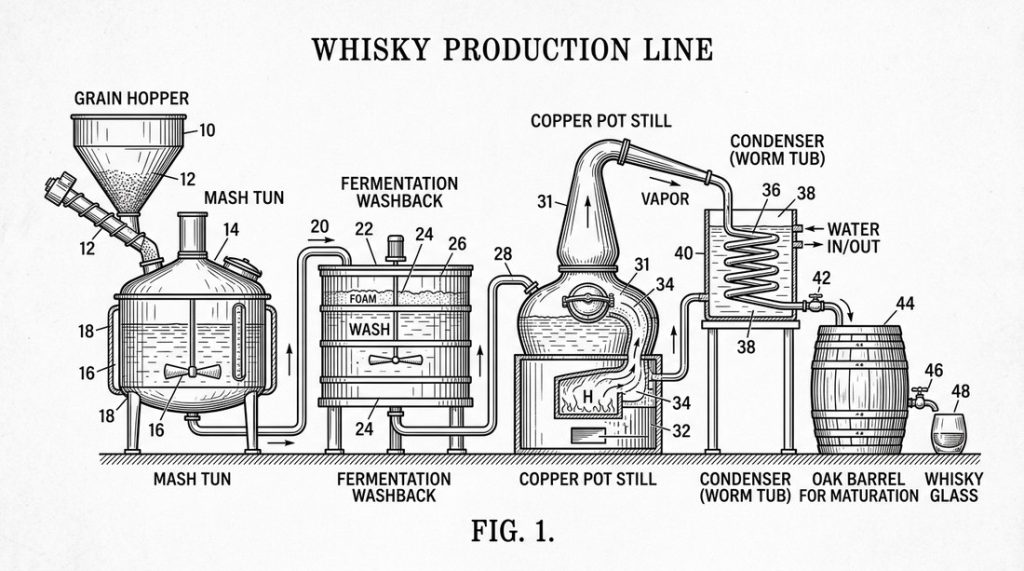
If you drink whisky for a while, at some point you start to wonder: "Where on earth do this aroma and flavor come from?" Half of the answer lies in distillation. In this article, we'll follow the whole process by which whisky is made, then slowly unpack what its heart — distillation — actually is, and the two distillation methods that divide a whisky's character — pot still and continuous, together with patent-drawing-style illustrations. If you've just gotten into whisky, this one article should give you the big picture.
The 6 Stages of Making WhiskyFrom a single grain of barley to a glass of amber
In the end, whisky is a spirit brewed from grain, distilled and then matured in oak casks. Taking malt whisky as the reference, it goes through roughly six stages. Each stage leaves a little trace on the aroma and flavor.
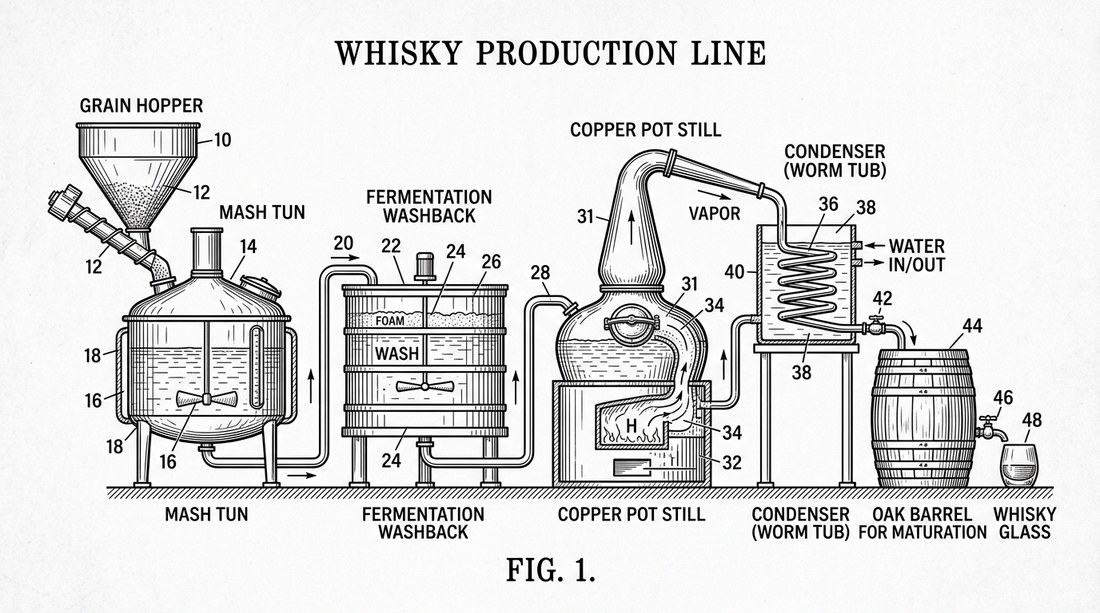
- MaltingBarley is soaked in water to germinate, then dried to make "malt." Enzymes form, and burning peat adds smokiness.
- MashingThe malt is ground and mixed with warm water, yielding a sweet "wort" in which the starch has turned into sugar.
- FermentationAdding yeast turns the sugar into alcohol. It becomes a "wash" of about 7–8% ABV (similar to beer).
- DistillationBoiled in a still to concentrate the alcohol and aromas. The key stage where the whisky's character is decided.
- MaturationYears to decades in oak casks. The once-clear spirit gains its amber color and deep flavor.
- BottlingThe strength is adjusted, it's filtered and put into bottles, and at last a single glass is complete.
From Grain to SpiritMalting · Mashing · Fermentation
It begins with barley. You can't make a spirit from plain barley alone. You need enzymes to convert the starch inside the barley into sugar, and these enzymes form when the barley sprouts. So malt is barley that has been soaked in water (steeping) to germinate, then dried in a kiln to stop the germination. If you burn peat during drying, its distinctive smoky aroma is layered in.
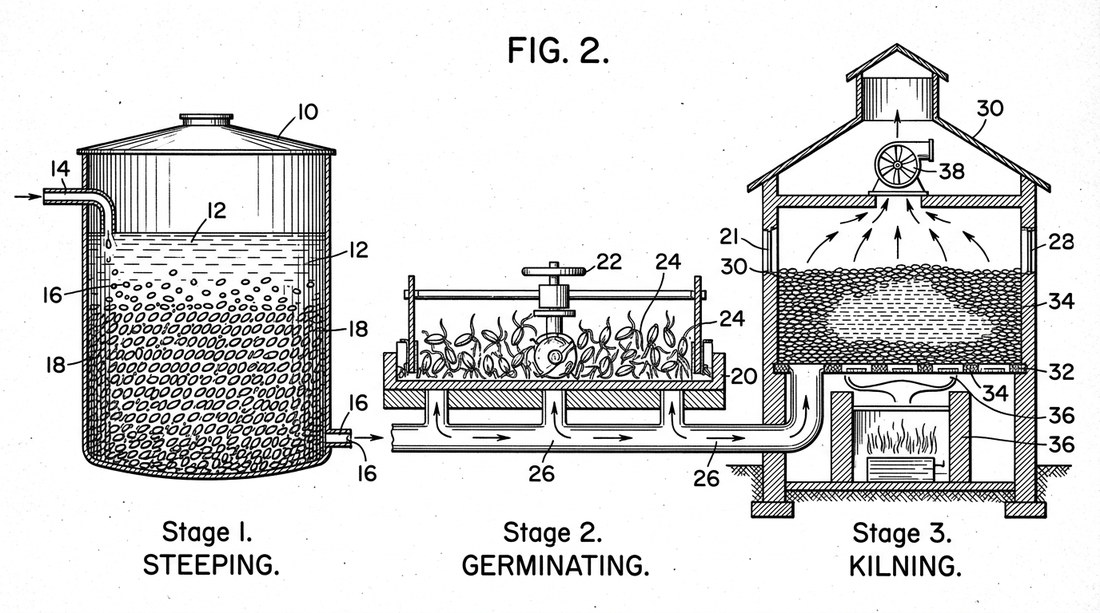
When the dried malt is finely ground, put into a mash tun, and mixed with hot water, the enzymes break the starch down into sugar and a sweet liquid is drawn out. This malt extract is the wort. It's the stage of preparing the "food" the yeast will eat and grow on.
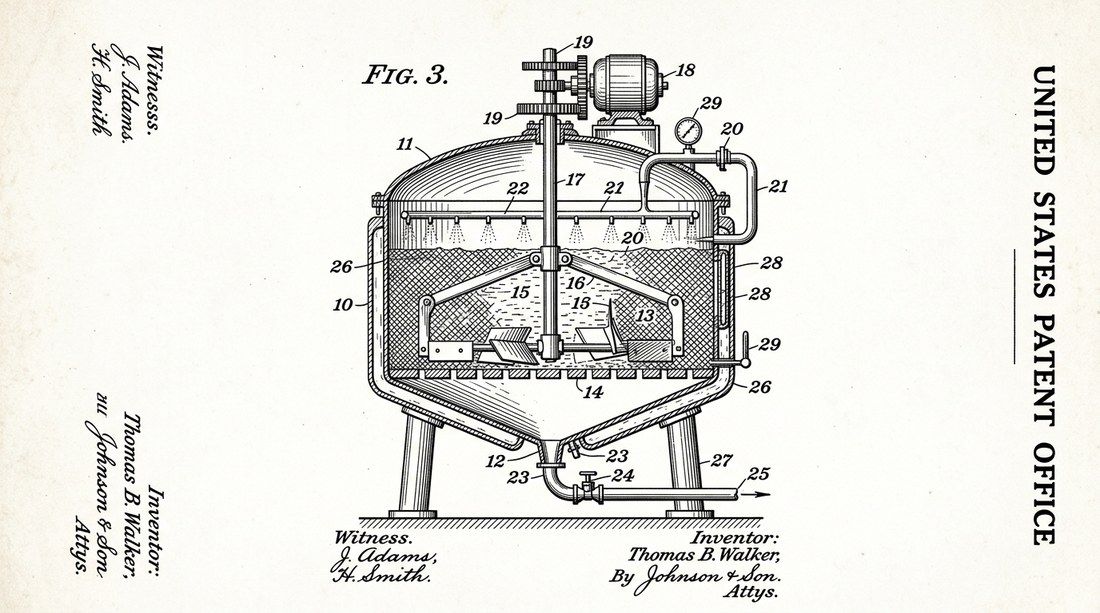
When the cooled wort is moved to a washback and yeast is added, the yeast eats the sugar and releases alcohol and carbon dioxide. A few days later, a wash of 7–8% ABV is complete. It's essentially beer without hops. Up to here it's a "fermented drink"; from the next stage on, it becomes whisky-like.
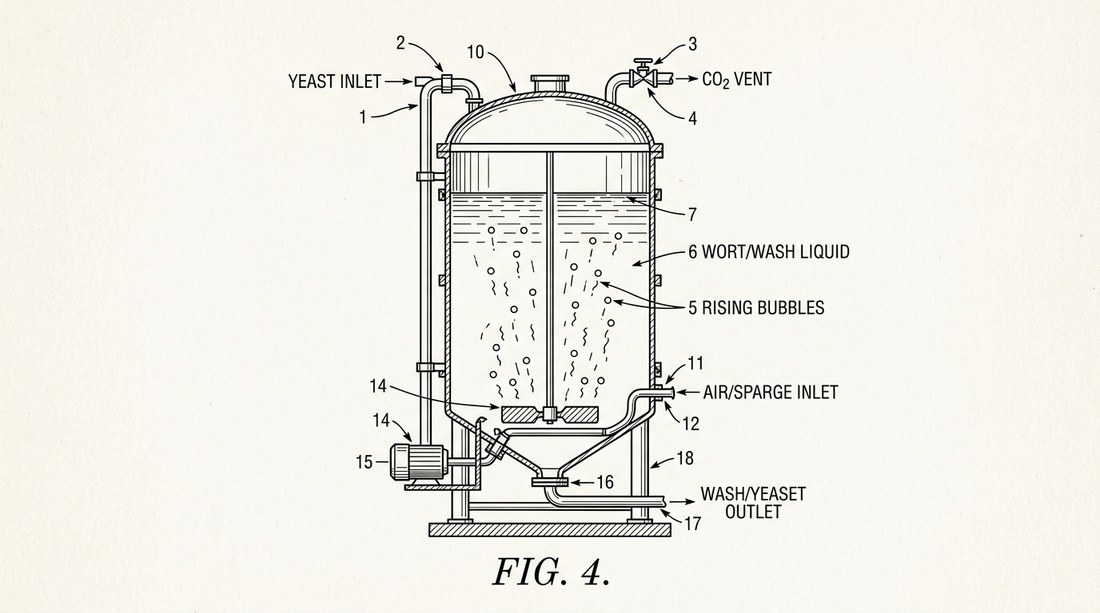
Distillation — the Heart of WhiskyIt uses the difference in boiling points
The strength of the wash is still at beer level. The magic that turns it into whisky is distillation. The principle is surprisingly simple. It uses the fact that alcohol and water have different boiling points. Alcohol (ethanol) boils at about 78°C, water at 100°C. When you heat the wash, the alcohol turns to vapor and rises before the water; collecting and cooling this vapor yields a liquid with a much higher alcohol concentration.
Distillation doesn't "create" something new;
it selects, gathers, and concentrates the alcohol and aromas already there.
But there isn't just one way to "select and gather." Depending on which still you use, a whisky's character changes completely. There are broadly two methods: pot distillation and continuous distillation.
① Pot Still DistillationThe traditional method for malt whisky
It's a batch method in which the wash is filled one potful at a time into a copper pot still and heated. The vapor rises up the round body, passes through the swan neck and the lyne arm, and becomes liquid again in the condenser. Usually it's distilled twice: the first run (wash still) makes a "low wine" of about 20% ABV, and the second run (spirit still) raises it to around 70%.
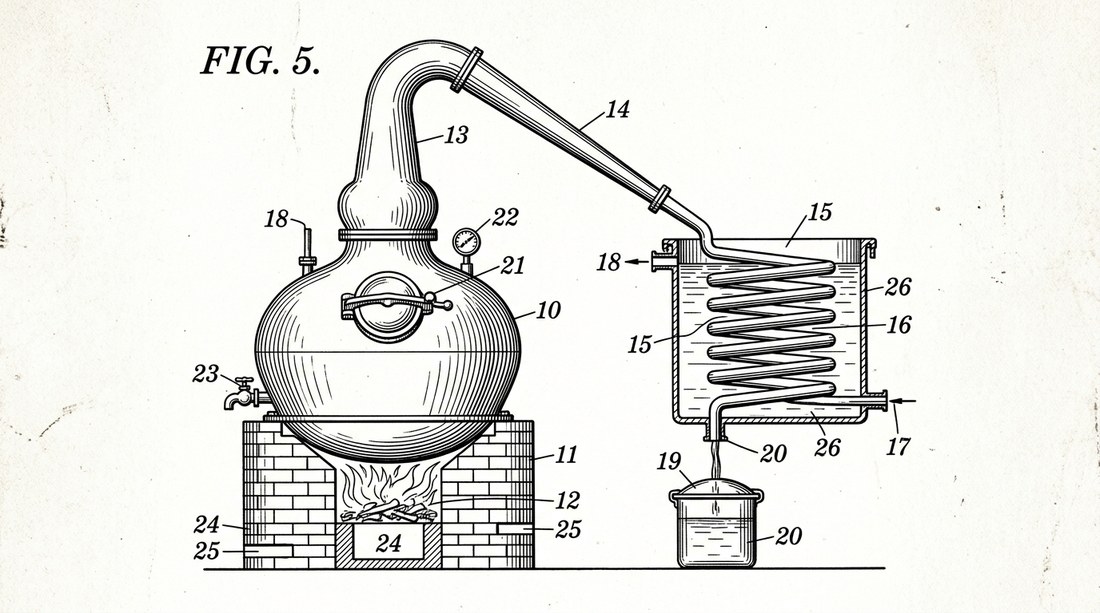
· Head (foreshots) — The harsh, pungent part that comes out first. Separated out.
· Heart (middle cut) — The cleanest, best-smelling middle part. Only this part is used as the real whisky spirit.
· Tail (feints) — The heavy, off-flavored part at the end. Mixed back into the next distillation and reused.
Copper is not merely a vessel but a purifying device that removes off-notes such as sulfur compounds. The weight of the spirit changes with the size of the still and the shape of its neck, giving each distillery its own character. The appeal of pot still distillation is precisely this rich, characterful flavor.
② Continuous Distillation (Column / Coffey Still)Grain whisky and mass production
A continuous still (also called a Coffey still or patent still) has many layers of perforated plates stacked inside a tall column. The wash comes down from above while vapor rises from below, producing the same effect as distilling dozens of times within a single unit. It runs without stopping, continuously fed with raw material. It's a method that was patented in the 1830s.
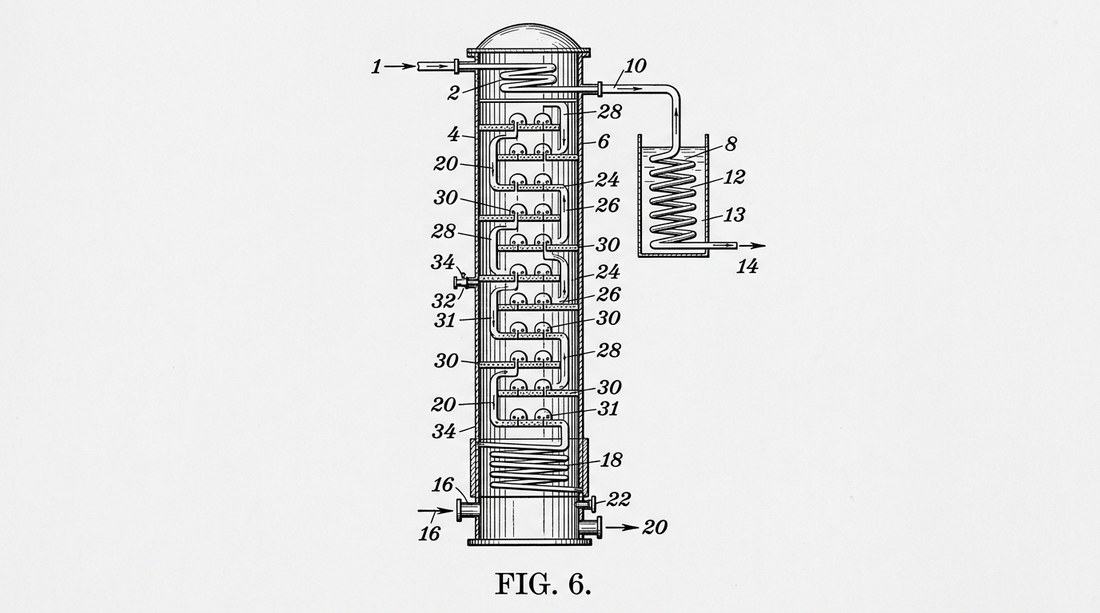
As a result, you efficiently obtain a very clean, light spirit in the 90% ABV range. The flavor is fainter than with the pot still, but smooth and consistent, and well suited to mass production. The blended whisky we commonly drink is made by mixing this light grain whisky with characterful malt whisky.
A Comparison at a GlancePot still vs. continuous
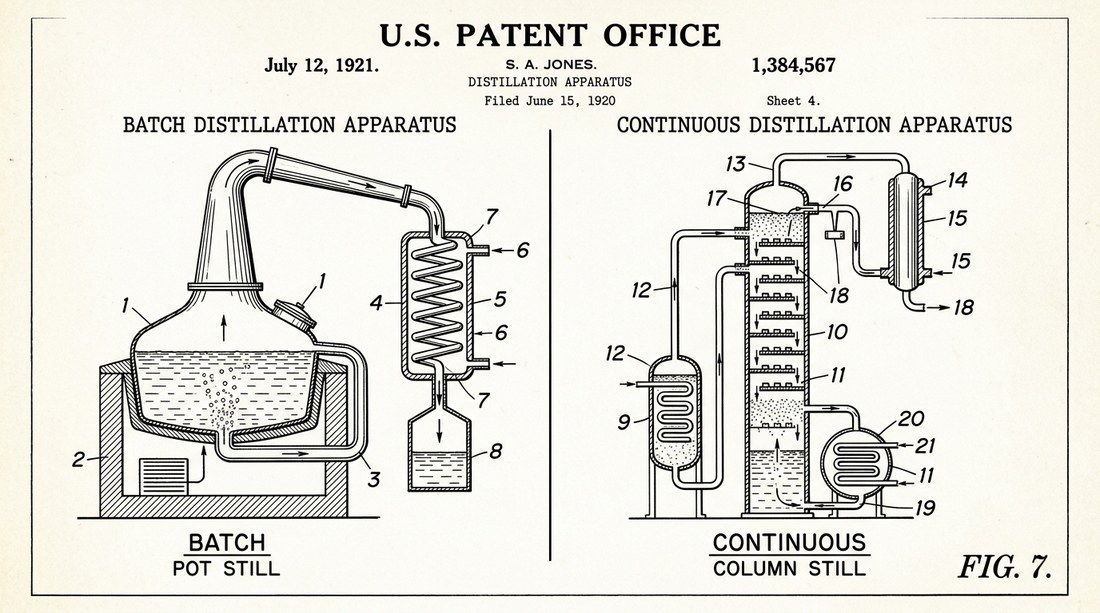
Pot Still Distillation
- One potful at a time (batch)
- Malt whisky
- 60–70% ABV
- Rich, characterful flavor
- Small-scale · high-cost
Continuous Distillation
- Continuous, without stopping
- Grain whisky · bulk spirit
- 90% ABV or higher
- Clean, light flavor
- Large-scale · efficient
| Item | Pot Still | Column Still (Continuous) |
|---|---|---|
| Method | One potful at a time (batch) | Continuous, without stopping |
| Main use | Malt whisky | Grain whisky · bulk spirit |
| Strength | About 60–70% | About 90% or higher |
| Flavor | Rich and characterful | Clean and light |
| Productivity | Low (small-scale · high-cost) | High (large-scale · efficient) |
It's less that one is better than the other and more that their purposes differ. If you want character, the pot still; if you want efficiency and smoothness, the continuous still. The two methods meeting is what creates the diversity of the whisky world.
Maturation and BottlingTime gives it color and flavor
The spirit right after distillation is a clear, raw "new make spirit." Whisky's distinctive amber color and smoothness come entirely from oak cask maturation. Passing through the wood, it gains color and aromas of vanilla, caramel, and fruit, and its rough edges are rounded off. By law, Scotch must be matured for at least 3 years. The amount that evaporates a little each year is romantically called the "Angel's Share."
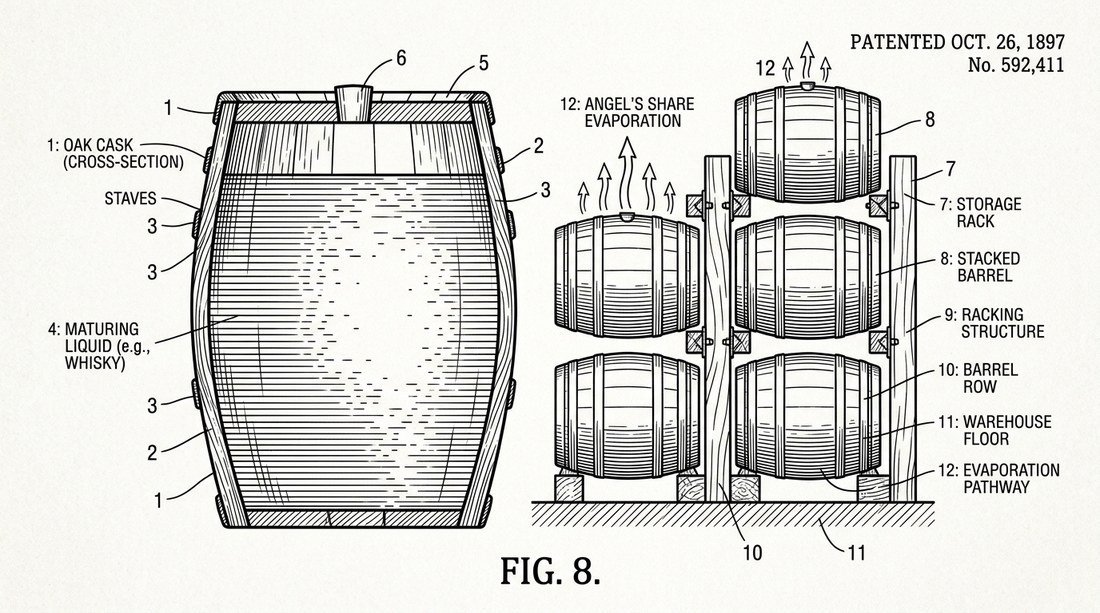
The matured whisky has water added to bring the strength down to a drinkable 40% or higher (cask strength keeps the spirit as is), and after filtering it is put into bottles. This is how a single grain of barley becomes a sip in our glass.
The next time you pour a glass of whisky, try to picture the six stages and the copper-toned still held within it. Even the same glass will surely feel different.
#WhiskyForBeginners#WhiskyDistillation#PotStillDistillation#ContinuousDistillation#PotStill#WhiskyMakingProcess
🥃

댓글 0
첫 댓글을 남겨보세요.