Whisky Science
Even starting from the same barley and the same water, one whisky gives off a crisp fruity aroma while another holds heavy raisin and smoky peat. This difference isn't chance — it's made at five decisive forks in the road. From fermenting the raw material to obtain spirit, to the shape of the still, the wood of the cask, the blending of different distillates, and right down to the final drop of water — we'll follow the entire process by which the flavor of a single glass is crafted, alongside its chemical principles.
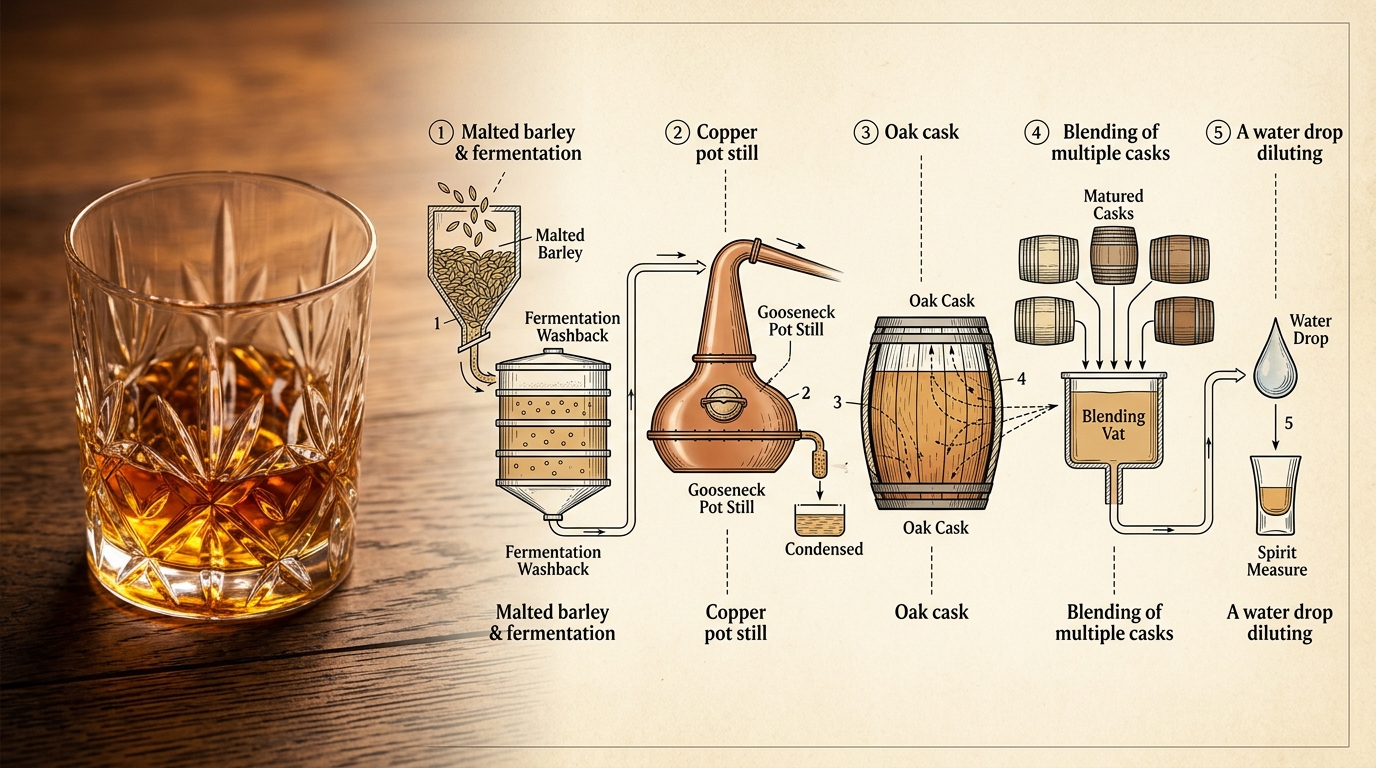
At a glance — the five things that decide whisky flavor
- Raw material and fermentation · malt, water, and yeast sketch the outline of the aroma (esters and phenols)
- The still · copper contact, reflux, and the cut point divide lightness from heaviness
- Oak cask maturation · 60–80% of the color and aroma is born here — the wood is the key
- Blending · mixing several distillates to engineer consistency and harmony
- Dilution with water · lowering the strength lifts hidden aroma molecules to the surface
01Raw material and spirit — it begins with malt and water
Whisky has just three basic ingredients: grain, water, and yeast. Malt whiskies of Scotland and Ireland mainly use germinated barley (malt), while North American bourbon and rye whiskies use corn, rye, and wheat. Change the type of grain and the aroma differs right from the starting line.
Malting — the germination that awakens enzymes
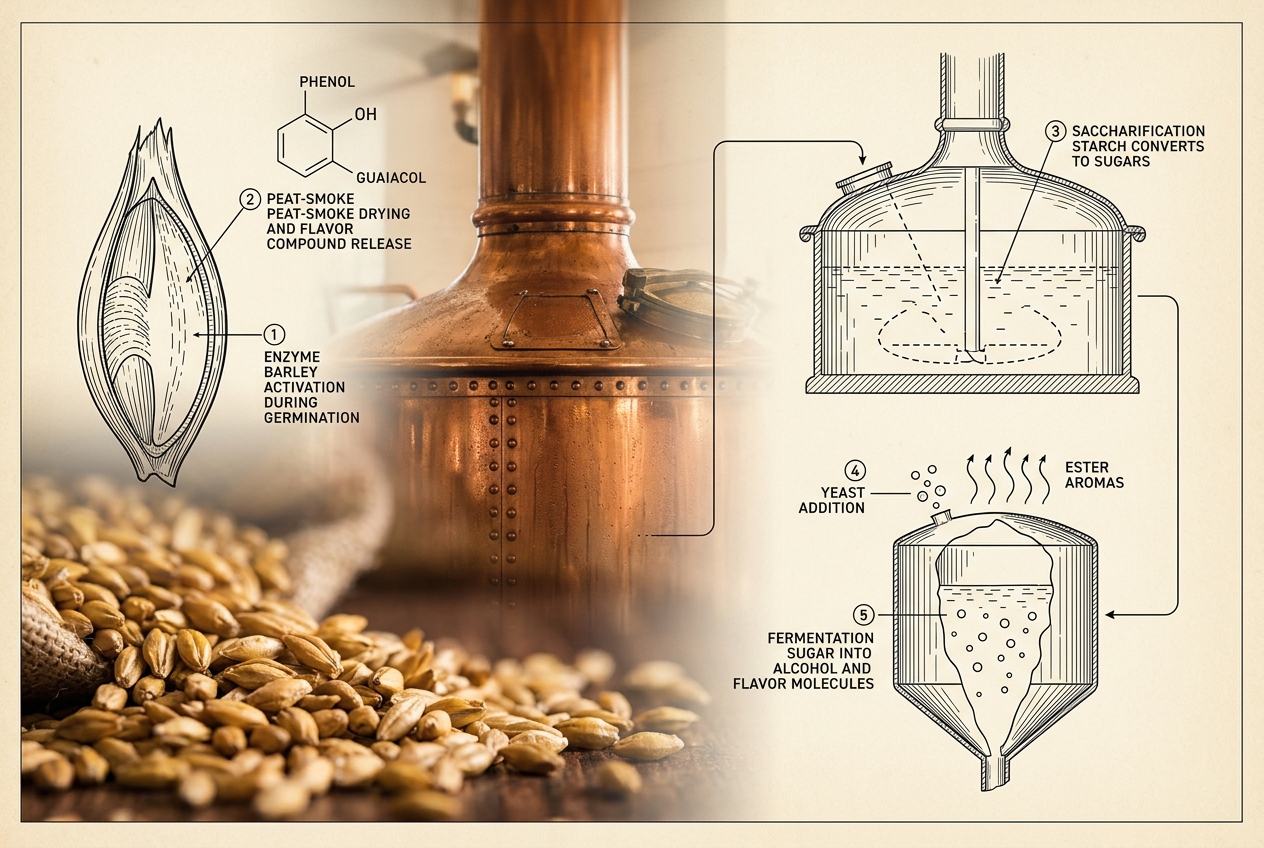
Steep barley in water and let it sprout, and enzymes within the grain become active. These enzymes are the key to breaking down the grain's starch into fermentable sugars. Once germination has progressed enough, heat is applied to dry the grain and halt germination — and it's at this drying stage that a major variable separating a whisky's character appears.
Peat — the identity of smokiness
The medicinal, smoky aroma distinctive to Islay whisky arises because the malt is dried with smoke from burning peat. The representative among the phenolic compounds that soak into the malt at this point is guaiacol. This molecule, which will appear again later, is the heart of smoky, spicy flavor, and even the same distillery becomes an entirely different spirit depending on whether peated malt is used.
Mashing and fermentation — the outline of aroma is drawn
Pour hot water over the milled malt to make a sweet liquid in which the sugars have dissolved (wort) — this is mashing — and then add yeast and ferment it to get a "wash" (the distillery's beer) of roughly 8% ABV. During fermentation, along with alcohol, countless flavor compounds such as esters, acids, and aldehydes are generated, and the outline of fruity and floral aromas is in effect decided at this stage. The longer the fermentation, the more the action of lactic-acid bacteria can develop an even more complex aroma.
The role of water
Water is the ingredient used in the greatest quantity, but its contribution to flavor is "subtle" rather than "decisive." There's a view that the mineral content of the water source used for mashing affects yeast activity and fermentation, but it's small compared with the variables of the distillation and maturation stages. The water used for the cutting (dilution) right before bottling, however, is a different story — and that's covered in the final chapter.
02The still — copper, shape, and reflux divide the character
If fermentation creates the "ingredients" of aroma, distillation is the process of "selecting" which of them to keep and which to discard. The type and shape of the still are the most direct devices that divide a whisky's weight and texture.
Pot still vs column still
There are broadly two methods. The pot still is a traditional method in which the wash is placed in a copper kettle and boiled up one batch at a time, leaving flavor compounds (congeners) abundantly. The identity of single malt Scotch and Irish pot still whisky comes from here. The column (continuous) still, on the other hand, distills continuously across multiple plates of a column to efficiently draw out a clean, high-purity, high-strength spirit. Grain whisky and the base of vodka and gin use this method.
| Category | Pot Still | Column Still |
|---|---|---|
| Method | Batch (one kettle at a time) | Continuous |
| Flavor | Rich and heavy, many congeners | Clean and light, high purity |
| Strength after distillation | Roughly 60–70% | Can reach much higher |
| Representative | Single malt Scotch, Cognac | Grain whisky, neutral spirits |
What copper does
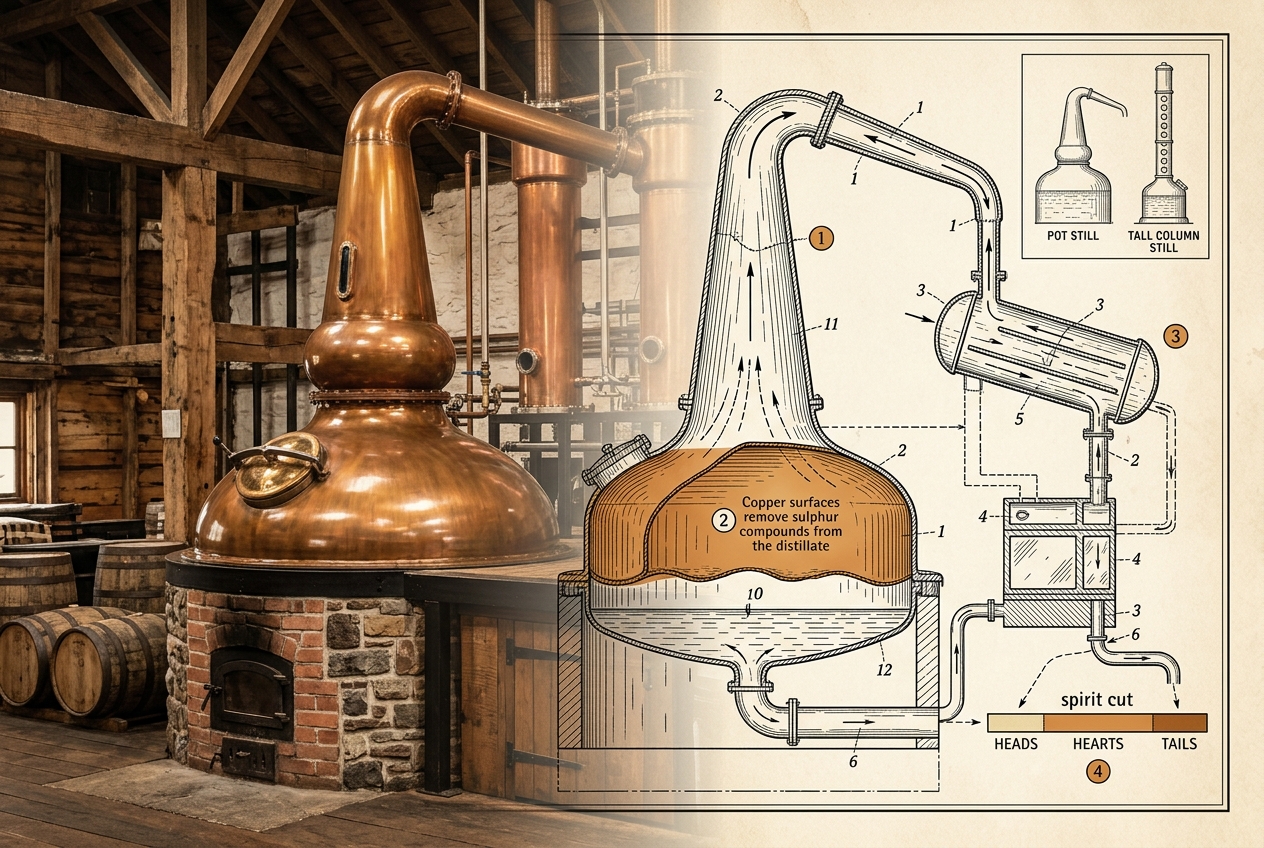
There's a reason traditional stills are deliberately made of copper. Copper reacts with the sulfur compounds (mercaptans and the like) that form during distillation, removing off-notes and balancing the fruity, ester aromas. The more contact with copper (the longer the neck or the more reflux), the cleaner and crisper the distillate; the less contact, the more it tends toward a meaty, heavy distillate.
Shape, reflux, cut — the realm of fine-tuning
The still's height and the thickness of its neck, the angle of the lyne arm, and the type of condenser all regulate the amount of "reflux." The taller and narrower-necked the still, the more the heavy components fall back, yielding a lighter, more fruit-rich distillate; short and wide, and it yields an oily, heavy distillate. The distiller also divides the outflowing liquid into heads, hearts, and tails, taking only the "hearts," and where the cut point is set creates the distillery's house style.
03Oak cask maturation — 60–80% of the flavor is born here
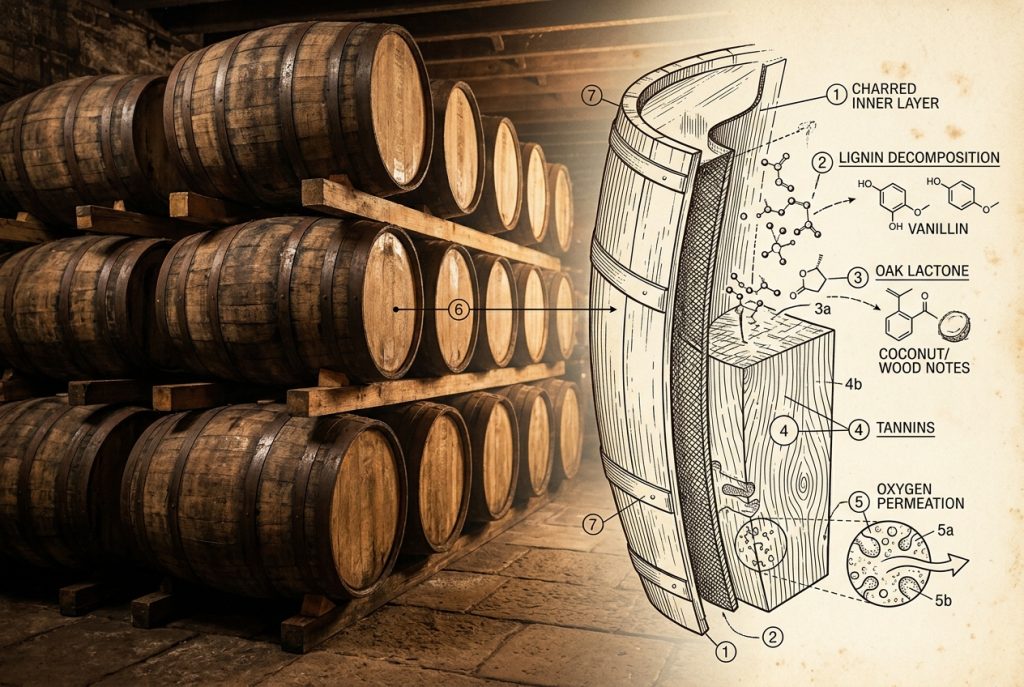
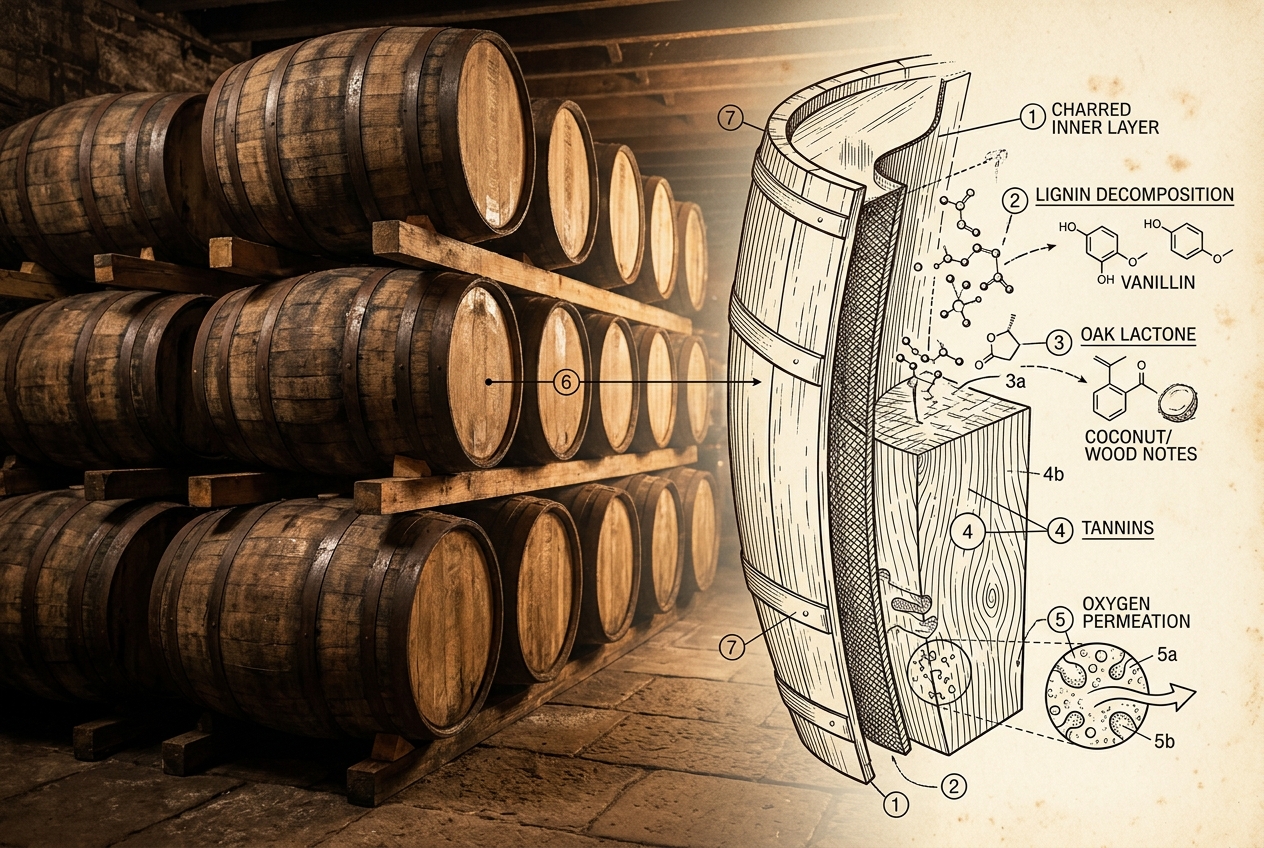
The distillate straight off the still (new make) is colorless, clear, and harsh. A large part of whisky's color and flavor — often said to be 60–80% — is born in oak cask maturation. That's how much which cask you use governs the final character.
The chemistry of how wood gives aroma
The lignin in the oak's cell walls breaks down during the process of charring (or toasting) the inside of the cask to create vanillin, which smells of vanilla. The oak's lipids yield lactones with coconut and woody aromas, and tannins impart structure and an astringent texture. At the same time, the cask breathes faintly, drawing in a small amount of oxygen and smoothing the harsh alcohol. Charring acts as a switch that raises the reactivity of all these reactions.
The wood of the oak — the cask is the very direction of flavor
| Oak type | Characteristics | Representative flavors |
|---|---|---|
| American oak (Quercus alba) | Tight grain, rich in vanillin and lactones | Vanilla, caramel, coconut, sweetness |
| European oak (Quercus robur) | High tannin and porous, mainly casks that held sherry or wine | Raisin, fig, dark chocolate, black pepper |
| French oak (Quercus sessiliflora) | Casks that held wine or Cognac, subtle vanilla | Spiciness, elegant tannin |
| Mizunara oak (Japanese) | Highly porous so prone to leaking, with high processing difficulty and cost | Exotic aromas of sandalwood, agarwood, and spice |
What was held before — the cask's history
In Scotland, new oak is rarely used. The aroma of new oak is so strong that it becomes excessive in long maturation. Instead, casks "tamed" by having held another spirit are reused. Bourbon casks leave a subtle sweetness of vanilla, honey, and coconut; sherry casks leave the weighty aromas of raisin, nut, and chocolate; and port and wine casks leave berry-like fruit aromas and acidity. Conversely, bourbon whiskey is required by law to use only "new oak casks charred on the inside," so even with the same oak, the rules are the exact opposite.
The cask is a variable too
The first-fill, holding whisky for the first time, has stronger flavor, and the more reuse it undergoes, the fainter it becomes. The smaller the cask, the larger the ratio of contact area between liquid and wood, so maturation and evaporation are faster, and the climate — the warehouse's temperature and humidity — also affects the speed of maturation and the amount of evaporation (the "angel's share"). And finishing, in which the spirit is placed in another cask for several months to two years after the main maturation, is a technique that lays a new layer of aroma over the existing character.
04Blending — the art of consistency and harmony
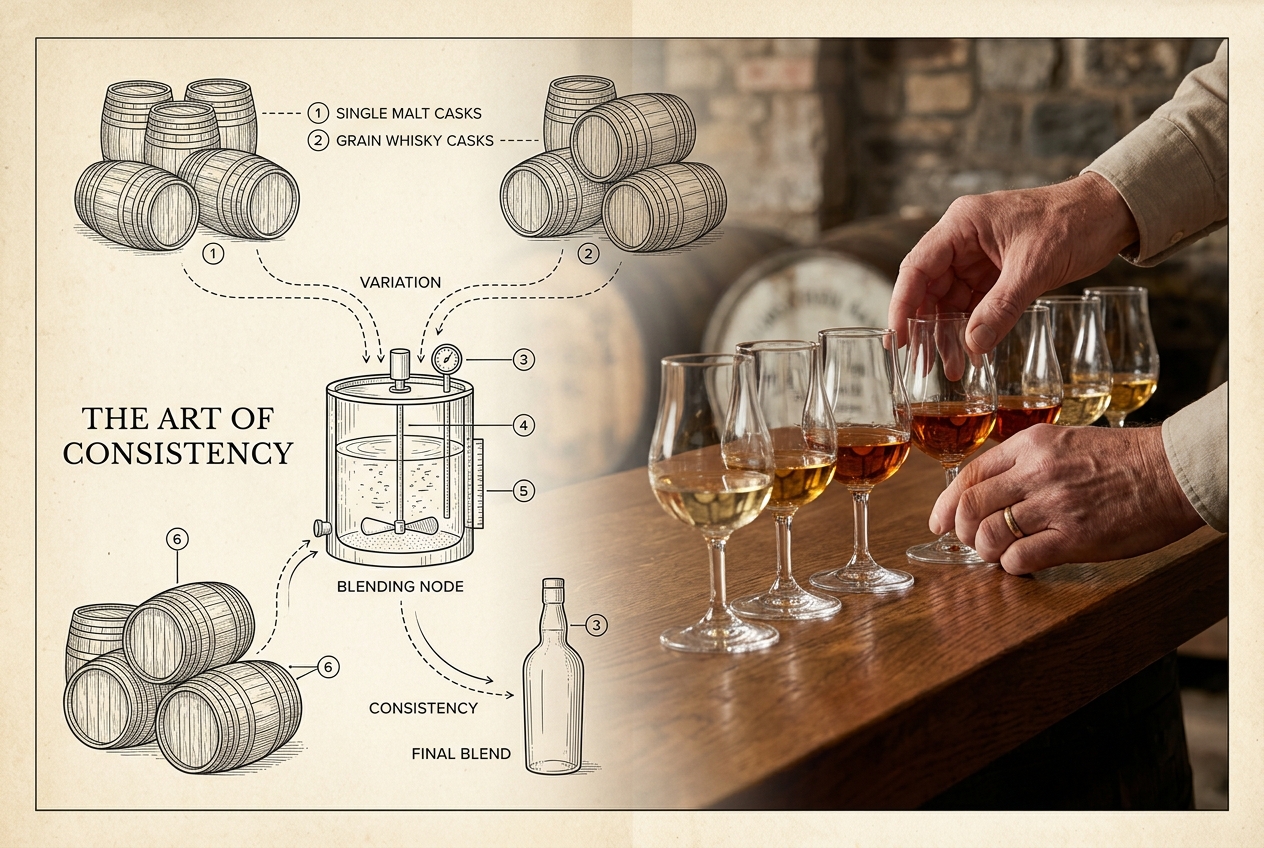
Even if cask after cask were distilled on the same day and matured right next to each other, years later they give off different flavors. So most whiskies are mixed from several distillates to bring them to the intended flavor. This work is designed by a master blender, relying on the memory of taste and smell.
The structure of blended whisky
The likes of Johnnie Walker, Ballantine's, and Chivas Regal that we commonly know are blended whiskies that mix malt distillates and grain distillates from several distilleries. Strongly characterful malts carry the heart of the flavor (these are called key malts), while light grain maintains the strength and smooths the whole into something easy to drink. The decisive turning point by which Scotch, once a local liquor, spread across the world was precisely the advent of this blending.
Why mix — consistency
The biggest purpose of blending is consistency. For every year and every bottle to give the same flavor, the deviation from cask to cask must be offset by the combination of several distillates. Blends, which can freely draw distillates from many distilleries and many casks, are therefore advantageous for achieving consistency of flavor. Single malt, which uses only one distillery's malt, by contrast puts that distillery's unique character front and center. For reference, even within a single malt, a small-scale kind of blending (vatting) occurs, selecting and mixing distillates from sherry and bourbon casks.
05Water — adjusting strength and releasing aroma
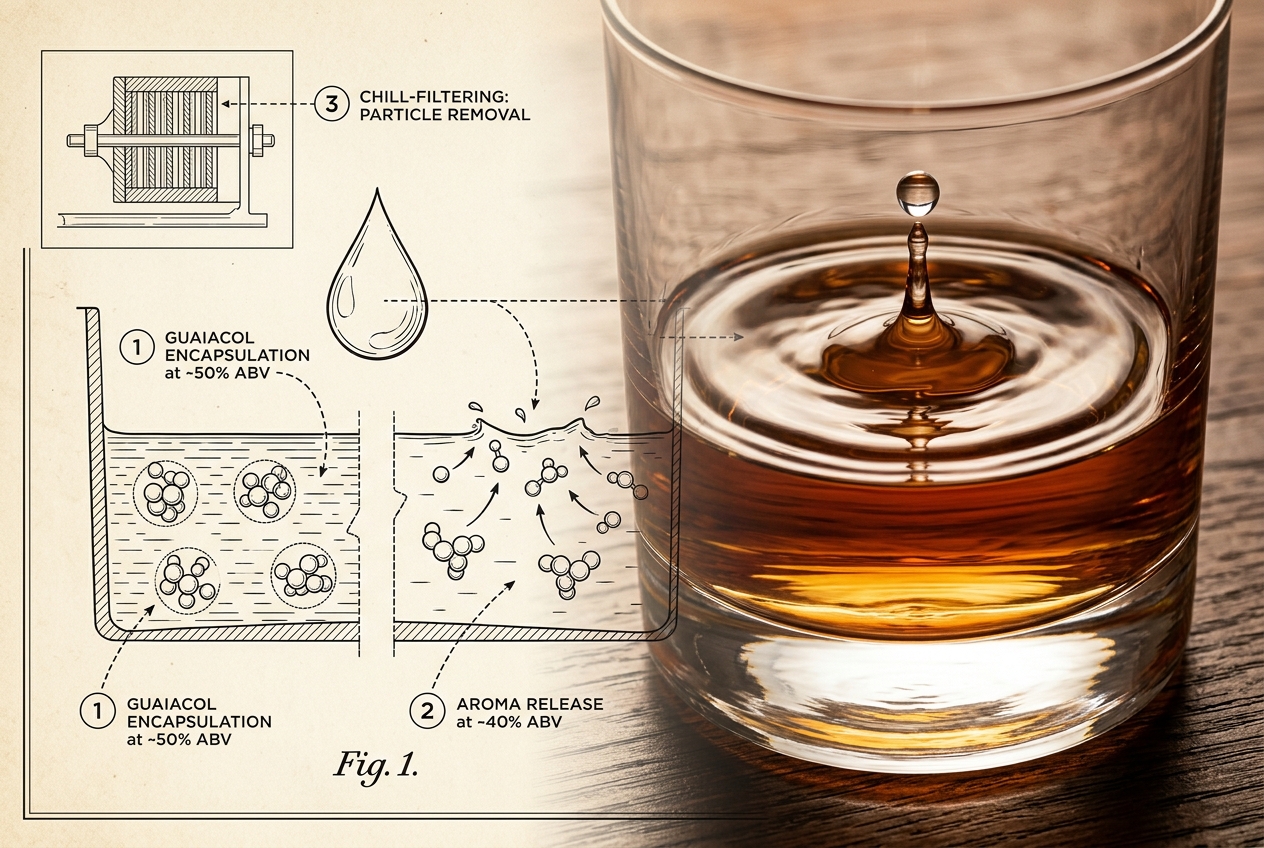
The last variable is the surprisingly simple-seeming "water." The distillate taken from the oak cask is usually 55–65% strength (cask strength). Most of it has water added before bottling to lower it to about 40%. But this cutting isn't simple dilution — it's an active manipulation that changes the flavor.
Why adding water brings the aroma alive
According to what a research team at Sweden's Linnaeus University showed in 2017 with a computer simulation, the aroma molecule guaiacol that appeared earlier clings well to alcohol molecules. At high strength, guaiacol is surrounded by alcohol and submerged within the liquid, but when water is added to lower the strength below 45%, guaiacol floats up to the surface of the liquid and is conveyed more readily to the nose and tongue. In other words, the right amount of water lifts a hidden aroma up to the surface. That said, guaiacol is just one of whisky's countless aroma molecules, so a cautious view also exists that this study doesn't explain every flavor.
Chill filtering — clear, but losing something
To prevent the haze that clouds whisky in the bottle when it cools or when water or ice is added, many makers do chill filtering, straining out fatty acids and esters at low temperature. The appearance is the main reason, but there's also criticism that this process strips out, along with them, the trace components that contribute to complexity and smokiness. So some distilleries flaunt "Non Chill-filtered" like a badge of pride. For reference, the haze rarely forms at strengths of 46.3% or above.
A drop of water as you drink
The same principle is at work when experts drop a few drops of water with a pipette during a tasting. After tasting a mouthful neat, you add it drop by drop, looking for the point at which the aroma opens up most fully. There's no correct ratio, though, and individual differences are large. The type of water also plays a subtle role — soft water or neutral water is thought to harm the delicate flavors less than tap water high in chlorine and minerals.
In closing — the variables held in a single glass
A single glass of whisky is the result of beginning in a barley field and crossing decades of time. What grain was fermented and how, what was kept with which still, how long it slept in which oak cask, how it was mixed, and finally how it was diluted. The choices at each of the five forks stack layer upon layer to become that unique aroma. The next time you raise a glass, if the single word "cask" on the label and the strength number read differently than before — that's the signal that you've begun to read these five variables.
This article organizes general information about whisky production and maturation, and there may be differing views on the scientific interpretation. Drinking can affect your health, and moderate consumption is recommended. ※ Please connect actual image files to the src paths of each image (whisky_01–06).

댓글 0
첫 댓글을 남겨보세요.