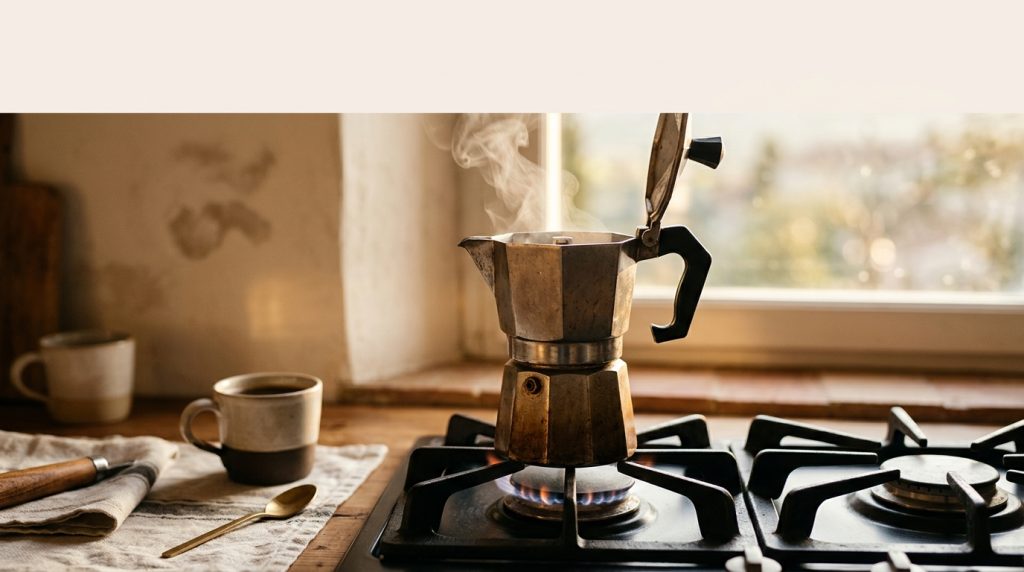
A single palm-sized octagonal pot has been responsible for Italian households' mornings for nearly a century. Coffee drawn out thick to the sound of bubbling on the gas range — this is the story of the moka pot. From its origin to how it works, how to brew without failure, and the beans and grind that suit it, we've laid it all out in one place.
1The origin of the moka pot

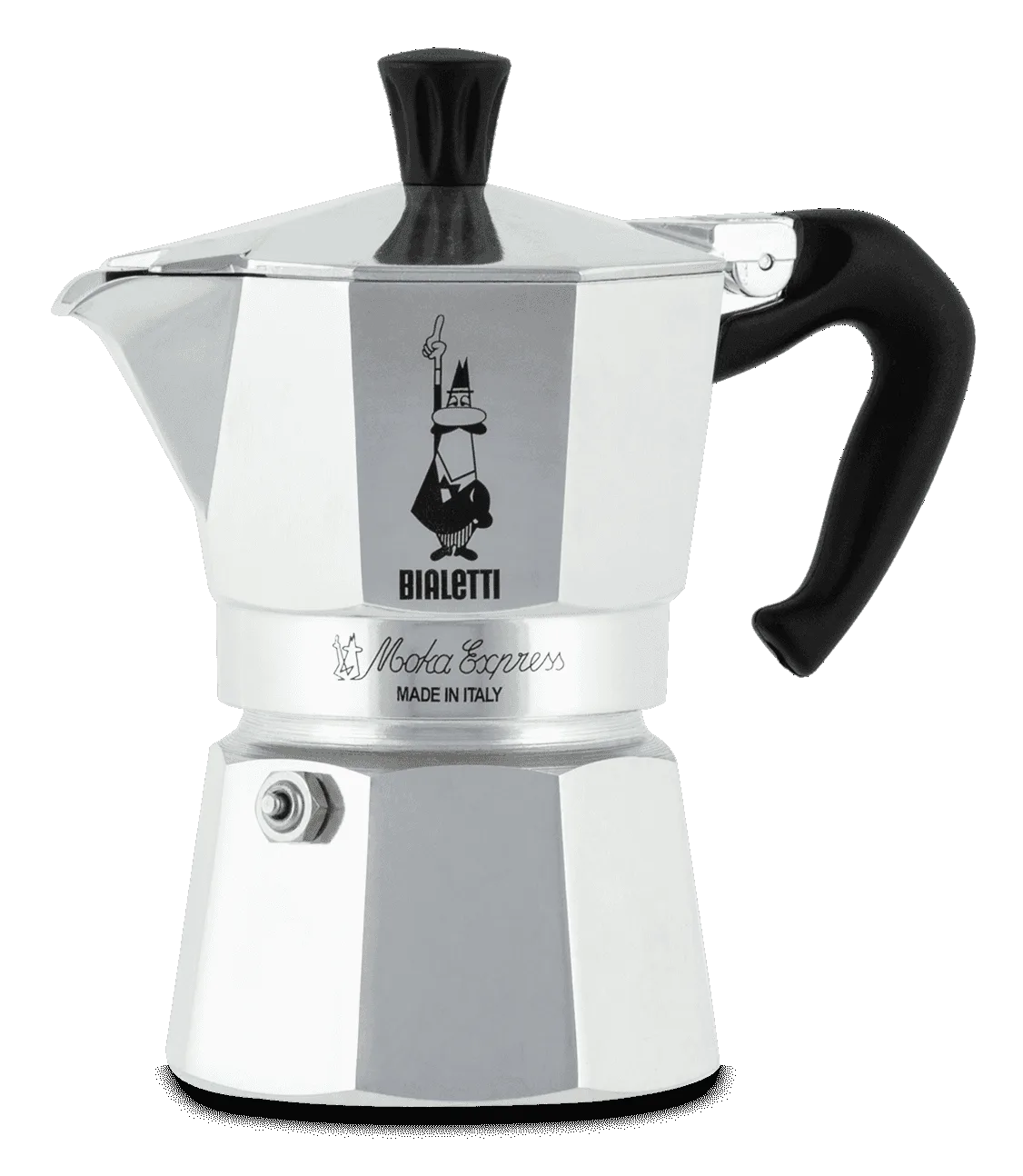
The moka pot was born in 1933 in Crusinallo, in the Piedmont region of northern Italy. Its starting point was the "Moka Express," made in his own workshop by Alfonso Bialetti, who had spent about ten years in the French aluminum industry learning metalworking. At the time, coffee was mainly a drink you had at the bar, but the moka pot made the idea of "thick coffee at home, just like at the bar" a reality.
The name "moka" was taken from Mokha, the Yemeni port city that once exported coffee to Europe. Interestingly, the design inspiration is said to have come not from the kitchen but from laundry. The story goes that, watching the washing devices of the day that boiled soapy water and used the steam pressure to spray water up over the laundry, Bialetti applied the same principle to coffee extraction. (Records also tell of the invention itself being made by Luigi De Ponti, with Bialetti buying the patent and mass-producing it.)
The moka pot truly became a national tool after World War II. His son Renato Bialetti, returned from a POW camp, took over the family business in 1946, focused the product range on the single Moka Express, and launched a sweeping marketing campaign using advertising, TV, and billboards. The little mustachioed man character "l'omino coi baffi" was born at this time, too. As a result, the moka pot spread to most Italian households and became a design icon with more than 300 million units sold cumulatively, exhibited in places like New York's Museum of Modern Art (MoMA) and London's Design Museum.
Moka in Italian daily life, the scene of a single cup
So much so that they say 9 out of 10 Italian homes have a moka, locally the moka is, beyond a "coffee device," the very scene of every morning. A 1–2 cup moka set on the gas flame, and a thick caffè in a small cup (tazzina) — that's the everyday picture.


2How does a moka pot brew coffee?
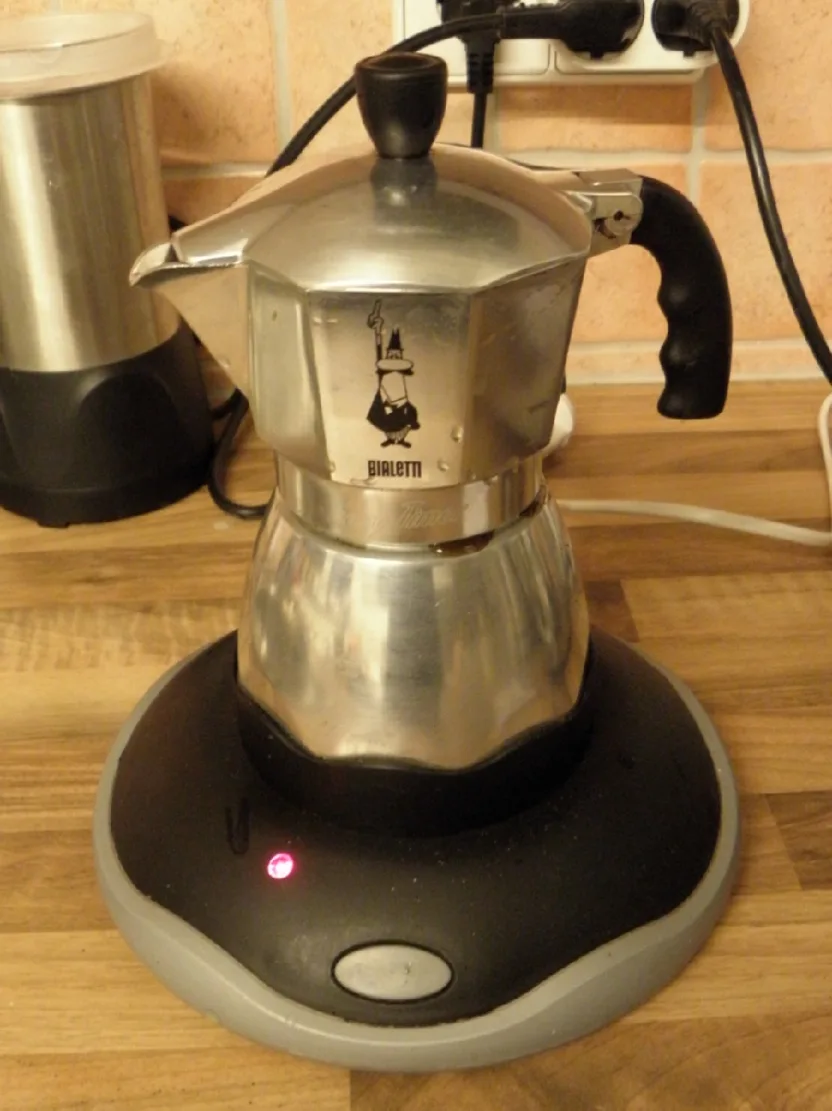
Knowing the principle lets you brew better. A moka pot is made up of roughly three parts.
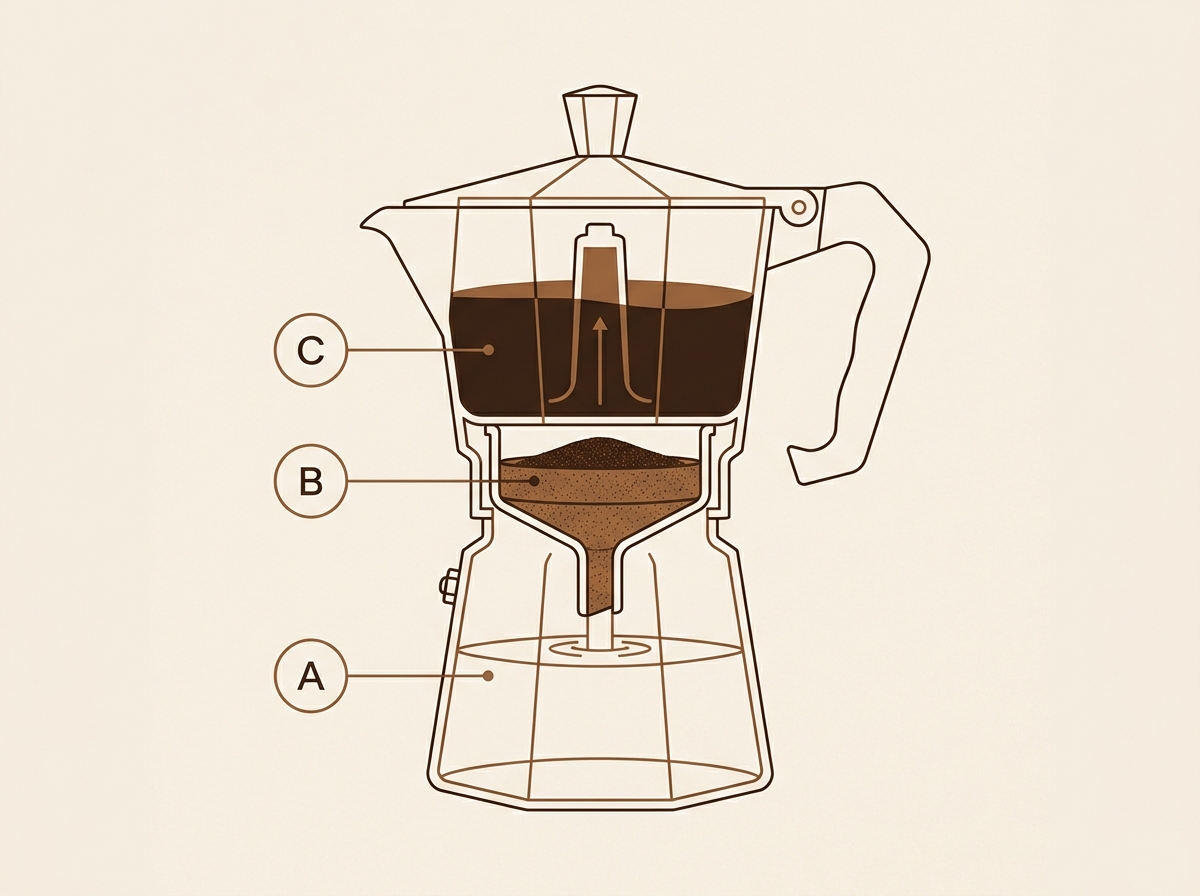
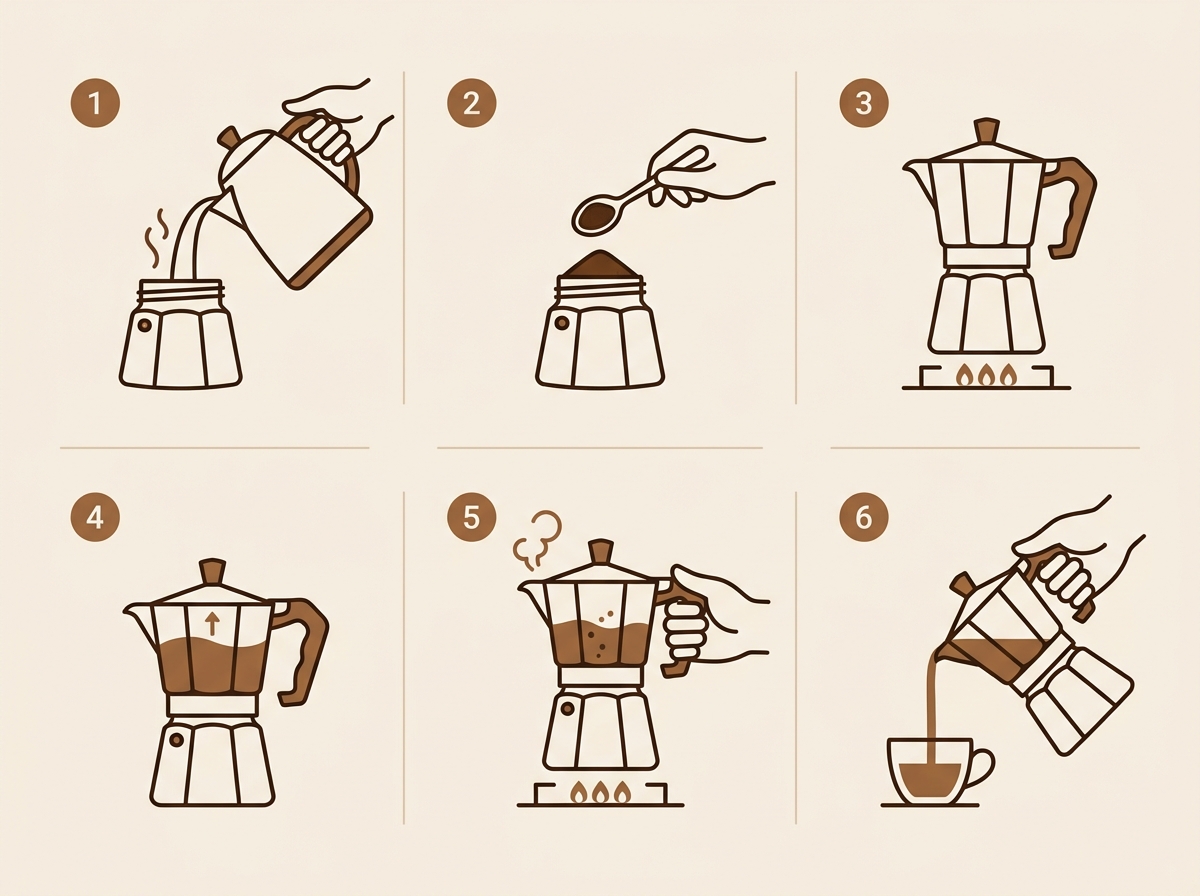
① Fill the bottom boiler with water, ② fill the funnel-shaped basket with coffee grounds, then ③ screw on the top chamber to seal it. Put it on the heat and the water in the boiler warms, raising the pressure of the trapped air and steam ever higher, and that pressure pushes the hot water up over the coffee bed in the basket. The coffee rises up the central tube and pools in the top chamber.
The key point is pressure. A moka pot usually extracts at a relatively low pressure of 1–2 bar, whereas the standard pressure of an espresso machine is 9 bar. So even though it's called "stovetop espresso," strictly speaking it isn't espresso but closer to a thick, full-bodied coffee somewhere between espresso and drip. When the bottom is nearly empty, steam mixes in and rises instead of water, making the distinctive "hiss~ bubble-bubble" sound — and that's exactly the signal to stop extraction.
In the final stage, when overheated steam passes through the coffee bed, abrupt over-extraction occurs, creating a bitter, harsh off-taste. When you hear the bubbling sound, take it off the heat without hesitation.
3How to brew a moka pot well

4The beans and grind that suit it
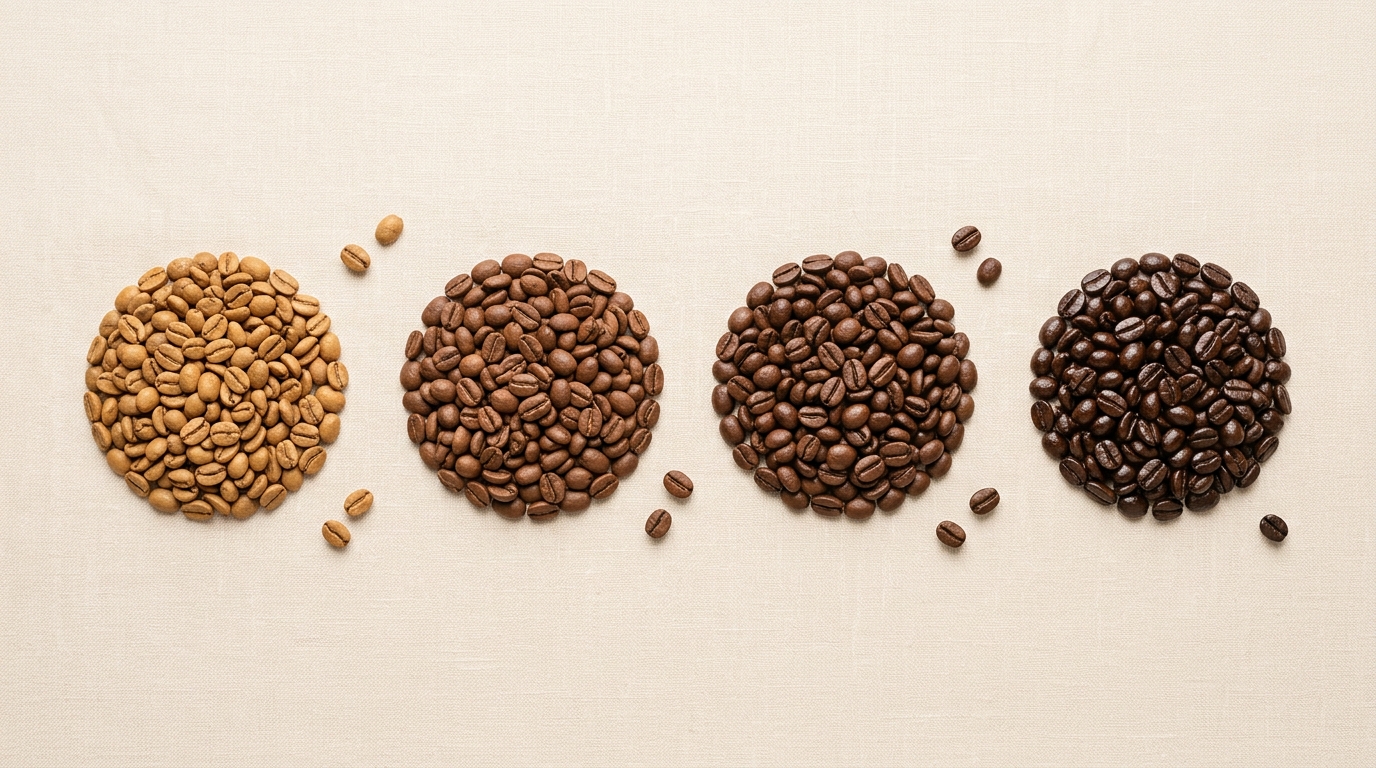
Roast — medium to medium-dark
The moka pot's thick extraction method pairs well with a medium to medium-dark roast that gives a heavy, rich flavor. Espresso-blend types are the classic choice. A dark roast gives chocolate, nutty, smoky heft, while a medium roast gives balanced sweetness and gentle acidity. If you like the bright acidity of a light roast, it's better to set the grind a bit coarser to avoid over-extraction.
Grind — finer than drip, coarser than espresso
The grind is the lifeblood of the moka pot. The right answer is "medium-fine (a little finer than medium)." Finer than drip but not as fine as espresso — roughly the particle of fine salt to granulated sugar (about 600–650㎛). It should feel slightly gritty between your fingertips; if it's fluffy like flour, it's too fine.
Ratio and fine-tuning
The coffee-to-water ratio is roughly 1:10 by weight as a baseline. For a 6-cup moka pot, about 18–22g of coffee is commonly recommended. Taste it and adjust, changing only one thing at a time as below.
| Symptom | Cause | Adjustment |
|---|---|---|
| Bitter and harsh | Over-extraction (grind too fine · heat too high · taken off late) | Grind slightly coarser, lower the heat, take off as soon as it sounds |
| Watery and sour | Under-extraction (grind too coarse · extraction too fast) | Grind slightly finer |
| Extraction too fast | Grind is coarse or the amount is too little | Grind finer / fill the basket level and full |
| Extraction stalls or too slow | Grind too fine or packed down | Grind coarser / don't press |
- Origin — Italy 1933, Alfonso Bialetti, the "Moka Express." The name comes from the Yemeni port of Mokha.
- Principle — steam pressure (1–2 bar) pushes water up over the coffee bed. Bubbling sound = signal to stop.
- Brewing — start with hot water · don't press · low-to-medium heat · take off the heat the moment it sounds.
- Beans — medium to medium-dark, espresso blend.
- Grind — medium-fine (fine salt to granulated sugar), finer than drip and coarser than espresso. With a burr grinder, right before brewing.
- Ratio — about 1:10. Taste and adjust only one thing at a time.
The older the tool, the more the knack sets in. Brew a few times to find the grind that fits your stove's heat and your palate, and the moka pot will become a reliable morning companion no less than any expensive machine.
We've laid out the things to prepare · the 6-step brewing sequence · the symptom-by-symptom adjustment table in a single "Ggomggomhan" guide. It's handy for checking off step by step as you brew.
Open the Ggomggomhan moka pot guide →

댓글 0
첫 댓글을 남겨보세요.