
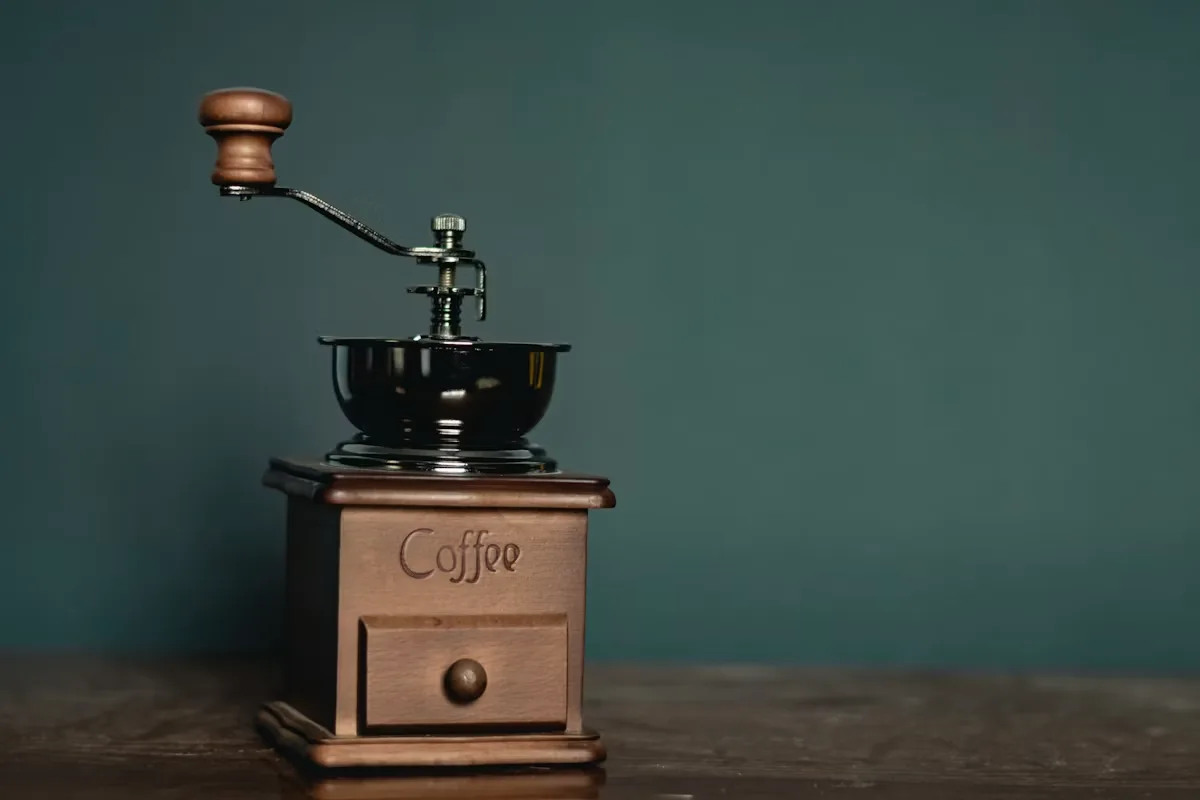
The reason manual grinders are still beloved is simple. At the same price point, they grind more uniformly than electric ones, and being compact they're robust for travel, camping, and power outages. The downside is clearly "time and your wrist." Grinding 20g for one cup usually takes about 1–2 minutes. Whether that effort is worth it is the starting point of every choice.
Comparison at a Glance
| Model | Burr | Adjustment | Capacity | Price (approx.) | Position |
|---|---|---|---|---|---|
| Comandante C40 MK4 | 39mm high-alloy steel | Internal click | About 40–50g | ₩380,000–450,000 | The ultimate high-end |
| 1Zpresso K-Ultra | Heptagonal steel | External dial (20μm) | About 35g | ₩180,000–220,000 | All-around premium |
| Timemore Chestnut S3 | 42mm S2C890 steel | External ring (15μm) | About 30g | ₩140,000–200,000 | Pour-over flagship |
| Kingrinder K6 | 48mm heptagonal steel | External collar (16μm) | About 35g | ₩130,000–160,000 | King of value |
| Timemore Chestnut C3 | 38mm S2C steel | Internal click | About 25g | ₩70,000–130,000 | Value entry |
| Porlex Mini II | Ceramic conical | Internal click | About 20g | ₩60,000–90,000 | Portable, ultra value |
※ Prices vary greatly with exchange rates, proxy-buying services, and sales. Overseas direct purchase is often cheaper than the local list price, so treat these as "approximate" only.
User Feedback by Model
Comandante C40 MK4
High-end
Roughly ₩380,000–450,000 · Made in Germany
A model often called the "end of the road" for hand grinders. Users especially cite the cleanliness, sweetness, and bright acidity it brings out in light roasts as its greatest strength. Because grind settings shared by bean retailers and communities are often organized around the Comandante (e.g., starting at 13 clicks, getting close to espresso around 10 clicks), being able to "follow the consensus" also adds to real-world satisfaction.
1Zpresso K-Ultra
All-rounder
Roughly ₩180,000–220,000
1Zpresso's flagship all-rounder, which rose to popularity in a flash with "convenience" as its weapon. The most frequently mentioned strength is its external dial adjustment — you can intuitively switch between drip and espresso without disassembling the catch cup. Thanks to its redesigned heptagonal burr, it has little static and retention, and many say it delivers a clean finish at higher brew ratios (1:17).
Timemore Chestnut S3
Flagship
Roughly ₩140,000–200,000
Timemore's flagship, released as the successor to the Chestnut X. The biggest change is the brand's first external adjustment ring — you can set a total of 90 clicks (in 15μm steps) from 0 to 9 by sight, without disassembling the catch cup. The 42mm S2C890 burr is designed to reduce fines (200–250μm) and increase the coarser particle band (250–400μm), and the dominant verdict is that it produces a cleaner, sweeter body in pour-over. Its full-metal unibody and precision bearings, which grind quickly without wobble, are also praised.
Kingrinder K6
Value
Roughly ₩130,000–160,000
A dark horse dubbed "the king of value." In one review's blind triangle test, the cup quality of the K6 and the K-Ultra were nearly indistinguishable (extraction yield 21.2% vs 21.8%, a 0.6%p difference), and the fact that the price is about a third drew a lot of attention. Because the adjustment collar is sealed outside the grinding chamber, real users also rate highly that there's little of the phenomenon where, over time, grounds get into the thread and throw off the setting.
Timemore Chestnut C3 / C3 ESP
Entry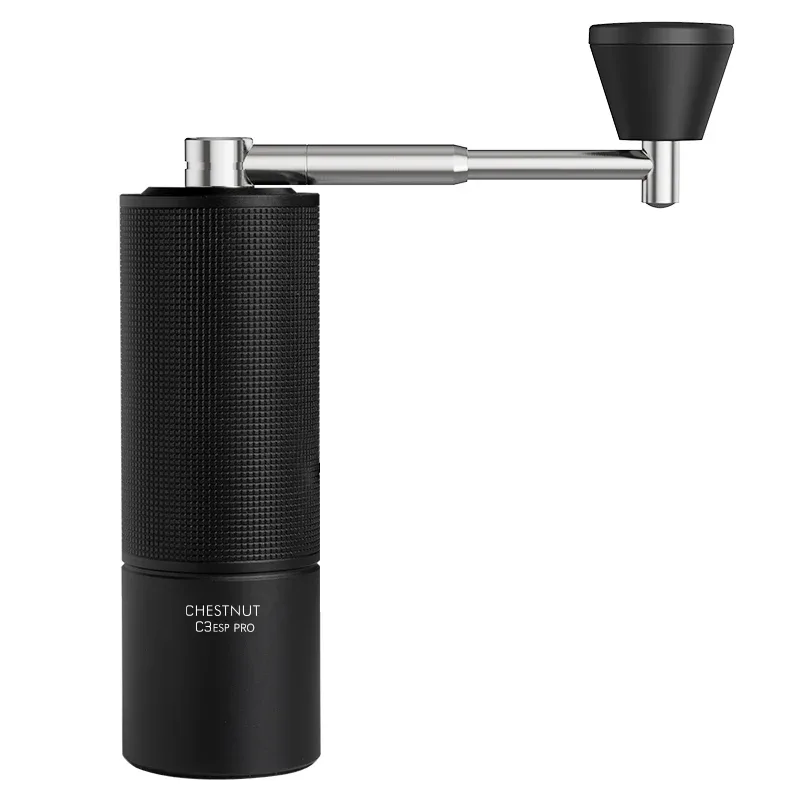
Roughly ₩70,000–130,000 (the C2 is cheaper)
The entry-level bestseller most often chosen as an alternative by people who say "the Comandante is too expensive…." The dominant verdict is that it's plenty excellent for one cup of pour-over (about 20g), and its minimalist design and portability (foldable handle, pouch included) are satisfying touches too. If you're also aiming at espresso, many recommend the ESP model with its wider fine-adjustment range.
Porlex Mini II
Portable
Roughly ₩60,000–90,000
A compact model often cited as the "value winner" in overseas comparison tests. Its ceramic conical burr produces astonishingly uniform results for the price, and being almost entirely stainless steel, it's sturdy. With its small size and rubber ring giving a good grip, it's especially popular as a travel grinder.
3 Points Where Users Split
1. Internal vs External Adjustment
The Comandante and the Timemore C series use the internal method, where you open the bean container and adjust with the inner screw. The structure is simple, so failures are few, but reviews say it's a hassle every time you adjust. By contrast, the 1Zpresso, Kingrinder, and the Timemore S3 use the external method of turning a dial/ring on the outside of the body, and the more you rotate among brewing tools, the higher the satisfaction. That said, the S3's adjustment ring doesn't lock firmly and can turn unintentionally, which is cited as a weakness compared to the 1Zpresso.
2. "Does the flavor difference match the price difference?"
This is the most contentious topic. It's true that the top-tier units (Comandante, Kinu, etc.) are excellent, but for a 20g single-cup pour-over, the prevailing opinion is that they're not quite worth 3x the price. There are even reported cases where, in actual blind tests, the cup quality of mid-range and high-end units couldn't be readily distinguished. That said, there are clearly users who, if they prize the subtle clarity of a light roast, feel that difference "earns its keep."
3. The Timemore "Axle Misalignment" Issue
Recently, some communities have circulated talk about axle misalignment on Timemore grinders (mostly the older C series). It's likely a matter of individual variation, and many say the S3, reinforced with a full-metal build and precision bearings, has virtually no wobble. If it concerns you, the advice is to also consider channels with easy local A/S or another model (e.g., Kingrinder).
Recommendations by Use
For one cup, a value model is plenty. If you want to maximize uniformity, the pour-over-specialized S3 is the strongest candidate in this price range.
Models you can switch quickly with external adjustment cause less stress. (The standard S3 is unsuitable for espresso.)
If you prioritize flavor clarity, durability, and ecosystem above all, it's a low-regret choice.
Small and sturdy, and some say the Q2's cup comes close to the Comandante.
Conclusion
Synthesizing user feedback, "more expensive is always the answer" simply isn't true. For a pour-over beginner, starting with a Timemore C2/C3 or Kingrinder K6 already brings very high satisfaction; if you want to take pour-over uniformity up a notch, the Timemore S3; if you want convenience and expandability, the 1Zpresso; and if you want the last 1% of flavor and lifelong durability, the Comandante is a candidate. If you travel often, the combination of also keeping a compact unit like the Porlex Mini is great.
Whatever you choose, there's one thing to remember. With a burr grinder that grinds uniformly, what divides the quality of the next cup is fresh beans and your brewing recipe. The grinder is just the tool that draws out that potential.
Taste is subjective, and prices and stock vary by time. Product images are taken from each brand's official website, and copyright belongs to the respective manufacturers. If possible, we recommend deciding after checking the grinding feel for yourself in a store.


댓글 0
첫 댓글을 남겨보세요.