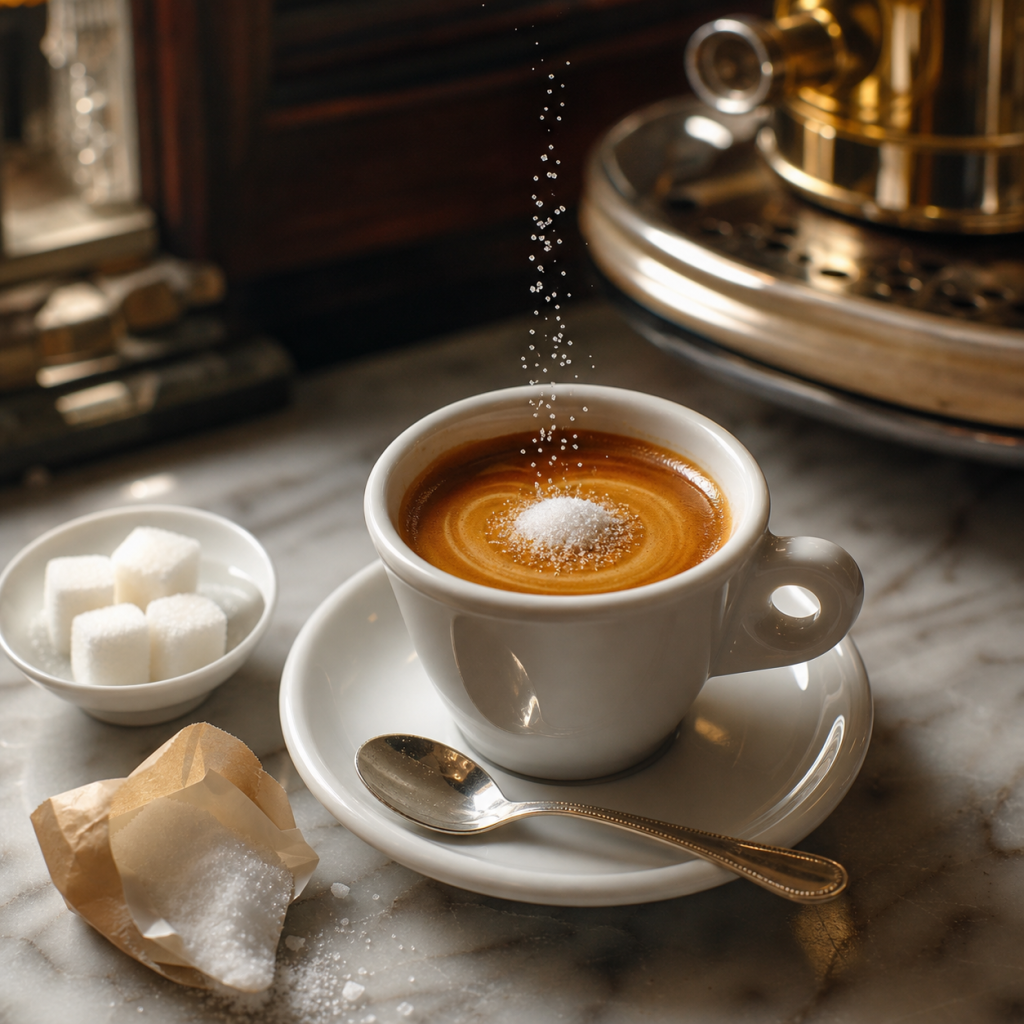
You've probably heard it at least once: "Putting sugar in espresso means you don't know coffee." Yet travel to Italy, espresso's homeland, and the scene is entirely different. Sugar packets are piled high on every bar counter, and in Naples espresso even arrives pre-sweetened. Today we answer the question "Is it okay to add sugar?" through Italy's own living culture, and round it out with a list of sugars that pair well with espresso plus how to add them properly.
The bottom line: yes, you can — and that's actually the tradition
In the specialty coffee scene, "good coffee needs no sugar" is treated almost like a creed. It's the culture born of the industry's long effort to elevate coffee into a complex beverage like wine. But in the Italian espresso tradition, the opposite holds. Mr. Espresso, which carries on Italian-style roasting in the United States, flatly states that "in the Italian espresso tradition, sugar is almost always added."

The reason lies in history. Both sugar and coffee entered Europe by way of the Arab world, and the first place sugarcane was cultivated in Europe was Sicily. The Italian word zucchero coming from the Arabic "al-sukkar" is a trace of that very history. When you remember that the coffees of the Mediterranean — Turkish, Greek, Arab — are all drunk strong and sweet, the sweet espresso of southern Italy sits squarely in that lineage.
Florence even has this half-joking proverb:
— When the spoon stands upright, there's enough sugar in the coffee. A saying passed among Florentine baristas
Of course, things are changing too. According to Italian coffee-industry sources, while the majority of Italians traditionally added sugar to their coffee, the share who drink it unsweetened has been steadily rising of late, and the sugar packets stocked at bars have become standardized at around 4 g — smaller than in the past. The tazzina amara camp, who drink it bitter as is, now coexists with the sugar camp; it has become, quite literally, a matter of taste. So feel free to let go of any anxiety that "you mustn't add sugar."
Local culture tour ① — the sugar scene at an Italian bar
Order a caffè at an Italian bar and you get an espresso. The counter almost invariably has sugar on hand, and in more varieties than you might expect.
| Italian term | What it is | Characteristics |
|---|---|---|
| zucchero (semolato) | White sugar | The basic standard. A packet (bustina) is typically about 4–5 g |
| zucchero di canna | (Partially refined) cane sugar | Amber-brown, with a faint molasses note. Stocked alongside white sugar at the bar |
| zucchero a velo | Powdered sugar | Literally "the veil of sugar." For confectionery — not used in coffee |
| zucchero integrale | Unrefined whole cane sugar | Panela and the like. Without centrifuging or filtering, the flavor is the most intense |
| dolcificante | Low-calorie sweetener | Kept on hand too, for customers watching their calories |
What's amusing is the regional pride surrounding table sugar. Vesuvio Live, a local outlet that covered Naples's Ten Commandments of coffee, goes so far as to declare flatly that "cane sugar (zucchero di canna) changes the taste of the coffee, so leave it alone." For Naples's intense dark roast, the answer is white sugar with its clean flavor, they argue. Conversely, at the lighter bars of Tuscany or the north, far more customers reach for the brown-sugar packet.
Local culture tour ② — Naples, the city where sugar is the default
Even within Italy, Naples is the pinnacle of sugar culture. At a traditional Naples bar, the barista puts a teaspoon of white sugar into the cup before extraction and pulls the espresso right over it. There's even a variant that adds two spoons of sugar to a cup closer to a 15 ml ristretto. When local guides introduce Naples's famous bars, an expression that never goes missing is "in a hot little cup and already sweetened (in tazzina calda e già zuccherato)."

The keyword that defines Neapolitan espresso is often summed up as the 3C. In Neapolitan dialect, "Comm' cazz' coce" — put politely, it means "incredibly hot." The cup is kept hot enough to burn your hand using the bagnomaria method of immersing it in water just shy of boiling, and the espresso falls onto the sugar in that scalding cup, so it's already half-dissolved before you even stir. There's even a story that seasoned Neapolitan baristas take pride in the calluses on their fingers from gripping hot cups every day.
And then there's the crowning glory of Naples's sugar culture, the cremina. It's a caramel-colored sugar cream made by vigorously whipping together the sugar and the darkest first drops of the espresso (or moka pot); spoon a dollop onto the cup and the coffee transforms into something like a dessert. At some Naples bars they top your cup with this cremina along with the question "Zuccherato? (Shall I add sugar?)" — and this is the secret behind tourists asking "why is Naples coffee so sweet and delicious?" We'll cover how to make it in the "how to add sugar" section below.
— As it happens, Italian coffee experts once toured Naples bars and ran a blind comparison of the same espresso as "amaro (no sugar)" versus "one packet of sugar (about 6 g)," and in many of the cups they reviewed that the sugar actually amplified negative nuances like earthy or musty notes and accentuated astringency. The conclusion: the better the beans, the less sugar you need.
A recommended list of sugars that pair with espresso
Based on what's easy to find in Korea, ordered by how well each pairs with espresso. The two key criteria are dissolving speed (espresso is a small volume that cools fast) and flavor interference (whether to let the bean's character shine or layer something over it).
BasicWhite sugar (refined white sugar / zucchero semolato)
The Italian bar standard and Naples's choice. Its neutral flavor doesn't mask the bean's inherent taste, and the fine grain dissolves well even in the scant 25–30 ml of liquid. White sugar is also the baseline when making cremina.
Fine grainUltra-fine sugar (caster sugar / Zefiro type)
Sugar with extremely fine crystals, like Eridania's "Zefiro," has the advantage of dissolving in an instant without clumping. It's especially good for the bar style of drinking quickly and leaving, or for iced drinks. Powdered sugar (which contains starch) is a no-no, though, as it clouds the coffee.

Adds flavorDemerara
Its coarse amber crystals retain a touch of molasses, adding toffee and caramel notes. It pairs superbly with the chocolate nuances of a dark-roast espresso, and its balanced sweetness sits charmingly between white and brown sugar. The grain is coarse and takes time to dissolve, so stir it well.
Adds flavorTurbinado (raw sugar)
A partially refined sugar obtained from the first pressing of cane juice. Lighter than demerara with a subtle caramel note, it works smoothly as a white-sugar substitute. Brands like "Sugar in the Raw" are used almost as a standard in café-syrup cultures.
In moderationMuscovado
A rich, moist sugar with almost none of its molasses removed. Its heavy flavors of dark sugar and rum turn an espresso into a dessert, but overdo it and it completely buries the bean's taste. Start with half your usual amount.
ClassicSugar cubes (zolletta)
The romance of European café culture. A cube is usually 3–5 g, which has the practical advantage of precise measurement. Watching a cube settle as you rest it lightly atop the crema is a small ritual of espresso in itself.

How to add sugar — from the basics to cremina
① The basics: an order that respects the crema
- When the espresso arrives, take a sip first. Check the bean's character without sugar. It's a common habit even at Italian bars, and it's the step where you gauge how much to add.
- Sprinkle the sugar evenly over the crema. If it's a good crema, the sugar will "perch" on top for a few seconds before slowly sinking — a longstanding test among baristas for gauging crema density.
- Wait 2–3 seconds, then stir briefly and gently down to the bottom. Stir roughly and you'll break the crema completely. A few circular scrapes of the spoon along the bottom of the cup, three or four times, is plenty.
- Drink it in two or three sips, and look forward to the last one. If a little undissolved sugar remains at the bottom, the final sip becomes the sweetest. Plenty of Italians deliberately under-stir to enjoy this "sweet finale." Spooning up the sugar left at the bottom is also a common way to finish locally.
② The Neapolitan way: making cremina
This is Naples's sugar cream, which you can recreate at home with a moka pot or espresso machine.
- Put 3–4 teaspoons of white sugar in a small cup. For 2–3 servings. The finer the sugar, the better it works.
- Drop just 1–2 teaspoons of the coffee's "first drops" onto the sugar. With a moka pot, that's the darkest part that rises first; with a machine, it's the concentrated liquid at the start of extraction.
- Whip vigorously with a teaspoon. Stir fast for 1–2 minutes and the color gradually lightens into a glossy, caramel-colored cream. When it falls like a ribbon as you lift the spoon, it's done.
- Pour the finished espresso into the cup and top it with a spoonful of cremina. Stir it just lightly and drink, and the foam-like sweetness floating on top mixes with the rich coffee in a single sip.

For reference, this technique is essentially the same principle as the "espumita" of Cuban cafecito, where Italian immigrants' coffee culture crossed to the Caribbean. The Cuban version calls for white sugar — because it dissolves fast and produces a smooth foam. Make it with brown-sugar types and the foam turns heavy and the molasses flavor grows strong, becoming yet another dessert.
③ Amount, timing, and the exceptions
| Situation | Recommendation |
|---|---|
| Dark-roast espresso (Italian style) | 2–4 g white sugar. The range with the best bitter-sweet balance |
| Medium roast, chocolate/nut notes | A small amount of demerara/turbinado — the caramel flavor amplifies the notes |
| Light roast, acidity-forward single origin | Unsweetened if possible. Sugar buries the delicate acidity and floral notes |
| Iced espresso / shakerato | Dissolve the sugar first while hot, or use ultra-fine sugar (it barely dissolves in cold liquid) |
One last principle. Add the sugar when the coffee is at its hottest. An espresso is only about 30 ml, so its temperature plummets within a minute or two, and in cooled coffee the sugar won't dissolve properly and just floats on the surface. The reason Naples heats its cups hot enough to burn your hand and adds the sugar before extraction comes down, ultimately, to this very principle.
In closing — yes, you can add sugar
Whether or not to put sugar in your espresso is not a question of right and wrong but of which tradition you stand in. The specialty path of savoring a region's character and the Neapolitan path of dissolving sugar in a hot cup and knocking it back in three seconds are both correct answers. Next time you get an espresso, try one sip plain first, then half a spoon of sugar — travel between the two worlds in a single cup. And on the weekend, take on cremina with a moka pot. Your kitchen briefly becomes Naples.
☕ We've organized the cremina-making from this article into a recipe with ingredients and a step-by-step timer.
If you have a moka pot, you can follow along right away.


댓글 0
첫 댓글을 남겨보세요.