At least 51% corn, a new oak barrel charred black on the inside, and the USA. Remember just those three and you already understand half of bourbon. It isn't "any old American whiskey" but a spirit whose qualification is set by law — which is why, in 1964, the US Congress declared bourbon "America's Native Spirit." This is a beginner's guide for someone trying bourbon for the first time, laying out everything from what makes bourbon bourbon to how best to drink it, all in one place.
Stand in front of the whiskey shelf and you'll find Scotch, rye, Irish, and bourbon all jumbled together. Among them, bourbon is remembered especially for its sweetness and smoothness. Caramel, vanilla, well-ripened oak — these flavors are no accident; they come almost inevitably from two ingredients, "corn" and "freshly charred oak barrels." On top of that, all of this follows specifications set not by taste but by US federal law (Title 27, CFR). Getting to know bourbon is, in the end, a matter of reading how those specifications translate into flavor.

The 6 rules that make bourbon bourbon
"All bourbon is whiskey, but not all whiskey is bourbon." That one sentence is the crux. For a whiskey to put "Bourbon" on its label, it must satisfy all of the conditions below. Break even one and it becomes just "whiskey" or a lower grade of spirit.
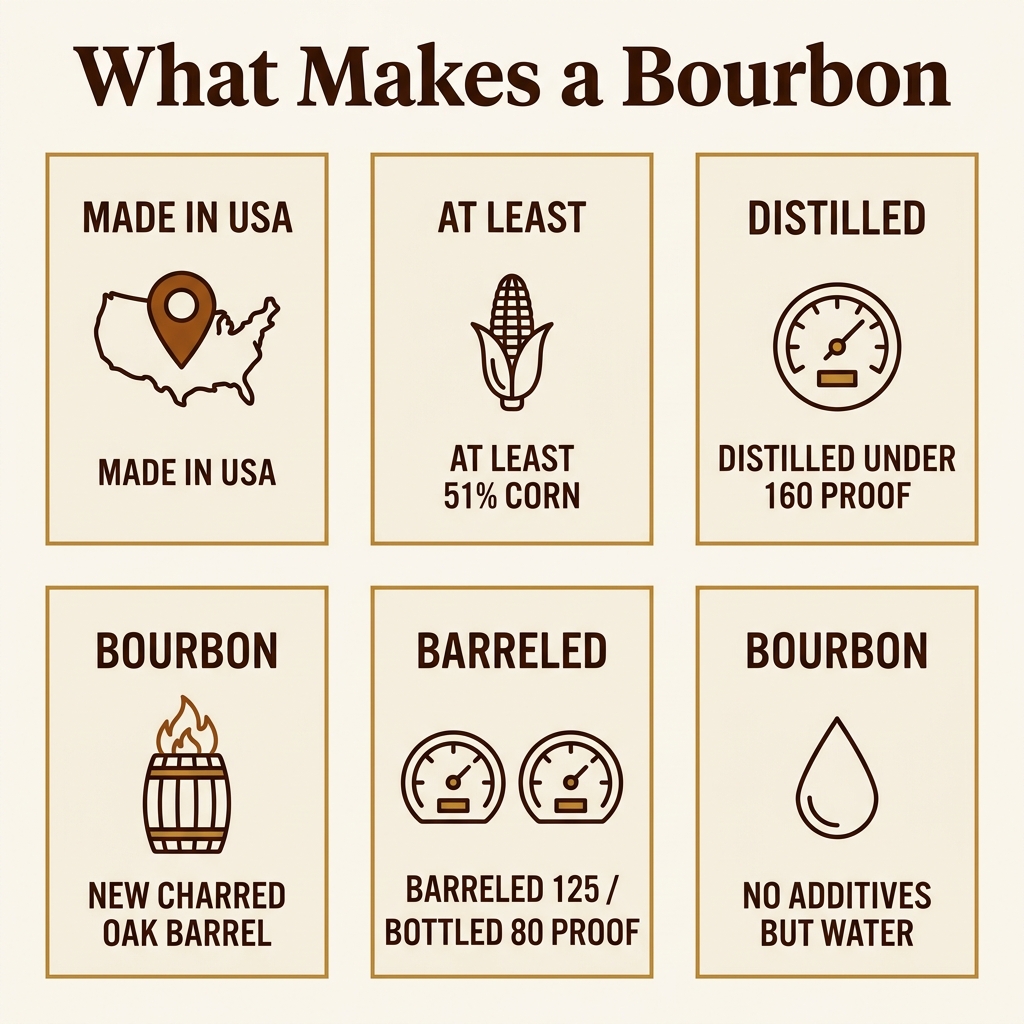
Made in the USA
It must be made in the United States. It doesn't have to be Kentucky, but in practice over 90% of bourbon comes from Kentucky.
At least 51% corn
At least 51% of the grain blend (mash bill) being fermented must be corn. This corn creates bourbon's signature sweetness.
Distilled at 160 proof or less
Distilled so as not to exceed 80% ABV (160 proof). Because it isn't distilled too high, more of the grain's flavor remains.
Aged in new charred oak
Aged only in "new" oak barrels charred on the inside. Used barrels aren't allowed. The source of color and flavor.
Barreled at 125 · bottled at 80
Must enter the barrel at 125 proof (62.5%) or less, and be bottled at 80 proof (40%) or more.
Nothing but water added
Aside from water to lower the proof, no coloring or flavoring may be added. All color and aroma come solely from aging.
As you may have noticed, this list has no "aging period." Regular bourbon has no minimum aging requirement, so in theory you could dip it briefly into a new oak barrel and pull it out and it would legally be bourbon (though it would taste of nothing, of course). A meaningful aging standard appears only from the "straight" grade that comes up later.
The GrainThe mash bill — the starting line of at least 51% corn
The mash bill is the grain recipe that makes a bourbon. What the law fixes is up to "at least 51% corn," and the remaining 49% is up to the distillery. Typically they raise the corn ratio to 60–75%, then add a second grain (rye or wheat) and malted barley, which acts as the enzyme. Corn provides sweetness and body, the second grain provides "character," and the malted barley helps fermentation.

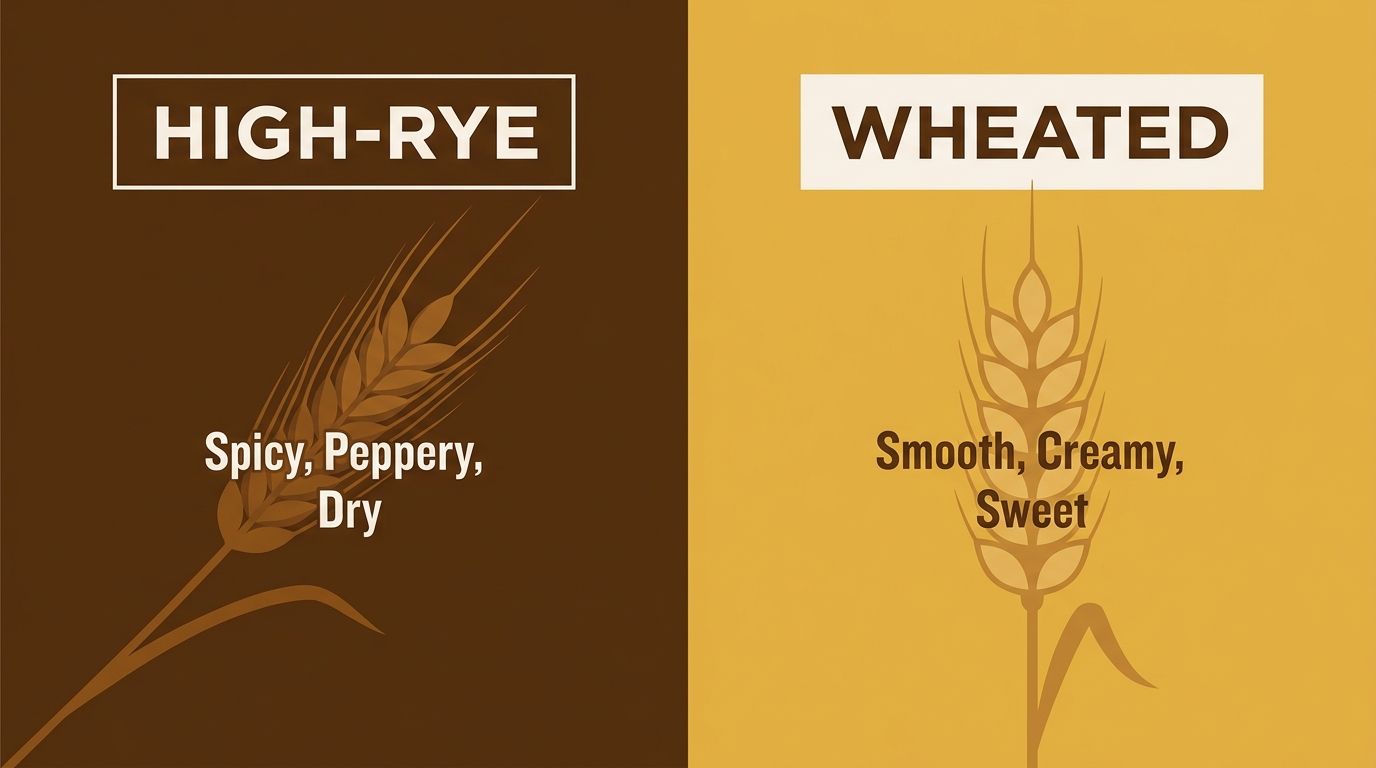
This "second grain" divides bourbon into its major branches. Use rye and you get a sharp, spicy bourbon; use wheat and you get a smooth, sweet one. That's why you'll often see the terms "high-rye" or "wheated" on the label.
High-rye bourbon
- Sharp pepper and spice nuances
- Dry, crisp finish
- e.g. Bulleit, Four Roses, Old Grand-Dad
Wheated bourbon
- Creamy, round texture
- Soft caramel and vanilla sweetness
- e.g. Maker's Mark, Weller, Pappy
The making — from grain to distillate
Bourbon starts from just four ingredients: grain, water, yeast, and oak. A big reason Kentucky became bourbon's home is that it had it all — clean water with iron filtered out by limestone, land where corn grows well, and white oak forests to make barrels from. The process roughly flows like this.
- Milling and mashingThe grain is ground and mixed with hot water to release the starch as sugar. Many bourbons keep a consistent flavor with the "sour mash" method, putting back part of the previous fermentation batch.
- FermentationAdd yeast to the cooled mash and the sugar turns into alcohol. Over several days it bubbles away, making a low-proof "distiller's beer."
- DistillationThe alcohol is concentrated with a large column still (continuous) or copper pot still. But it isn't taken above 160 proof, so the grain's aroma remains.
- BarrelingThe proof is brought to 125 or below and the spirit is filled into new oak barrels charred inside. From this point the real magic, aging, begins.

The magic of the new charred oak barrel
It's no exaggeration to say that over 90% of bourbon's color and flavor comes from the barrel. The key is that it's "new" and "charred on the inside." When the inside of the barrel is scorched with fire, three chemical things happen at once. The lignin that supported the wood breaks down, creating vanillin (vanilla aroma); the wood's sugars caramelize, forming a sweet "red layer" just beneath the charred surface; and a component called oak lactone adds a subtle coconut and woody nuance.
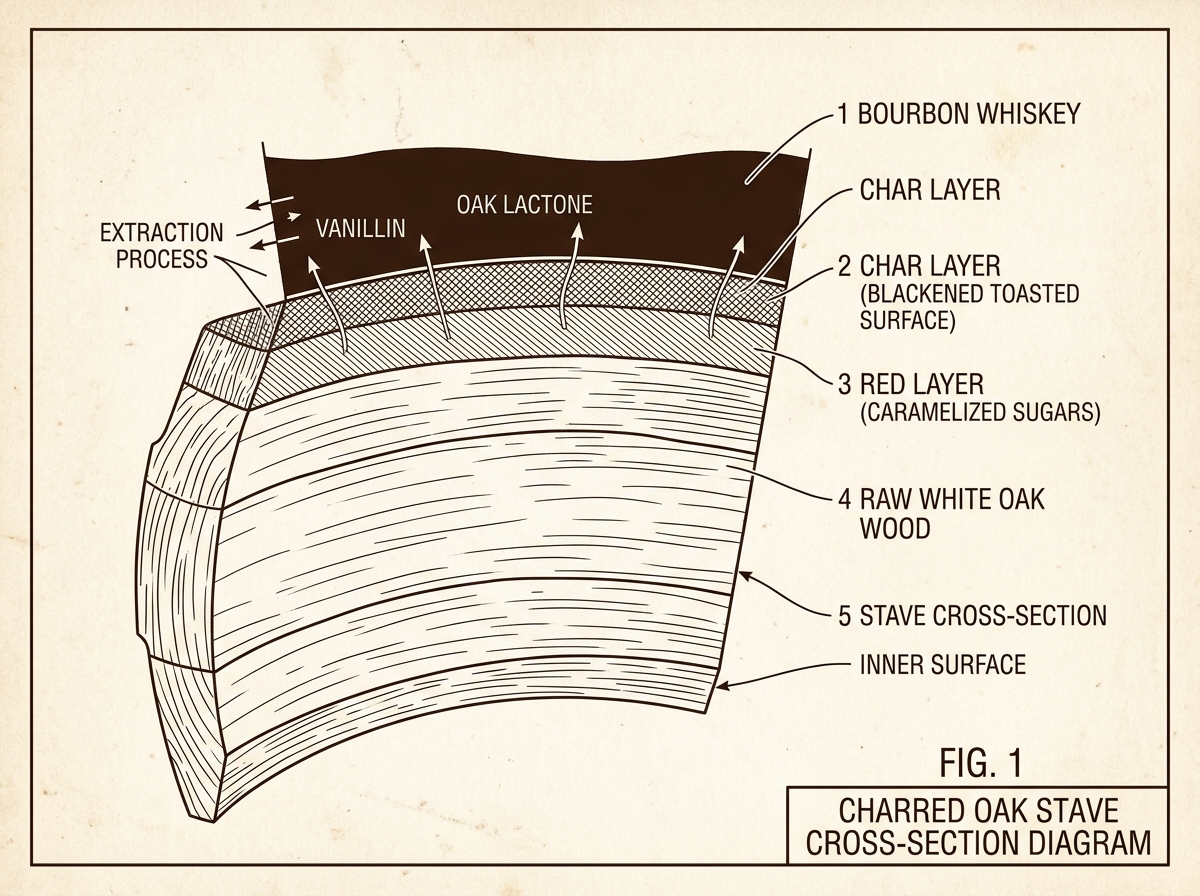

Other whiskeys like Scotch reuse barrels that have been used once, but bourbon must always use new barrels, so flavor soaks in faster and more deeply. The spirit moves in and out of the wood's charred surface, absorbing color and aroma. Interestingly, thanks to this "new-barrel obligation," Kentucky's used bourbon barrels are exported to Scotland and the Caribbean, living a second life as aging barrels for other spirits.
AgingWhat happens in the rickhouse
Once barreled, bourbon spends several years in a huge aging warehouse called a "rickhouse." With the temperature difference between summer and winter, the spirit moves in and out of the wood, drawing in flavor, and in the meantime some evaporates and disappears. Distillers romantically call this natural evaporation the "angel's share." The higher the floor in the warehouse, the greater the temperature swing, so even the same barrel will taste different depending on where it was placed.

As mentioned, regular bourbon has no minimum aging period, but for a label to bear "Straight," it must be aged at least 2 years in new charred oak barrels. And if it's under 4 years, the age must be stated on the label. That's why many of the good bourbons on the shelf carry the long name "Kentucky Straight Bourbon Whiskey."
"Bourbon's flavor comes half from the grain and half from the wood."
Reading the LabelReading the label terms — types of bourbon
Knowing the expressions you'll meet when picking a bottle makes it much easier to find a bourbon to your taste.
Straight
Bourbon aged at least 2 years in new charred oak. If under 4 years, the age is stated. The grade you'll see most often.
Bottled-in-Bond
One distillery, one distilling season, aged 4+ years in a government-supervised warehouse, bottled at exactly 100 proof. An old promise of quality assurance.
Small Batch
Bottled by selecting and blending a relatively small number of barrels. There's no legal definition, but it usually implies a more carefully chosen expression.
Single Barrel
Bottled from a single oak barrel only. Each barrel differs subtly, so even the same product has its own character by barrel number.
Cask / Barrel Strength
Bottled at the barrel's proof with almost no water added. Rich and intense, great to drink with water added to taste.
Wheated / High-rye
If the second grain is wheat, it's smooth (wheated); if rye, spicy (high-rye). The key clue that divides the direction of the flavor.
A spoonful of history
Bourbon was born on the Kentucky frontier in the late 18th century. Scots-Irish settlers who migrated after American independence brought their distilling tradition, and it began as they turned surplus corn into a form that kept and traded well over time — that is, into liquor. The origin of the name pits the "Bourbon County" theory in Kentucky against the "Bourbon Street" theory in New Orleans, and there's also a story that a minister named Elijah Craig first made it, but none of these has settled into established fact.
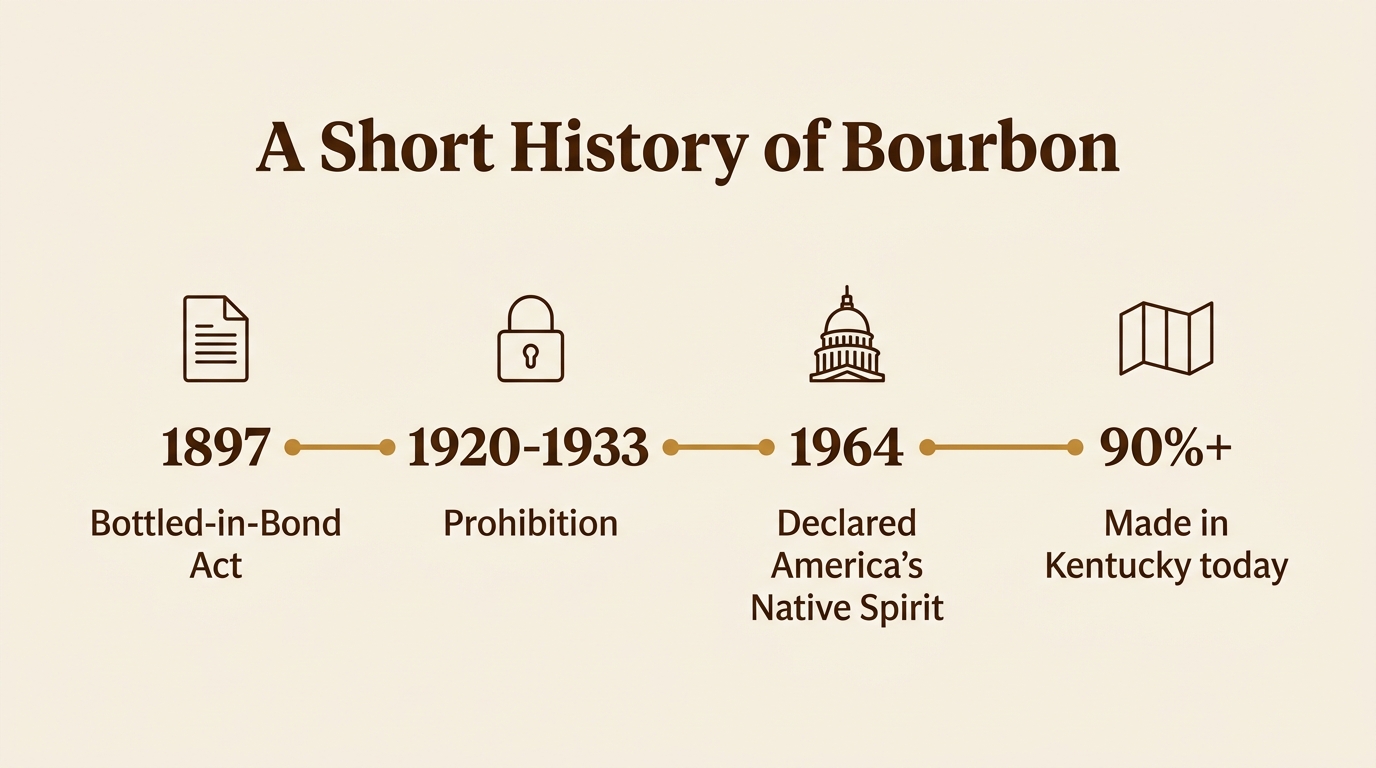
At the end of the 19th century, trust collapsed because unscrupulous merchants sold liquor cut with tobacco-steeped water or even kerosene, so the Bottled-in-Bond Act was enacted in 1897. It was America's first consumer protection law, with the government guaranteeing quality. Prohibition (1920–1933) nearly destroyed the industry, but in May 1964 the US Congress declared bourbon "America's distinctive native spirit," granting it the same origin protection that Scotch enjoys in Scotland and champagne in France. Bourbon is the only American spirit with this status.
vs. The RestBourbon vs Scotch vs rye vs Tennessee
Here's an at-a-glance summary of how these similar-looking brown spirits differ.
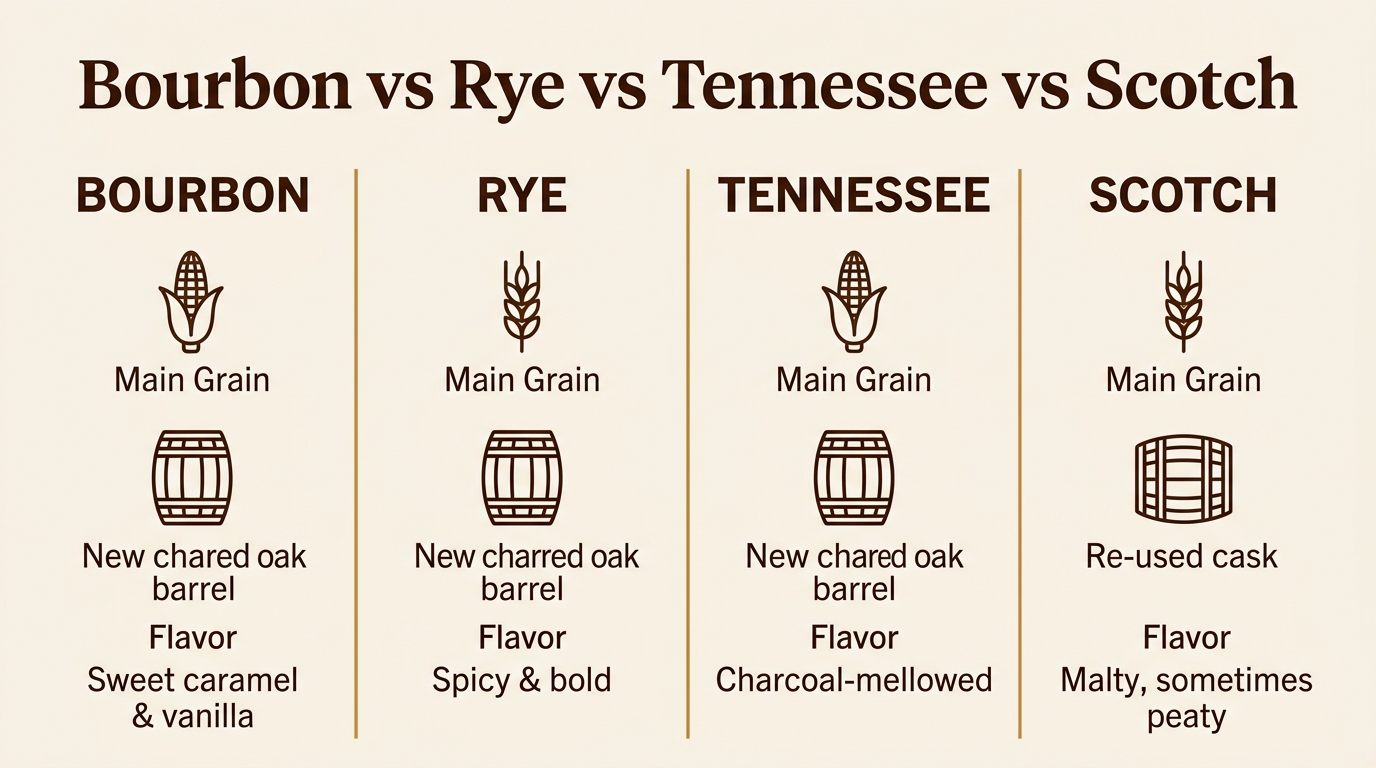
| Category | Main grain | Barrel | Flavor tendency |
|---|---|---|---|
| Bourbon | 51%+ corn | new charred oak (required) | sweet caramel and vanilla |
| Rye | 51%+ rye | new charred oak | sharp and spicy |
| Tennessee | 51%+ corn | new charred oak | similar to bourbon, but goes through the charcoal-filtering "Lincoln County Process" |
| Scotch | mostly barley | mostly reused barrels | malty, sometimes peat (smoke) |
In short, Tennessee whiskey (e.g. Jack Daniel's) in fact meets nearly all the conditions of bourbon, but adds a step of filtering once through maple charcoal before barreling, and so calls itself "Tennessee whiskey."
How to DrinkHow to drink it — 4 ways for beginners
There's no right answer. But if it's your first time, I recommend exploring lightly in this order.
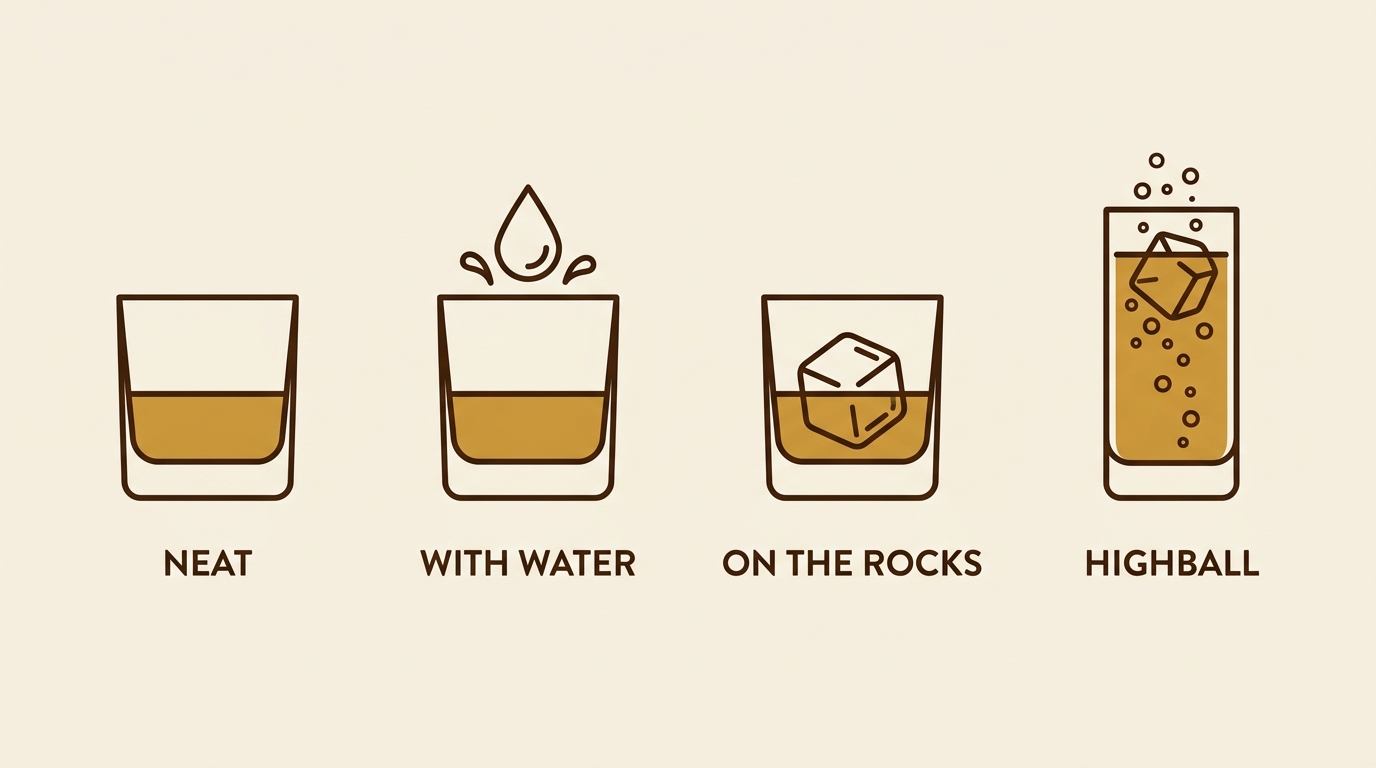
Neat (straight)
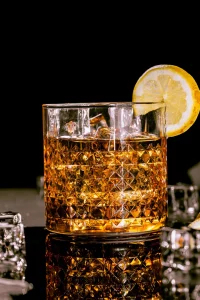
Nothing added, at room temperature. It shows that bourbon's bare face most honestly. A small sip at a time.
A few drops of water
For a high-proof bourbon, a few drops of water swing the closed-up aromas wide open. Especially recommended for beginners.
On the rocks
Slowly chilled with one large ice cube. The bite eases and it turns smoother. The bigger the ice, the less it dilutes.
Highball
Pour bourbon long into soda water for a light, refreshing mealtime drink. A great, easy starting point.

Once you're used to this, move on to cocktails. The Old Fashioned (bourbon with a sugar cube, bitters, and orange), the Manhattan (mixed with sweet vermouth), and the Whiskey Sour (made tangy with lemon and syrup) are all classics in which bourbon is the star. Start a smooth wheated bourbon neat and a spicy high-rye bourbon as a cocktail, and you'll rarely go wrong.
The textbook of "wheated bourbon," Maker's Mark
A bourbon made with wheat instead of rye for a smooth sweetness, and red wax dipped by hand. See, in the story of a single glass, how the "wheated bourbon" covered in this guide is realized in an actual brand.
Go to the Maker's Mark brand deep-dive →Note · Compiled based on US federal regulations (27 CFR 5.143), the Bottled-in-Bond Act, and public materials from bourbon-specialist media and distilleries. The legal figures (proof, aging standards, etc.) are for general introductory explanation, and the labeling of specific products may vary by brand.
댓글 0
첫 댓글을 남겨보세요.