The two things that trip up most first-time moka pot buyers are size and material. Search "how many cups should I buy?" and you get 1, 3, 6, and 9-cup options thrown at you all at once; ask "what's the difference between stainless and aluminum?" and opinions split again. The good news: both questions have clear answers. In this post we lay it all out cleanly, using Bialetti as the reference.
A moka pot "cup" (cup / tazza) is not the mug we drink from. It refers to a single espresso demitasse, roughly 50–60ml. Just knowing this one thing settles 90% of the sizing question.
CAPACITY · 01A moka pot "cup" is not a mug
This is where the most common misunderstanding about Bialetti sizing comes from. One "cup" on a moka pot means one Italian-style espresso glass — that is, a single demitasse serving of about 50–60ml. This convention dates all the way back to the 1930s, when Alfonso Bialetti designed the original Moka Express. In Italy, "one cup" simply means one shot of espresso.
So a "6-cup moka pot" isn't six mugs of coffee — it's six shots of espresso, about 300ml in total. In mug terms, that's roughly two mugs. The most common mistake is buying a 3-cup to serve two people and then wondering, "Why does it make so little?"
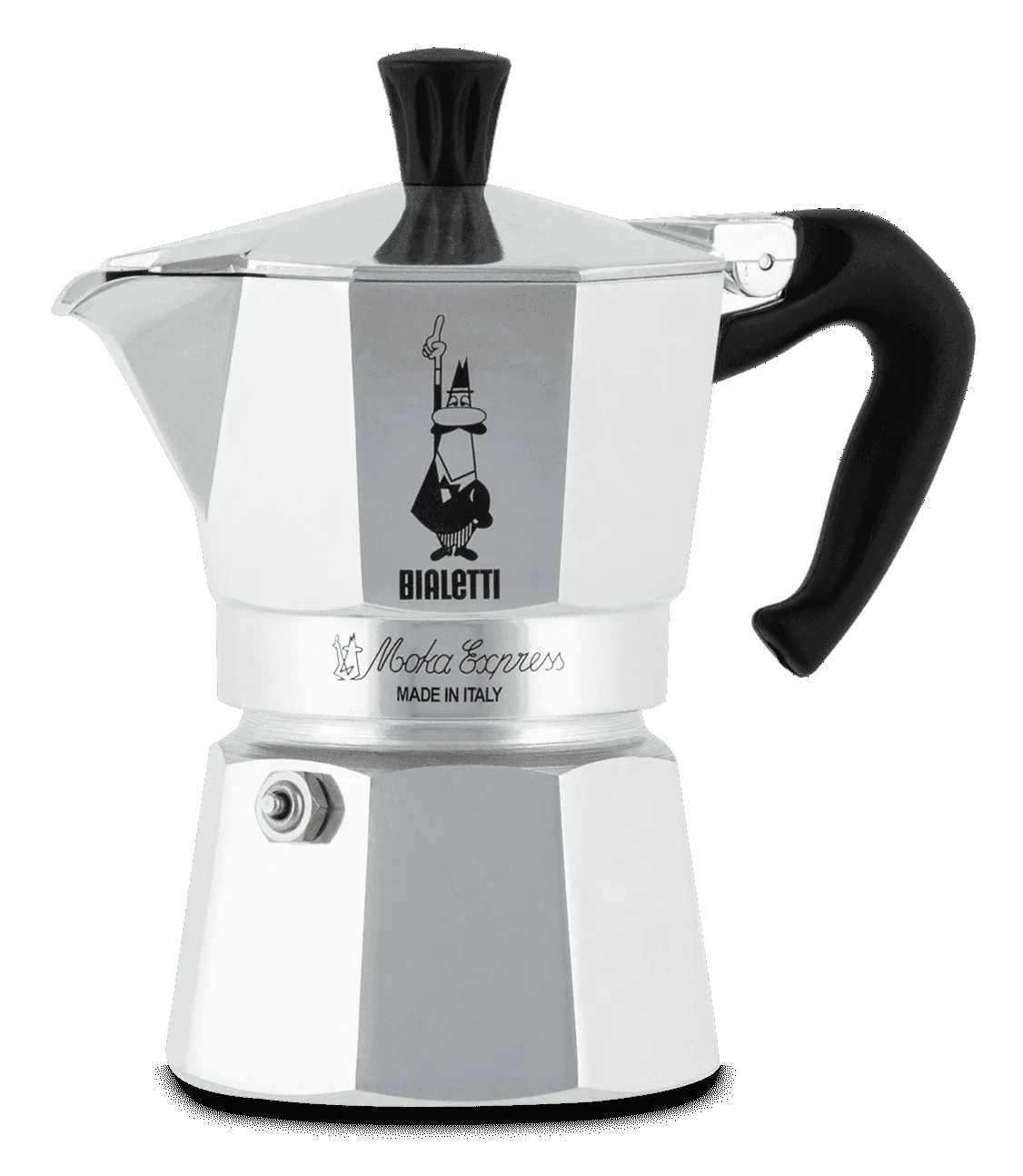
CAPACITY · 02Real yield by size & who it suits
Converting the stated cup count into actual servings (ml) makes the choice far easier. Approximate figures for Bialetti are below (expect a variation of about ±10% depending on the amount of coffee and water).
| Stated | Actual yield (approx.) | In mugs | Recommended for |
|---|---|---|---|
| 1 cup | 50–60ml | 1 strong shot | Solo, short and strong like espresso / camping & travel |
| 2 cups | about 90ml | Double shot | One latte or americano for yourself |
| 3 cups | about 130–180ml | 1 large mug | Solo daily — the safest one-person pick |
| 4 cups | about 200–230ml | 1–2 mugs | A generous serving for one, or a little each for two |
| 6 cups | about 300ml | 2 mugs | For 2 / milk drinks — the most popular size |
| 9 cups | about 450ml | 3 mugs | Households of 3–4, entertaining guests |
| 12 cups | about 600ml | 4 mugs | Large families · brunch · the office |
CAPACITY · 03The absolute rule: never fill it halfway
"Can't I just buy a big one and fill it halfway when I want less?" — this is the expectation that breaks most often with moka pots. A moka pot is designed to be used full, to its rated capacity. That's because the boiler (water chamber) and the basket (coffee funnel) are matched to each other.
Add too little water and the steam pressure is too weak, so extraction is uneven; underfill the basket and steam escapes through the gaps between the grounds, causing channeling. The result is weak and watery coffee, or the opposite — bitter and harsh. So the key isn't "go big to be safe" but "pick the size that matches how much you usually drink." If your volume varies a lot, you're better off keeping two pots — one small and one large.

The larger the capacity, the taller it gets. Below is a 9-cup model — at a glance you can see it has a different bulk from the everyday 3–6 cup pots. It makes sense if you have an office or entertain guests often, but for a single cup a day on your own, it's overkill.

MATERIAL · 04Aluminum vs stainless — does the taste really differ?
The second question. Bottom line: "Not a dramatic difference, but a different character." Material decides not only taste but also heat conduction, maintenance, induction compatibility, and durability, so you shouldn't choose on taste alone.

The core of the taste is "seasoning" and "metallic flavor"
Aluminum conducts heat well, so it warms up fast and evenly. And the more you use it, the more coffee oils coat the inner walls — a process called seasoning. Italian enthusiasts believe this seasoned film makes the flavor rounder and deeper. Conversely, scrubbing a new aluminum pot harshly or running it at high heat can bring up a faint metallic flavor — which is why the rule with aluminum is to rinse with hot water rather than scour with detergent and a sponge.
Stainless steel is chemically stable and doesn't react with the acids in coffee. In other words, no worries about a metallic taste, and a clean flavor from the very first cup with no seasoning needed. The trade-off is slower heat conduction — it takes about a minute longer — and you can't expect the "rounding" that seasoning brings. In short, aluminum is a classic flavor you break in over time, while stainless is a clean, consistent flavor from the start.
Aluminum
- Fast heat conduction → quick, even extraction
- A classic flavor you break in through seasoning
- Light and inexpensive, best value
- Induction ✗ (adapter required)
- No detergent or dishwasher ✗ · rinse with hot water
- Can oxidize and discolor over long use
Stainless steel
- No reaction with coffee acids → no metallic taste
- No seasoning needed, clean from the first cup
- Works on every stovetop including induction ✓*
- Dishwasher-safe (hand washing recommended)
- Resists scratches and corrosion, lasts a long time
- Slower heat conduction so slightly slower extraction · more expensive
* Note that some small models such as the Venus 2-cup may not be induction-compatible, so check the model's specifications.
MODEL MAP · 05So which Bialetti should you buy?
Once you've decided on material, the model choice narrows automatically. Here's the Bialetti lineup viewed by material and stovetop type.
| Model | Material | Induction | Character |
|---|---|---|---|
| Moka Express | Aluminum | ✗ | The famous octagonal original. The top pick for getting into the classic |
| Brikka | Aluminum | ✗ | A version with a dedicated valve that pulls more crema |
| New Venus | 18/10 stainless | ✓ | Curved design · the flagship induction model |
| Musa | 18/10 stainless | ✓ | Straight cylinder design · sibling to the Venus |
| Moka Induction | Stainless base + aluminum | ✓ | A hybrid that adds induction compatibility to the classic look |

You use induction, or prefer easy care with no metallic taste → stainless Venus / Musa.
REVIEW · 06The differences users actually notice
Pulling together reviews from home and abroad, perceptions of taste generally fall into three camps.
① The "honestly, I can't tell" camp — the largest group. With the same beans and the same grind, they say it's hard to tell aluminum from stainless in a blind test. The dominant view is that the variables of beans, water temperature, and heat control matter far more than the material.
② The "seasoned aluminum tastes better" camp — they prefer the round, deep flavor unique to well-broken-in aluminum. That's exactly why Bialettis around the world get used while looking a bit blackened on the outside. These folks are most wary of scrubbing a new aluminum pot.
③ The "clean stainless is better" camp — people bothered by aluminum's metallic nuance, or for whom induction and easy care come first. They value getting a consistent taste from the very first cup.

CHECKLIST · 07Pre-purchase checklist
- Start with how much you usually drink. Use black solo → 3-cup, milk drinks / 2 people → 6-cup as your reference points.
- "Filling halfway" is not an option. If your volume varies, two pots (small + large) beat one big one.
- Check your stovetop. On induction, the aluminum Moka Express needs an adapter → go stainless (Venus / Musa) or Moka Induction.
- Taste preference. A classic you break in → aluminum / clean from the first cup → stainless.
- Maintenance style. If you want to use a dishwasher and detergent, stainless. With aluminum, rinsing with hot water is the rule.
- Gaskets and filters are consumables. Check that the model has genuine Bialetti replacement parts (gasket + plate) readily available.
※ The yields and conversions in this post are approximations compiled from Bialetti's standard specifications and numerous reviews, and may vary with the beans, grind, and water amount. Aluminum leaching is within the safety standards of international bodies such as EFSA.


댓글 0
첫 댓글을 남겨보세요.